




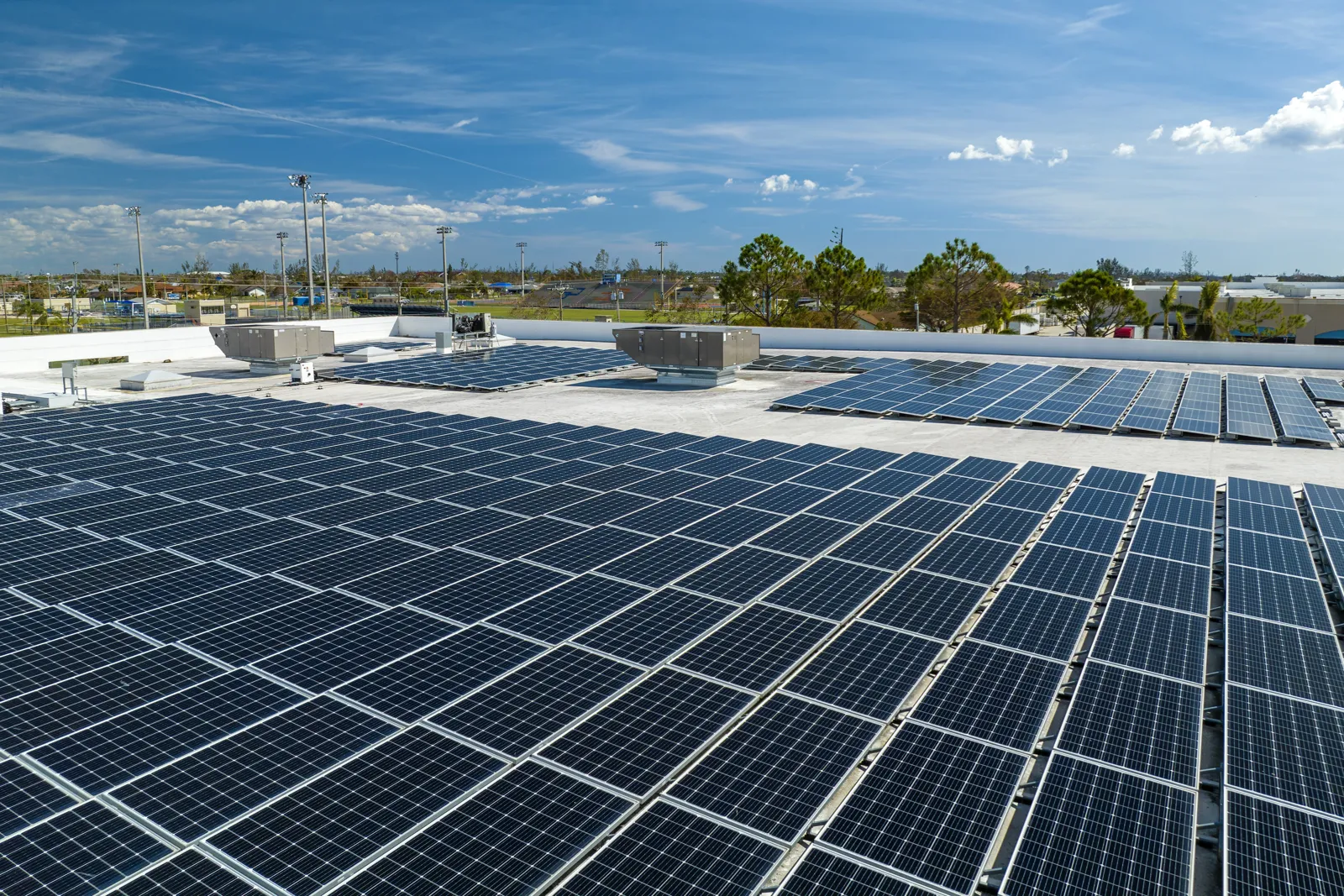
A hybrid inverter charger is a central power conversion device in PV-plus-storage systems. It manages solar generation, battery charging and discharging, grid import and export, and often backup or generator interaction.
In commercial and industrial PV projects, it is not just an equipment choice. It influences system architecture, battery strategy, grid interconnection design, commissioning complexity, and lifecycle cost.
For EPCs, installers, resellers, and facility owners, system performance depends on how well the inverter matches real site conditions. Different facilities have different priorities. A warehouse focused on demand charge reduction is very different from a telecom site running on weak grids or an industrial plant requiring backup power.
This guide explains how hybrid inverter chargers work, how to size them, and which technical and compliance factors matter most. It also clarifies when a hybrid inverter charger is suitable, and when large C&I systems should use separate PV inverters, battery PCS, and EMS platforms.
A hybrid inverter charger combines multiple functions that were traditionally handled by separate devices. In modern commercial PV systems, hybrid inverter platforms integrate PV conversion, battery charging, and grid interaction into one system for energy management and backup control. However, product definitions vary by manufacturer. Buyers must confirm key functions such as MPPT input capability, battery voltage range, backup operation, grid export control, generator input support, and BMS communication compatibility. These differences directly affect system design, battery selection, and commissioning results.
The system converts DC power from PV modules into AC power for facility loads or grid export. It also charges batteries from solar, the grid, or a generator, and discharges batteries to reduce peak demand or provide backup power. In addition, it manages protection functions, communication interfaces, and operating modes to ensure stable operation under different grid and site conditions.
In commercial PV projects, this coordination matters because energy flows are rarely simple. During midday, PV may supply building loads while charging batteries. During a tariff peak, batteries may discharge to reduce demand. During an outage, only critical circuits may remain energized. If export is restricted by the utility, the inverter must limit or prevent grid feed-in. If the site includes a generator, the inverter may need to coordinate charging, load support, and generator start/stop logic.
A modern hybrid inversor solar therefore acts as both a power conversion device and a control point. Its capabilities determine whether the project can deliver the intended business outcome: lower energy bills, better resilience, higher PV self-consumption, or reduced diesel runtime in a microgrid.
The terms are often used inconsistently across manufacturers, distributors, and EPC procurement documents, which can lead to mismatched system design and incorrect equipment selection. A conventional inverter charger usually converts battery DC to AC and charges the battery from an AC source such as the grid or a generator. It is common in backup and off-grid systems, but it may not include PV input management or grid-tied solar export functions.
A hybrid inverter charger usually integrates PV input management, battery charging, battery discharge, and grid interaction. Many commercial models include MPPT solar inputs, grid-tie functionality, export control, battery management communication, and backup or islanding modes. However, manufacturers use terminology differently. Some products marketed as “hybrid” require separate PV inverters. Others support batteries but cannot provide backup power. Some can operate without batteries as grid-tied PV inverters, while others require a battery connection for stable operation.
For professional procurement, this distinction is critical. Before selecting a solar inverter charger or PV storage inverter, EPCs should verify whether the unit includes MPPT inputs, compatible battery voltage ranges, anti-islanding protection, grid-code certification, export limitation, generator support, and energy management functions.
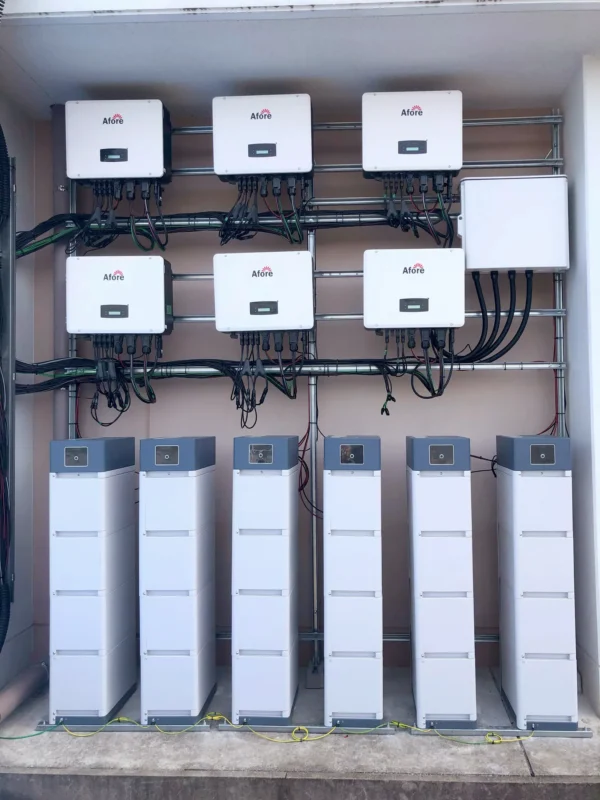
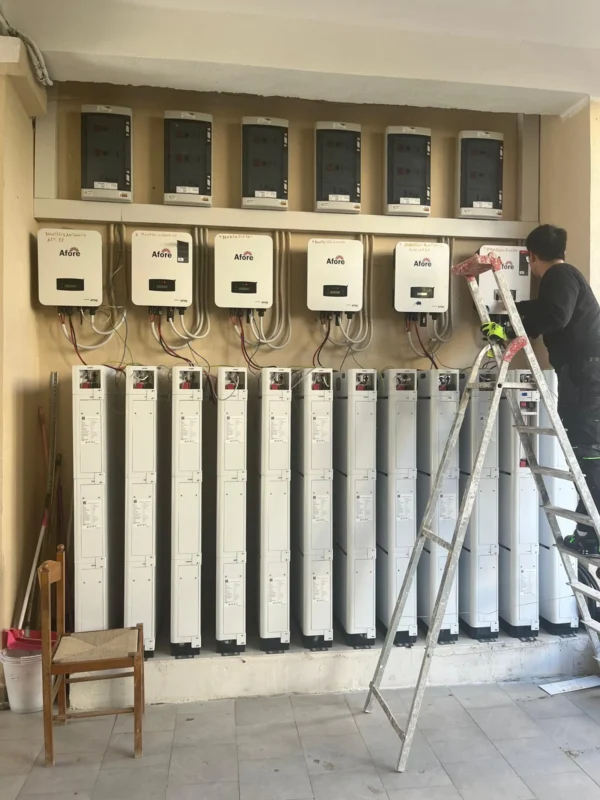
In commercial and industrial PV, hybrid inverter chargers are usually deployed for one or more of four objectives: self-consumption, backup power, peak shaving, and microgrid operation. A logistics warehouse may use batteries to absorb surplus midday PV and discharge in the evening. A cold storage facility may prioritize backup power for refrigeration loads. A telecom site may combine PV, batteries, and diesel generation to reduce fuel consumption. A commercial park may use multiple units in parallel to support three-phase loads and reduce peak demand.
These applications have different design priorities. Self-consumption projects need accurate load matching and tariff analysis. Backup projects need critical-load segregation and autonomy planning. Peak-shaving projects need demand monitoring and fast control.
Peak-shaving projects need demand monitoring and fast control, while microgrid systems require advanced control functions. One important distinction in microgrid applications is whether the inverter operates in grid-following or grid-forming mode.
Grid-following inverters depend on an external grid or generator reference. They are common in standard grid-tied systems.
Grid-forming inverters can create voltage and frequency in island mode. They are required for backup microgrids and black-start operation.
For project design, EPCs must confirm whether the inverter is grid-forming or grid-following in island mode.
In B2B procurement, vague product language can create expensive problems. “Hybrid inverter charger,” “battery inverter charger,” “solar battery inverter,” and “commercial energy storage inverter” may refer to different architectures, voltage classes, and operating modes. Misinterpretation can lead to incompatible batteries, undersized backup outputs, failed grid approvals, or unexpected balance-of-system costs.
For example, an EPC may assume that a hybrid inverter can support zero-export operation, only to find that external meters or firmware options are required. A reseller may stock a model compatible with low-voltage batteries while local commercial projects are moving toward high-voltage battery cabinets. A facility owner may expect full-building backup, while the inverter is designed only for a limited critical-load panel. Clear technical scope at the quotation stage reduces redesign, commissioning delays, and customer disputes.
Sizing a hybrid inverter charger starts with the project objective, not with the inverter datasheet. The following simplified sizing formulas are commonly used in early-stage engineering estimation and feasibility design.
Required inverter power can be estimated using a basic design rule:
Required inverter kW ≥ maximum simultaneous critical load kW × safety margin (typically 1.1–1.3 for commercial systems)
Battery energy sizing can be estimated using:
Required battery kWh = critical load kW × backup hours ÷ usable depth of discharge ÷ system efficiency
For peak shaving applications:
Battery discharge power ≥ target peak reduction kW
The EPC must understand the facility load profile, tariff structure, critical loads, available PV capacity, battery strategy, grid export limits, backup duration requirements, and future expansion plans. Only then should inverter power, PV input, battery power, and communication features be compared.
The inverter kW rating is important, but it cannot be evaluated alone in commercial and industrial applications. In commercial and industrial systems, power rating should also consider kVA and power factor. Motor-heavy loads such as HVAC systems, pumps, and compressors may operate at low power factor, which increases apparent power demand. In these cases, inverter kVA capacity and overload capability are as important as kW rating for stable operation.
Surge capacity, MPPT current limits, battery voltage range, charging power, thermal derating, three-phase capability, and grid-code functions all affect real project suitability. A 100 kW inverter with insufficient battery discharge power may fail a peak-shaving target. A unit with strong PV conversion but limited backup overload capacity may not start motors during an outage. A device with impressive lab efficiency may derate heavily in a hot rooftop plant room.
For a facility with 80 kW critical load and 2-hour backup requirement:
These ranges provide a quick reference for early design estimation and should be validated against actual load profiles.
Recommended battery capacity: approximately 190–200 kWh (subject to design margin and battery chemistry selection)
Typical sizing ranges in commercial PV-plus-storage systems:
| Use case | Sizing logic | Key design focus |
|---|---|---|
| Reduzir picos de demanda | Based on peak kW reduction | Fast response + discharge power |
| Backup power | Load × autonomy hours | Battery kWh + inverter overload |
| Self-consumption | PV surplus vs demand | Energy shifting optimization |
| Microgrid | Full system balance | Grid-forming + generator coordination |
In hybrid PV-storage systems with backup or off-grid capability, generator coordination becomes a critical part of system sizing. Generator integration introduces additional sizing constraints in hybrid inverter charger systems. The generator kVA rating must match both load demand and battery charging requirements. In many commercial systems, many diesel generators are generally recommended to operate above 30–40% load to reduce the risk of wet stacking.
As principais considerações incluem:
Proper coordination ensures stable operation and avoids generator inefficiency or inverter shutdown during transitions.
Commercial sites should be sized using interval load data wherever possible. Monthly bills provide a useful starting point, but they do not show short demand peaks, motor starting behavior, weekday/weekend differences, or night loads. For storage economics, 15-minute or 30-minute demand data is often much more valuable than annual kWh consumption.
Critical-load planning is especially important. Many commercial owners initially request backup for the entire facility, but this may be uneconomic or technically difficult. Separating critical circuits, such as IT systems, refrigeration, security, emergency lighting, communications, control systems, or selected production equipment, often produces a more practical design.
Battery autonomy should be calculated from usable energy, not nominal capacity. Depth of discharge, battery efficiency, inverter efficiency, temperature, aging, and reserve state of charge all reduce usable backup time.
| Fator de projeto | Why it matters in commercial PV-storage sizing |
|---|---|
| Peak load in kW or kVA | Determines inverter continuous output and grid support needs |
| Surge or starting current | Affects motor loads, compressors, pumps, HVAC, and industrial equipment |
| Critical-load profile | Defines backup panel size and required island-mode capacity |
| Battery usable kWh | Determines autonomy and load-shifting duration |
| Battery charge/discharge power | Limits peak shaving and rapid response capability |
| PV DC/AC ratio | Influences yield, clipping, and inverter utilization |
| Export limit | Determines metering, CT placement, and control strategy |
| Ambient temperature | Affects derating and long-term reliability |
In a DC-coupled architecture, PV and batteries connect through a shared DC-side power conversion platform. This can reduce conversion steps when charging the battery from solar, potentially improving PV-to-battery efficiency and reducing some balance-of-system complexity. DC-coupled systems are often attractive for new-build commercial PV-plus-storage projects where the PV array, battery, and inverter can be designed together from the beginning.
In an AC-coupled architecture, PV inverters and battery inverters connect on the AC side. This approach is often useful for retrofits, especially where an existing grid-tied PV system is already operating. Adding storage without replacing the existing PV inverter can reduce downtime and preserve previous investment. AC coupling may also provide modularity, but it can add control complexity because separate devices must coordinate export limits, backup operation, and frequency or power control.
The choice is not simply about efficiency. EPCs should compare BOS cost, commissioning complexity, compatibility with existing assets, utility approval requirements, monitoring integration, and serviceability. In larger C&I systems, separate PV inverters and dedicated power conversion systems may be more suitable than an integrated hybrid inverter charger, particularly when power levels move into multi-hundred-kW or MW-scale installations.
In this guide, “hybrid inverter charger” primarily refers to integrated PV-battery-grid conversion equipment. However, some commercial storage projects use AC-coupled architectures that deliver similar functional outcomes through coordination between separate battery inverter/chargers and PV inverters.
Smaller commercial sites may use single-phase or split-phase configurations, depending on regional electrical infrastructure. However, many commercial and industrial buildings require three-phase output for balanced load distribution, motors, HVAC equipment, elevators, pumps, and grid interconnection requirements.
Three-phase hybrid inverter charger selection should consider more than voltage and power rating. The design must account for phase balancing, neutral current, unbalanced load tolerance, motor starting, power factor, harmonic limits, and local grid rules. In some systems, multiple units can operate in parallel or as a three-phase cluster. In others, the inverter is a native three-phase platform. The distinction affects redundancy, wiring, communications, commissioning, and fault behavior.
A common design error is confusing battery energy capacity with inverter power. Battery capacity is measured in kWh and determines how long loads can be supported. Inverter power is measured in kW or kVA and determines how much load can be supplied at any moment. A system may have enough battery energy for four hours of backup but still trip if the inverter output cannot handle the instantaneous load.
Commercial battery systems must also respect C-rate limits. A 200 kWh battery may not be able to discharge at 200 kW continuously unless the battery design allows a 1C discharge rate. Similarly, charging power must be coordinated with battery limits, BMS settings, thermal management, and warranty conditions. Lithium systems commonly allow higher usable depth of discharge than lead-acid batteries, but actual usable capacity depends on the approved operating window, ambient conditions, and degradation assumptions.
For many C&I behind-the-meter projects, battery capacity is often designed for 0.5 to 2 hours of inverter-rated power when the main goal is peak shaving or short-duration load shifting. Longer backup applications require a different approach, often combining larger batteries, load shedding, generator integration, or prioritized critical circuits.
Datasheets for hybrid inverter chargers can be difficult to compare because manufacturers emphasize different metrics. A professional specification should translate project requirements into verifiable electrical, communication, environmental, and compliance criteria.
PV input design should account for maximum DC voltage, MPPT voltage window, maximum input current, number of MPPT channels, string current, and module temperature behavior. Incorrect string sizing can reduce yield, increase clipping, or exceed safe voltage limits under cold conditions.
Commercial PV modules continue to increase in current output, so MPPT current limits deserve close attention. A hybrid inverter charger that was suitable for previous module generations may be constrained by newer high-current modules. Installers should coordinate module electrical data, string length, site minimum temperature, cable voltage drop, and inverter MPPT limits before finalizing procurement.
Multiple MPPT channels can improve design flexibility on roofs with different orientations, tilt angles, or partial shading. However, MPPT quantity alone is not enough. The current rating per MPPT and the allowable string configuration determine whether the inverter can actually use the available PV capacity.
Peak efficiency values for modern hybrid inverters are often high, commonly in the upper 90% range for PV-to-AC conversion. However, commercial performance depends on the efficiency curve, standby consumption, battery conversion efficiency, and thermal behavior under real operating conditions.
A hybrid inverter charger installed in a hot electrical room, dusty warehouse, metal enclosure, or outdoor cabinet may not sustain full output indefinitely. Thermal derating can reduce PV output, battery discharge power, or backup capability. This is especially important in regions with high ambient temperatures or facilities with continuous daytime loads.
Overload capacity should also be interpreted carefully. A unit may support 110%, 125%, or higher overload for a limited duration, but this may not be enough for motor starting or simultaneous critical loads. EPCs should compare overload duration, short-circuit behavior, and load type compatibility, not just maximum surge numbers.
Battery compatibility is one of the most important risk areas in hybrid PV-storage projects. Many commercial hybrid inverter chargers are optimized for lithium-ion batteries, especially lithium iron phosphate systems, because of their cycle life, safety profile, and suitability for daily cycling. Some systems also support lead-acid batteries, but lead-acid designs usually require more conservative depth of discharge and different charging behavior.
Voltage compatibility is only the starting point. Low-voltage battery systems (typically around 48V) are commonly used in residential, telecom, and small commercial or off-grid applications. These systems require higher current to deliver the same power, which results in larger conductor sizes and higher conduction losses. However, they are simpler to design and maintain in small-scale installations.
High-voltage battery systems are typically used in commercial and industrial energy storage applications. They operate at higher DC voltage, which reduces current for the same power level and improves system efficiency. These systems are better suited for large-scale PV storage projects but require stricter insulation, protection coordination, and BMS communication control.
A hybrid inverter designed for low-voltage battery systems is not interchangeable with a high-voltage battery inverter. Mismatched system architecture can result in communication failure, unsafe operating conditions, or complete system incompatibility.
The inverter and battery BMS must communicate correctly, often through CAN, RS485, Modbus, or manufacturer-specific protocols. The BMS may send state of charge, voltage, current limits, temperature, alarms, and shutdown commands. If communication fails or firmware versions are mismatched, the system may operate in a restricted mode or shut down entirely.
Approved battery lists are therefore critical. EPCs and resellers should verify battery model compatibility, firmware versions, communication cables, warranty alignment, and commissioning procedures before committing to a design. A battery-inverter match that works in one market or software version may not automatically apply to another.
| Recurso | Low-voltage battery | High-voltage battery |
|---|---|---|
| Typical voltage | ~48V | 200–1000V+ |
| Aplicativo | Residential / telecom / small off-grid | C&I / utility-scale storage |
| Current level | High current | Low current |
| Cable size | Larger conductors required | Smaller conductors |
| System efficiency | Lower (higher losses) | Maior eficiência |
| Design complexity | Simpler | More complex (BMS + safety) |
| Best use case | Small systems | Commercial PV storage |
A commercial hybrid inverter charger should include protection against overvoltage, undervoltage, overcurrent, short circuit, and thermal failure. These safety functions are addressed through a combination of inverter safety standards such as IEC 62109 and grid-interconnection standards applicable in the target market. Grid-connected systems must also include anti-islanding protection and grid monitoring functions.
Power quality matters because commercial facilities may operate sensitive IT systems, drives, control equipment, refrigeration, medical devices, or manufacturing loads. Harmonic distortion, voltage stability, frequency regulation, transfer time, and response to unbalanced loads should be reviewed. For utility approval, the inverter may also need certified reactive power control, ride-through functions, and export limitation capabilities depending on the jurisdiction.
Grid compliance is one of the biggest differences between consumer inverter selection and commercial PV project execution. In hybrid inverter charger projects, compliance requirements can be grouped into three main areas.
Export control is also increasingly important. Many commercial sites face zero-export rules, limited feeder capacity, or interconnection agreements that cap export power.
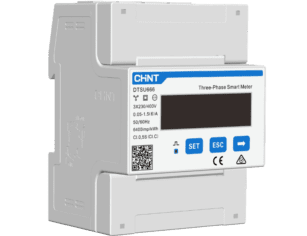
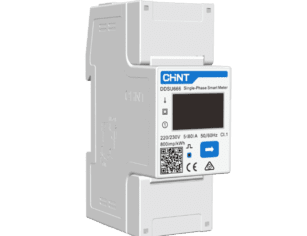
Meter or CT placement must be carefully designed at the point of common coupling (PCC). In commercial systems, this is usually the main service entrance, but some sites may use sub-panels depending on load structure. Incorrect CT placement can lead to inaccurate export readings and unstable control behavior.
In three-phase systems, export control may require per-phase CTs or meters. This ensures that imbalance between phases does not cause reverse power flow on a single phase, which can violate utility limits even when total export appears compliant.
Export-control performance also depends on response speed. Meter data refresh rate and inverter response time must be aligned so that fast load changes do not cause export spikes. Slow communication between meter and inverter can lead to temporary overshoot beyond utility limits.
If meter communication fails, most hybrid inverter chargers will enter a fail-safe mode. This may include limiting output, stopping export, or switching to self-consumption mode depending on firmware design. The exact behavior should be verified during commissioning.
Commissioning should include a simulated low-load, high-PV test condition to confirm export remains within utility limits under worst-case scenarios. This test is critical for utility acceptance in commercial PV projects.
Export-control commissioning checklist includes:
Standards vary by region, voltage level, and project type. In the United States, interconnection requirements often reference IEEE 1547 and UL 1741 for distributed energy resources. In Europe, requirements may involve EN 50549, national grid codes, and local distribution operator rules. International safety standards such as IEC 62109 are commonly relevant for inverter safety, while stationary battery systems may need additional energy storage and fire safety compliance.
The key point for EPCs and distributors is that certification is market-specific.
Battery energy storage systems require strict safety planning in commercial PV projects. Proper design must consider installation location, fire protection, and emergency response access.
| Região | Key Standards & Requirements |
|---|---|
| Estados Unidos | IEEE 1547, UL 1741, NEC Articles 690/705/706, NFPA 855, UL 9540 |
| União Europeia | EN 50549, IEC 62109, CE marking, national grid codes |
| United Kingdom | G98 / G99 interconnection standards |
| Austrália / Nova Zelândia | AS/NZS 4777, DNSP requirements |
| International projects | IEC 62109, IEC 61727, local utility requirements |
A product certified for one country may not be accepted in another, even if the hardware is similar. Before procurement, confirm the exact model number, firmware version, certificate scope, grid-code settings, and any required local listing.
Backup functionality must be designed intentionally.
Commercial systems often require a critical-load panel, transfer switching, and clear separation of backed-up and non-backed-up circuits.
It is important to understand that the grid-tied output rating of a hybrid inverter charger may differ from its backup output rating. In many systems, backup power is limited compared to grid-connected operation due to inverter design constraints.
Backup overload capacity is often restricted and may only be available for short durations. This means that short spikes such as motor starting events may exceed inverter capability even if steady-state load is within rating.
Not all loads should be placed on the backup panel. Critical loads such as IT systems, refrigeration, security, and emergency lighting are typically prioritized, while non-essential loads are excluded to avoid overload during outages.
Motor starting loads may require derating strategies, including soft starters or staggered startup sequences to prevent inverter shutdown.
In some cases, load shedding logic is required to disconnect non-critical loads automatically when backup capacity is limited.
Neutral and grounding arrangements require special care in multi-source systems that include grid supply, batteries, PV, and generators. Requirements differ by country and earthing system, so local electrical codes and qualified engineering review are essential. The inverter’s internal switching design must be understood before finalizing the single-line diagram.
Commercial PV-plus-storage projects typically require more documentation than PV-only systems. Datasheets, certificates, single-line diagrams, protection settings, export control descriptions, battery documentation, site layouts, commissioning forms, fire safety information, and installer qualifications may all be requested by authorities or utilities.
Incomplete documentation can delay energization, revenue recognition, and customer handover. For resellers and EPCs working across multiple markets, a supplier’s documentation quality can be as important as hardware price. Clear manuals, grid-code certificates, battery compatibility statements, and commissioning guides reduce project risk.
A hybrid inverter charger only creates value when its battery strategy matches the commercial objective. The same battery can be operated for self-consumption, demand charge reduction, backup reserve, or tariff arbitrage, but each strategy affects cycling, savings, and available backup capacity.
Some hybrid inverter chargers can operate without batteries as grid-tied PV inverters, allowing a site to install solar now and add storage later. Others require a battery connection for operation or only support limited modes without batteries. Backup functionality generally requires batteries, because the inverter needs an energy source when the grid is down.
Professionals should verify battery-free operation before designing “storage-ready” projects. The review should include manufacturer specifications, approved operating modes, minimum battery requirements, warranty conditions, and firmware limitations. A battery-ready system that cannot be commissioned without a battery may create avoidable commercial disputes.
For commercial sites, energy storage value depends heavily on tariff structure. If export compensation is low and daytime loads are limited, storing excess solar for later use can improve self-consumption. If demand charges are high, the battery may be more valuable when reserved for short peak-shaving events. If time-of-use rates are significant, scheduled charging and discharging can shift energy from low-cost periods to high-cost periods.
The hybrid inverter charger must support the required control mode. Basic self-consumption logic may not be enough for demand charge management. Peak shaving requires accurate site metering, fast response, and configurable thresholds. Time-of-use optimization requires scheduling and sometimes integration with an external energy management system.
The BMS protects the battery by monitoring cell voltage, temperature, current, state of charge, and fault conditions. In commercial systems, the hybrid inverter charger must respect BMS limits in real time. For example, the BMS may reduce allowable charge current at low temperature or limit discharge power at low state of charge.
Communication failures should be considered during design and commissioning. If the inverter loses BMS communication, does it shut down, enter a safe limited mode, or continue using fixed voltage settings? The answer affects uptime and safety. EPCs should test communication loss behavior during commissioning where practical and document the expected fault response for O&M teams.
Many commercial owners start with a modest battery system and plan to expand later. Future expansion depends on inverter power rating, parallel capability, battery cabinet architecture, BMS communication limits, available floor space, ventilation, fire clearances, cable routes, and switchgear capacity.
Oversizing the inverter for future expansion may improve flexibility but increase upfront CAPEX. Undersizing may reduce future options. For portfolio deployments, standardized battery cabinet sizes and inverter configurations can reduce engineering effort, training requirements, spare parts complexity, and after-sales support costs.
Hybrid inverter charger installation requires competence across PV, batteries, AC distribution, communications, software configuration, and grid compliance. Many field problems are not caused by defective hardware but by configuration errors, communication issues, poor site conditions, or incomplete commissioning.
A proper site assessment should review load data, existing switchgear, transformer capacity, cable routes, grounding, space constraints, ventilation, fire safety clearances, environmental exposure, and network connectivity. Battery cabinet placement should consider access for service, thermal management, fire code requirements, and future expansion.
Environmental conditions deserve attention. Dust, humidity, salt mist, vibration, high temperatures, and poor ventilation can reduce inverter life and battery performance. Outdoor installations require enclosure ratings and corrosion protection appropriate to the site. Indoor installations require adequate heat rejection and safe maintenance access.
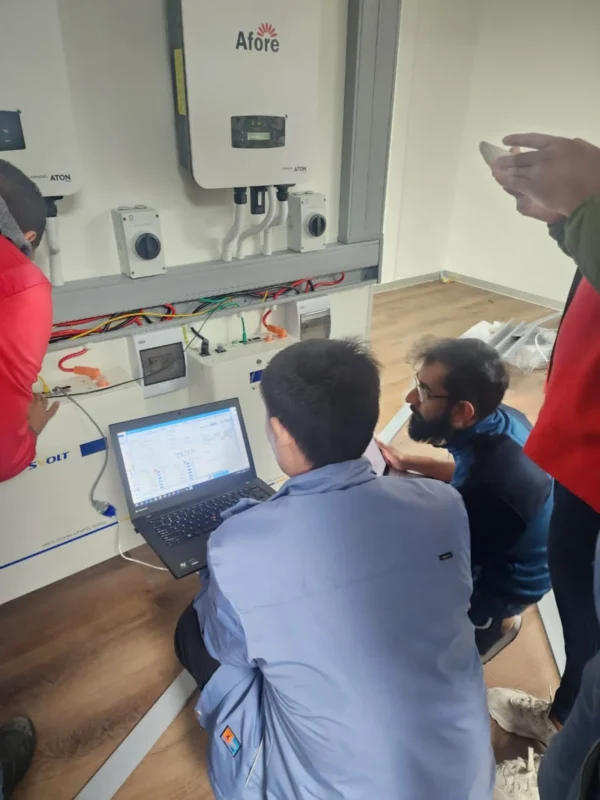
Commissioning should verify both electrical safety and operational logic. A typical commercial workflow includes firmware verification, battery communication setup, grid-code selection, protection setting review, CT or meter configuration, PV string checks, battery charge/discharge testing, backup load testing, export control validation, remote monitoring setup, and operational mode confirmation.
Because hybrid systems have multiple operating states, commissioning should test more than “PV generation on.” The team should verify behavior during grid import, grid export, battery charge, battery discharge, limited export, outage simulation where permitted, reconnection, and alarm conditions. Documented commissioning protects the EPC, supports warranty claims, and gives O&M teams a reliable baseline.
Incorrect CT orientation is one of the most common causes of export control and peak-shaving problems. If the inverter reads import as export, or one phase is reversed, the control logic may behave unpredictably. Other frequent issues include undersized conductors, poor communication cable routing, incorrect battery protocol selection, loose terminations, inadequate ventilation, unbalanced backup loads, and missing firmware updates.
In multi-site programs, small errors can repeat at scale. Standardized checklists, installer training, commissioning templates, and remote review of system data can significantly reduce after-sales calls.
A hybrid inverter charger is more complex than a PV-only string inverter. Installers must understand battery safety, BMS communication, AC protection, backup circuits, metering, networking, and software configuration. Service teams must be able to interpret alarms, retrieve logs, update firmware, and distinguish between inverter faults, battery faults, grid events, and configuration issues.
For resellers, technical support capability is a commercial differentiator. A lower-cost product can become expensive if it generates high support demand, repeated site visits, or unresolved compatibility issues.
Monitoring is essential for commercial PV-plus-storage because the value of the system depends on operational behavior, not only installed capacity. Facility owners and asset managers need visibility into PV generation, battery state of charge, load consumption, grid import/export, alarms, temperature, charge/discharge history, and fault events.

A good monitoring platform should show whether the system is meeting its intended use case. For self-consumption, the operator needs to see solar utilization and export. For peak shaving, the operator needs demand trends and battery response. For backup readiness, the operator needs battery state of charge, alarm status, and critical-load availability.
Portfolio owners also need fleet-level visibility. A retail chain, telecom operator, or agricultural group with dozens of sites benefits from standardized dashboards, alarm prioritization, remote diagnostics, and consistent performance reporting. Open communication protocols such as Modbus or other recognized interfaces may also matter when integrating with building management systems or third-party EMS platforms.
Inverter warranties and battery warranties should be reviewed together. Inverter warranties may focus on product defects and duration, while battery warranties often include throughput, cycle, temperature, and state-of-charge conditions. If operating modes cause excessive cycling or violate battery conditions, warranty claims may be difficult.
Serviceability affects lifecycle cost. EPCs should assess whether the inverter has replaceable fans, modular power stages, accessible terminals, downloadable logs, local repair options, and available spare parts.
For mission-critical sites, replacement logistics and response time can matter more than a small difference in purchase price.
There is no universal lifespan that applies to every hybrid solar inverter. Service life depends on component quality, operating temperature, enclosure design, cooling method, load profile, grid stability, installation quality, maintenance, and manufacturer support. Electrolytic capacitors, fans, relays, and power electronics are all affected by thermal and electrical stress.
Rather than relying on generic lifespan claims, commercial buyers should compare warranty terms, derating curves, temperature ratings, enclosure protection, service procedures, spare parts availability, and field support. The expected replacement schedule should be included in lifecycle cost modeling, especially for projects with 15- to 25-year PV asset horizons.
Hybrid systems combine PV, batteries, power electronics, communications, software, and grid interaction. Reliability therefore depends on the entire system. Battery degradation, inverter thermal stress, dust, humidity, corrosion, firmware problems, communication failures, unstable grids, and poor O&M can all reduce performance.
The practical implication is that equipment selection alone does not guarantee reliability. Good design, correct installation, disciplined commissioning, remote monitoring, and proactive maintenance are equally important.
A hybrid inverter charger can improve commercial PV economics, but only when the business case is modeled accurately. Savings depend on site-specific tariffs, load profiles, battery dispatch, export rules, incentives, maintenance costs, and avoided outage losses.
CAPEX includes the inverter, batteries, PV modules, switchgear, meters, protection devices, cabling, enclosures, installation labor, engineering, permitting, and commissioning. OPEX includes monitoring subscriptions, preventive maintenance, replacement parts, battery degradation, service visits, and warranty administration.
For commercial buyers, payback should be modeled with interval load data and actual tariff structures. A system designed only from annual consumption may miss demand charge opportunities or oversize storage for loads that do not align with PV generation.
| Economic driver | Commercial impact |
|---|---|
| Demand charges | Can make short-duration peak shaving highly valuable |
| TOU tariffs | Support scheduled charge/discharge strategies |
| Export compensation | Influences self-consumption value |
| Outage cost | Justifies backup for critical operations |
| Battery degradation | Affects long-term usable capacity and ROI |
| Maintenance cost | Impacts total cost of ownership |
| Incentives and tax rules | Can change project payback significantly |
Integrated hybrid inverter chargers can reduce equipment count, wiring complexity, footprint, and commissioning effort. They may also simplify control because PV, battery, grid, and backup functions are managed through one platform. This is attractive for many small and mid-size commercial projects, especially new-build systems.
However, separate PV inverters, battery inverters, or dedicated power conversion systems may be better for larger or more complex C&I projects.
For small and mid-size commercial systems, integrated hybrid inverter chargers are often preferred because they reduce equipment count and simplify installation.
For large C&I or MW-scale projects, dedicated PCS systems with battery containers and separate PV inverters are more common due to higher scalability and power control flexibility.
For retrofit projects, AC-coupled systems are often easier to deploy because they can integrate with existing PV inverters without full system replacement.
In complex multi-building sites or tariff-sensitive applications, separate EMS control may be required to coordinate energy flow, generator operation, and demand response strategies.
Modular systems or multiple inverters can also improve redundancy and reduce single-point-of-failure risk, improving long-term reliability.
Service strategy should also be considered. Modular architectures may reduce downtime because individual components can be replaced or serviced without shutting down the entire system.
Supplier evaluation should focus on system compatibility and long-term support rather than price alone. Key criteria include battery compatibility, grid certification coverage, firmware version control, local technical support, and warranty reliability. Documentation quality and responsiveness are also critical for commercial deployment success.
Product selection checklist for EPCs and distributors:
For resellers, SKU rationalization matters. Stocking too many incompatible inverter and battery combinations increases inventory risk and support complexity. A smaller, well-supported portfolio with clear compatibility across project types can be more profitable than a broad catalog with uncertain integration outcomes.
For commercial chains, telecom networks, agricultural portfolios, and distributed energy operators, total cost of ownership is strongly influenced by operational efficiency rather than hardware cost alone.
Reduced truck rolls significantly lower maintenance expenses by enabling remote fault detection and diagnosis. Faster fault isolation reduces downtime and improves system availability.
Standardized platforms across multiple sites reduce training costs for O&M teams and improve response consistency. They also reduce commissioning variance, helping ensure that systems behave consistently across deployments.
Standardized spare parts and service procedures further reduce lifecycle costs and simplify long-term maintenance planning.
Commercial loads evolve. Facilities may add EV chargers, electrify heating, expand production lines, or introduce flexible loads. A hybrid inverter charger selected only for today’s load may constrain tomorrow’s energy strategy.
A hybrid inverter charger can be suitable for three-phase commercial systems if it has the required output capability, grid-code certification, parallel operation support, battery compatibility, and load-handling performance. Smaller units may work for light commercial applications, while larger C&I sites may need modular commercial hybrid inverters, dedicated storage PCS platforms, or multiple coordinated units.
The decision should be based on load profile, fault behavior, redundancy requirements, and interconnection limits. For facilities with large motors, high inrush currents, or sensitive production loads, engineering review is essential.
Many commercial hybrid systems scale by operating multiple inverter units in parallel. This can increase total power, improve design flexibility, and support phased expansion. However, parallel operation requires reliable communication, load sharing, firmware consistency, and clear fault management.
For mission-critical loads, redundancy planning should consider what happens if one inverter module fails. An N+1 design may allow continued operation at reduced capacity, while a single large inverter may create a larger single point of failure. Service continuity should be evaluated alongside CAPEX.
In weak-grid and off-grid applications, hybrid inverter chargers often operate with generators. The system may start the generator when battery state of charge falls below a threshold, charge batteries during efficient generator operation, and shut the generator down when PV and storage can support loads. This can reduce fuel consumption and maintenance compared with diesel-only operation.
More advanced commercial systems may integrate with an EMS, building management system, or microgrid controller. Communication interfaces, data access, control permissions, and cybersecurity requirements should be reviewed early. A technically strong inverter with closed or poorly documented communications may limit future optimization.
EV charging can significantly change a commercial load profile. So can HVAC electrification, refrigeration expansion, or new production equipment. If these loads are likely, the PV-storage design should allow future electrical capacity, load management, monitoring integration, and battery expansion.
A hybrid inverter charger does not need to solve every future requirement on day one. However, it should not block reasonable expansion. EPCs should discuss future load growth during design rather than treating it as a later problem.
A hybrid inverter charger can simplify commercial PV-plus-storage design and improve project value, but only when it is specified around the site’s real operating requirements. For EPCs, installers, resellers, and facility owners, the strongest projects start with load data, tariff analysis, compliance review, battery compatibility checks, and a clear commissioning plan. Treat the hybrid inverter charger as the control center of a complete energy system, and evaluate it through the full lifecycle: design, approval, installation, operation, service, and future expansion.
Some hybrid inverter chargers can operate without batteries in grid-tied PV-only mode. In this case, they behave like a standard solar inverter and only supply power when the grid is available. However, off-grid or backup operation normally requires a battery. Even battery-ready systems may need correct firmware settings, meters, or configuration before full hybrid functions are enabled.
Sizing starts with identifying critical loads and non-critical loads. The inverter must meet both steady load demand and short surge requirements in kW and kVA. Battery size is based on required backup hours or load shifting goals. PV input limits, grid export rules, thermal derating, and battery compatibility must also be checked together.
Yes, but suitability depends on system type. Options include native three-phase inverters, parallel-configured units, or larger PCS-based systems for bigger sites. Key factors include facility voltage, motor starting loads, unbalanced load handling, and grid-code compliance. Backup output limits and scalability should also be reviewed.
An inverter charger mainly converts battery DC power to AC and charges the battery from the grid or a generator. A hybrid inverter adds PV input management, battery charge/discharge control, grid interaction, and export control. Some also include backup or islanding capability. Manufacturers use these terms differently, so functions must always be verified.
Main risks include compliance issues, battery incompatibility, backup power limitations, and export-control failures. Support quality and warranty conditions also affect long-term performance. Buyers should verify exact model certification, firmware version, approved battery list, and BMS protocol. Local service availability and spare parts support are also critical.








 Turkish
  Romanian