





For teams researching inversor híbrido vs microinverter b2b decisions, the real question is not which inverter technology is universally “better.” The better question is which architecture fits the project’s scale, roof conditions, battery strategy, grid-code environment, installation model, service plan, and financial targets.
In commercial and industrial solar PV, inversor selection affects much more than energy conversion. It shapes PV string design, battery compatibility, export control, rapid shutdown strategy, commissioning workflow, O&M cost, warranty exposure, monitoring granularity, and long-term asset performance. A small commercial rooftop with multiple orientations may justify a very different inverter architecture from a 2 MW uniform warehouse roof or a factory site planning peak-shaving storage. According to the U.S. Department of Energy (DOE), modern solar inverters increasingly function as grid-support and energy-management platforms rather than simple DC-to-AC conversion devices. Advanced inverter functionality may include voltage regulation, frequency response, reactive power support, export management, and coordination with battery storage systems, all of which are becoming more important in commercial PV deployments.
Hybrid inverters and microinverters both have strong commercial use cases. Hybrid inverters are often favored where PV-plus-storage, centralized control, larger system blocks, and commercial energy management are priorities. Microinverters are often attractive where module-level control, distributed rooftops, shade tolerance, phased expansion, and detailed monitoring provide measurable value.
This guide is written for EPCs, installers, system integrators, distributors, resellers, and commercial PV owners evaluating inverter architecture at a project and portfolio level. It starts with a practical decision matrix, then moves into system design, battery integration, compliance, commissioning, O&M, procurement, and lifecycle economics.
Commercial PV discussions often use terms like string inverter, hybrid inverter, microinverter, and optimizer interchangeably, even though they describe different electrical architectures and operational capabilities. For EPCs, distributors, installers, and commercial asset owners, distinguishing these architectures early improves system sizing, storage planning, service strategy, and lifecycle cost modeling.
A string inverter is a centralized DC-to-AC inverter connected to multiple PV module strings. DC power from several modules is aggregated before inversion, making this architecture cost-efficient and common in commercial rooftop and ground-mounted systems with consistent roof orientation and minimal shading.
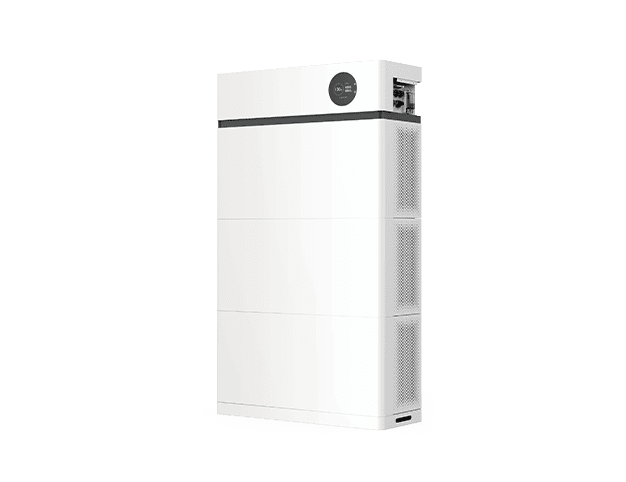
A hybrid inverter is a battery-interactive inverter that combines PV inversion and energy storage control within the same platform. Unlike standard string inverters, hybrid inverters support battery charging/discharging logic, backup operation in some configurations, export limitation, and energy-management integration. In commercial projects, hybrid inverters are commonly evaluated for self-consumption optimization, peak shaving, and storage-ready PV deployments.
A microinverter is a module-level inverter installed behind individual PV modules. Each module independently converts DC to AC, allowing module-level optimization, monitoring, and mismatch mitigation. Microinverter systems are often evaluated on rooftops with multiple orientations, partial shading, difficult maintenance access, or high monitoring granularity requirements.
An optimizer architecture uses module-level DC optimizers combined with a centralized string inverter. Unlike microinverters, power conversion still occurs at the central inverter level, while optimizers provide module-level MPPT, monitoring visibility, rapid shutdown functionality, and mismatch mitigation. This architecture is frequently selected for commercial roofs requiring better shade tolerance without adopting a full microinverter topology.
The decision matrix should consistently distinguish among:
Hybrid inverters should not be grouped together with standard string inverters because storage integration, export management, backup capability, and EMS interaction materially change system behavior, cost structure, commissioning workflow, and utility interconnection requirements.
Similarly, optimizer-based systems should not be categorized as full microinverter systems because DC power conversion remains centralized and the inverter remains a single dependency point.
For large commercial rooftops with uniform orientation, long string runs, and limited shading, standard string inverter systems typically provide the lowest installed cost and simplest maintenance structure. This architecture is commonly prioritized in logistics facilities, manufacturing buildings, warehouses, and utility-adjacent commercial sites.
For rooftops with multiple azimuths, irregular setbacks, equipment obstructions, or shading exposure, optimizer-based systems or microinverters are frequently evaluated to reduce mismatch losses and simplify module-level performance visibility.
When energy storage is included from the beginning, hybrid inverter platforms are usually evaluated first because they simplify DC-coupled storage integration, export limitation, self-consumption control, and energy-management coordination.
If storage is expected after initial PV deployment, storage-ready hybrid architectures may reduce future retrofit complexity compared with replacing conventional string inverters later.
Buildings with expensive rooftop access procedures, restricted maintenance windows, or elevated labor costs may justify module-level electronics because remote diagnostics and module-level monitoring can reduce troubleshooting time.
Microinverters are more commonly evaluated on small-to-mid commercial rooftops, distributed multi-building portfolios, carports, schools, retail sites, and architecturally complex installations where module-level flexibility outweighs higher hardware cost.
String and hybrid inverter architectures are more commonly evaluated in medium-to-large commercial systems where BOS efficiency, cable reduction, centralized serviceability, and lower inverter cost per watt become increasingly important.
Projects focused on demand-charge reduction, backup continuity, energy arbitrage, or grid-interactive operation often prioritize hybrid inverter platforms regardless of roof complexity because storage functionality becomes a primary design driver rather than a secondary feature.
Commercial PV inverter selection should begin with the project use case, not with a datasheet comparison. Peak efficiency, warranty length, and unit price matter, but they are not enough to determine the best architecture. For B2B buyers, the decision should include installation repeatability, grid approval risk, storage roadmap, service access, and financial performance over the project life.
A hybrid inverter is usually a centralized or string-based inverter architecture designed to manage PV generation and, where applicable, battery charging and discharging. In commercial PV, hybrid systems may be used for self-consumption, peak shaving, backup power, export limitation, or future storage readiness.
A microinverter is a module-level power electronics device that converts DC power to AC at or near each PV module. Instead of one inverter managing multiple strings, each module has its own conversion and MPPT behavior. This architecture can be valuable on complex rooftops, but it also increases the number of rooftop electronic devices.
The best option depends on the commercial design objective. Hybrid inverters generally fit larger, more uniform C&I systems where battery integration, centralized energy management, and lower cost per watt are priorities. Microinverters generally fit small-to-mid commercial rooftops where module-level performance, shading tolerance, simplified rapid shutdown, and granular monitoring are more important.
For example, a logistics warehouse with a large, flat, unobstructed roof and a clear plan to add 1 MWh of battery storage will often lean toward a hybrid or string-based storage-ready architecture. By contrast, a multi-building commercial campus with skylights, HVAC obstructions, mixed roof planes, and phased tenant-driven expansion may benefit from microinverters because they reduce mismatch risk and simplify module-level monitoring.
The decision becomes more complex when storage is introduced. Hybrid inverters are commonly selected for PV-plus-storage because they can coordinate PV, battery, grid import/export, and site loads within one control architecture. Microinverter systems can also support batteries, but typically through AC-coupled storage or a separate battery inverter, which adds equipment and control complexity.
For commercial solar projects without battery storage, architecture selection is usually driven by roof geometry, shading behavior, service strategy, and CAPEX sensitivity rather than energy-management functionality.
Large uniform rooftops with consistent production conditions generally favor centralized string inverter systems because they optimize installed cost, simplify electrical aggregation, and reduce inverter cost per watt.
Commercial roofs with multiple orientations, uneven irradiance, or high-performance visibility requirements often favor optimizer-based systems or microinverters because module-level MPPT improves mismatch management and operational transparency.
Microinverters are more frequently justified where maintenance access is difficult, uptime visibility is critical, or rooftop segmentation makes traditional stringing inefficient.
For commercial projects with battery storage, inverter selection shifts from pure PV optimization toward energy-flow management, export control, and facility-load interaction.
Hybrid inverters are commonly prioritized when the project includes:
In storage-led commercial projects, the ability to coordinate PV generation, battery dispatch, utility interconnection limits, and facility loads often outweighs the benefits of pure module-level optimization.
Instead of broad project-dependent framing, selection criteria can be simplified into practical commercial decision paths:
Hybrid inverters are especially strong in commercial solar projects where energy storage is central to the business case. These include self-consumption projects, demand-charge reduction, time-of-use optimization, backup power, export-controlled systems, and sites where batteries may be added later.
Three-phase commercial hybrid inverter options are particularly relevant for factories, warehouses, schools, retail facilities, logistics centers, and agricultural operations. In these projects, the inverter is not only converting solar energy; it may also support load management, battery dispatch, grid-code functions, and monitoring of energy flows.
The key design requirement is accurate sizing. Hybrid inverter selection must account for PV array capacity, DC/AC ratio, battery capacity, battery voltage class, expected charge and discharge power, backup load requirements, export limits, and the facility’s interval load profile. Oversizing or undersizing the inverter can reduce project value, either by increasing unnecessary CAPEX or by limiting the ability to capture solar energy and manage demand peaks.
Hybrid inverters should be treated as storage-ready or battery-interactive platforms rather than conventional string inverters with minor feature additions. Their architecture is specifically designed to coordinate PV generation, battery charging, facility consumption, and grid interaction simultaneously.
In commercial environments, hybrid inverters are frequently selected for:
Commercial hybrid inverter deployments must evaluate compatibility with three-phase electrical infrastructure, including:
Three-phase hybrid systems may also support:
Because commercial facilities often exhibit uneven phase loading, inverter sizing and EMS configuration should align with real facility load behavior rather than relying only on PV production estimates.
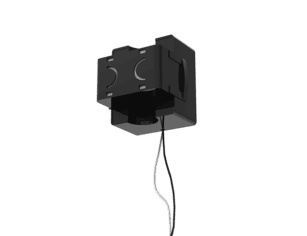
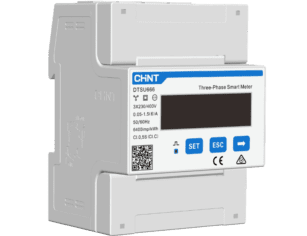
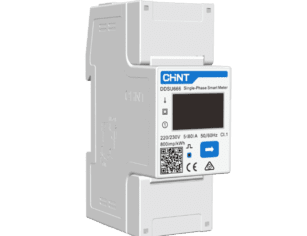
Commercial hybrid inverter performance depends heavily on accurate CT and meter placement for three-phase monitoring and export-control logic.
Improper CT orientation, incorrect meter location, or incomplete phase monitoring can affect:
For larger systems, EPCs frequently coordinate inverter controls with external EMS platforms, switchgear monitoring, and facility SCADA infrastructure.
Commercial projects should verify:
These requirements can materially affect inverter selection, commissioning workflow, and approval timelines, particularly in commercial sites deploying battery storage or advanced export-control functionality.
Microinverters are often a good fit for commercial rooftops with multiple orientations, uneven shading, many roof obstructions, or phased expansion requirements. Because each module operates independently, one shaded or underperforming module has less impact on neighboring modules compared with a traditional string arrangement.
This architecture can be attractive for retail buildings, schools, healthcare facilities, multi-tenant commercial properties, and smaller industrial roofs where layout complexity limits string design efficiency. Microinverters also support detailed module-level monitoring, which can help installers and O&M teams identify underperforming modules, connector faults, or localized soiling issues.
However, microinverters require careful project planning at commercial scale. EPCs must account for AC trunk cabling, branch circuit limits, rooftop device count, gateway communication, module mapping, and replacement access. The system may be electrically simpler on the DC side, but it is not automatically simpler as a complete commercial installation.
Microinverters can provide strong module-level visibility and flexibility, but large commercial deployments introduce scaling considerations that differ from centralized inverter architectures.
Commercial microinverter systems require careful AC branch design because each branch circuit has limits on:
As rooftop size increases, branch aggregation strategy becomes a major design variable rather than a simple installation detail.
Manufacturers typically specify maximum inverter quantities per AC branch circuit based on:
Exceeding branch limits can affect protection coordination and long-term reliability.
Voltage rise becomes increasingly important on large commercial rooftops with extended AC homeruns. Distributed AC conversion may create more voltage-rise sensitivity than centralized DC string collection, especially when rooftop distances are substantial.
Microinverter systems require structured AC trunk-cable routing across the rooftop. Commercial layouts with multiple roof elevations, setbacks, expansion joints, and equipment obstructions can increase cable-management complexity.
Large commercial rooftops may exceed the communication range of standard monitoring gateways. Some projects require additional repeaters, segmented gateway architecture, or enhanced network planning to maintain reliable module-level reporting.
Module-level monitoring becomes operationally valuable only when digital system mapping accurately matches physical rooftop layout. Poor mapping practices can significantly increase troubleshooting time on large installations.
Replacing failed module-level electronics on commercial rooftops may require:
These operational realities can materially affect lifecycle service cost.
Microinverter architectures distribute electronics across every module position. While this reduces centralized single-point failure exposure, it also increases the total quantity of rooftop electronic devices over system life.
Large commercial microinverter systems generate significantly more monitoring data than string-level architectures. Fleet operators may require stronger monitoring workflows to manage alerts, analytics, and maintenance prioritization efficiently.
Facilities such as airports, logistics hubs, hospitals, data centers, and industrial plants may impose restricted rooftop access procedures that increase service complexity for module-level architectures.
The following table provides a fast B2B comparison. It should be used as a starting point, not a substitute for project-specific modeling.
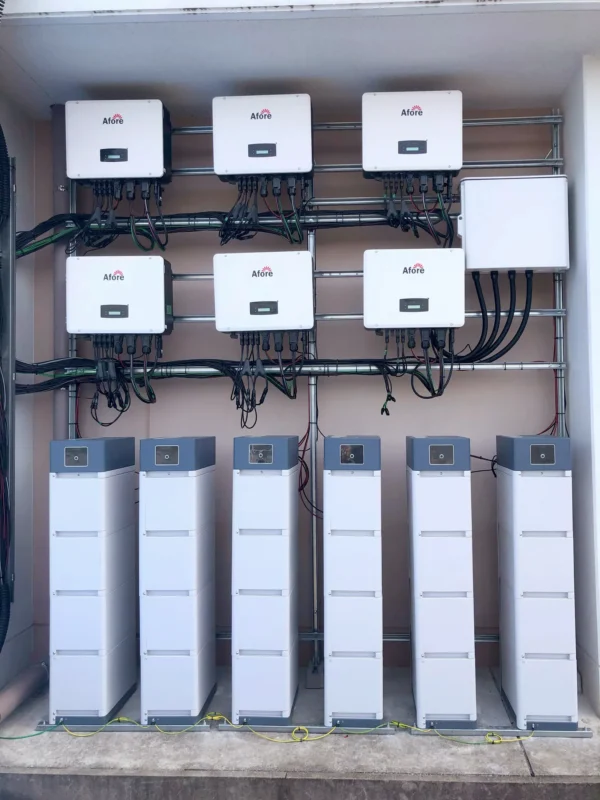
Standard string inverter systems generally provide the lowest inverter cost per watt in commercial PV deployments. Hybrid inverters typically carry higher upfront pricing due to storage-control electronics and battery integration capability. Microinverters usually present the highest inverter hardware cost because each module includes independent inversion hardware.
String-based architectures often reduce balance-of-system costs through centralized AC infrastructure and simplified wiring layouts. Microinverter systems may increase BOS costs due to distributed AC trunk cabling and larger quantities of rooftop electronics, while optimizer systems typically sit between centralized and full module-level architectures.
Microinverter and optimizer deployments may increase rooftop installation time because electronics are installed at the module level. However, they can simplify string design and reduce mismatch-related troubleshooting during commissioning. Centralized inverter systems generally reduce rooftop component count but may require more detailed string-voltage engineering.
Microinverters and optimizer platforms often include module-level monitoring as part of the ecosystem architecture, while conventional string inverter systems may rely primarily on string-level monitoring unless additional hardware is deployed.
Centralized inverter replacement may involve larger single-event service costs but fewer replacement points overall. Module-level electronics distribute failure exposure across many devices, potentially reducing single-event downtime while increasing total component quantity over system life.
Inverter architecture determines how power flows through the PV system. It also defines where conversion happens, how MPPT operates, how faults are detected, and how storage can be added. For commercial PV design teams, these architecture-level differences are more important than simple product comparisons.
A conventional string inverter connects multiple PV modules in series strings. The inverter performs DC-to-AC conversion at a centralized point and typically tracks power at the string or MPPT input level. This architecture is efficient and scalable, especially where modules have similar orientation, irradiance, and operating temperature.
A hybrid inverter builds on this concept by adding battery interaction and energy management functions. In many commercial systems, hybrid architecture allows PV generation to charge batteries, support loads, export to the grid, or provide backup functions depending on the inverter’s certification and system design. Hybrid inverters may be DC-coupled, AC-coupled, or part of a broader power conversion and energy management system.
Microinverters decentralize conversion. Each PV module has its own inverter, and AC power is aggregated across branch circuits. This reduces the impact of module mismatch and supports module-level monitoring. It also changes the balance of installation work from centralized inverter wiring to distributed rooftop device installation.
Optimizers sit between these approaches. They provide module-level DC optimization but still rely on a central inverter for DC-to-AC conversion. In commercial PV, optimizers may be used where design teams want some module-level benefits without fully adopting microinverters.
Optimizer systems occupy a middle position between centralized string inverter architectures and full microinverter systems.
In an optimizer architecture, each module includes a DC optimizer for module-level MPPT and performance tracking, but DC-to-AC conversion still occurs through a centralized inverter. This differs from microinverters, where inversion occurs independently at every module.
Commercial EPCs often evaluate optimizer systems when projects require:
At the same time, optimizer systems preserve many advantages of centralized inverter serviceability and lower AC rooftop complexity compared with full microinverter architectures.
Because the inverter remains centralized, overall system production still depends on inverter availability. However, optimizer systems can improve visibility into underperforming modules while reducing production losses caused by partial shading or module mismatch on commercial rooftops where a full microinverter architecture is not preferred.
Commercial PV projects require careful inverter loading strategy. The DC/AC ratio affects annual energy yield, clipping, inverter utilization, and financial performance. A higher DC/AC ratio can improve inverter utilization during lower irradiance periods, but excessive oversizing can increase clipping and reduce marginal energy value.
For hybrid inverter systems, sizing must also consider battery charge windows and site load behavior. A system designed for peak shaving may prioritize battery charging during solar production hours and discharging during demand peaks. A system designed for backup may require enough inverter power and battery capacity to support critical loads during outages. A system under export limitation may use storage to capture energy that would otherwise be curtailed.
Microinverter projects require different sizing checks. Each module must be matched to an appropriate microinverter input range, current limit, and power rating. Designers must also account for AC branch circuit limits, conductor sizing, voltage rise, and AC aggregation equipment. At larger scale, the repetitive nature of the architecture can help standardization, but it also increases the importance of clean module mapping and commissioning discipline.
Commercial microinverter systems require branch-circuit design validation early in the engineering phase because branch loading affects cable sizing, breaker coordination, and rooftop layout strategy.
Maximum inverter quantities per branch vary according to:
Commercial rooftop segmentation may also affect branch distribution strategy.
Voltage rise analysis is particularly important for large distributed AC rooftops. Long AC trunk runs may require:
AC trunk routing should be coordinated with:
Poor trunk-cable planning can complicate future troubleshooting and rooftop modifications.
Modern high-power PV modules create additional inverter selection issues. Commercial modules may have higher current output, larger form factors, and different temperature behavior than older modules. Inverter input current limits, MPPT voltage windows, maximum DC voltage, and derating curves must be checked against site-specific temperature conditions.
For hybrid and string-based systems, string length must remain within the inverter’s voltage range across cold and hot operating conditions. Bifacial modules may also increase current under high-albedo conditions, which can affect inverter input assumptions. Designers must verify whether the inverter can operate efficiently under expected irradiance and temperature conditions.
For microinverters, module pairing is critical. A microinverter that is undersized relative to the module may clip more frequently. A device with insufficient input current capacity may limit performance with high-current modules. These losses may be acceptable in some designs, but they should be modeled rather than assumed.
Site conditions often determine whether theoretical inverter advantages become real project value. Roof orientation, shading, structural access, cable routes, ambient temperature, dust, humidity, and serviceability all influence the choice.
Microinverters may reduce mismatch losses on roofs with multiple orientations, parapet shading, rooftop equipment, or inconsistent soiling patterns. Hybrid and string-based systems may be more efficient and cost-effective on uniform arrays with clean cable routes and accessible inverter locations.
Commercial design teams should evaluate these factors during feasibility and yield modeling, not after procurement. A lower-cost inverter architecture can become expensive if it creates design compromises, difficult service access, or unexpected performance losses.
Throughout this section, maintain clear differentiation between:
Avoid using “string inverter” and “hybrid inverter” as interchangeable terms because storage capability changes system topology, commissioning requirements, protection strategy, and utility interaction.
Energy storage is one of the strongest reasons commercial buyers evaluate hybrid inverters. Batteries change the role of the inverter from simple solar conversion to active energy management. The inverter must coordinate generation, load, grid import/export, and battery operation in line with tariff rules and site objectives.
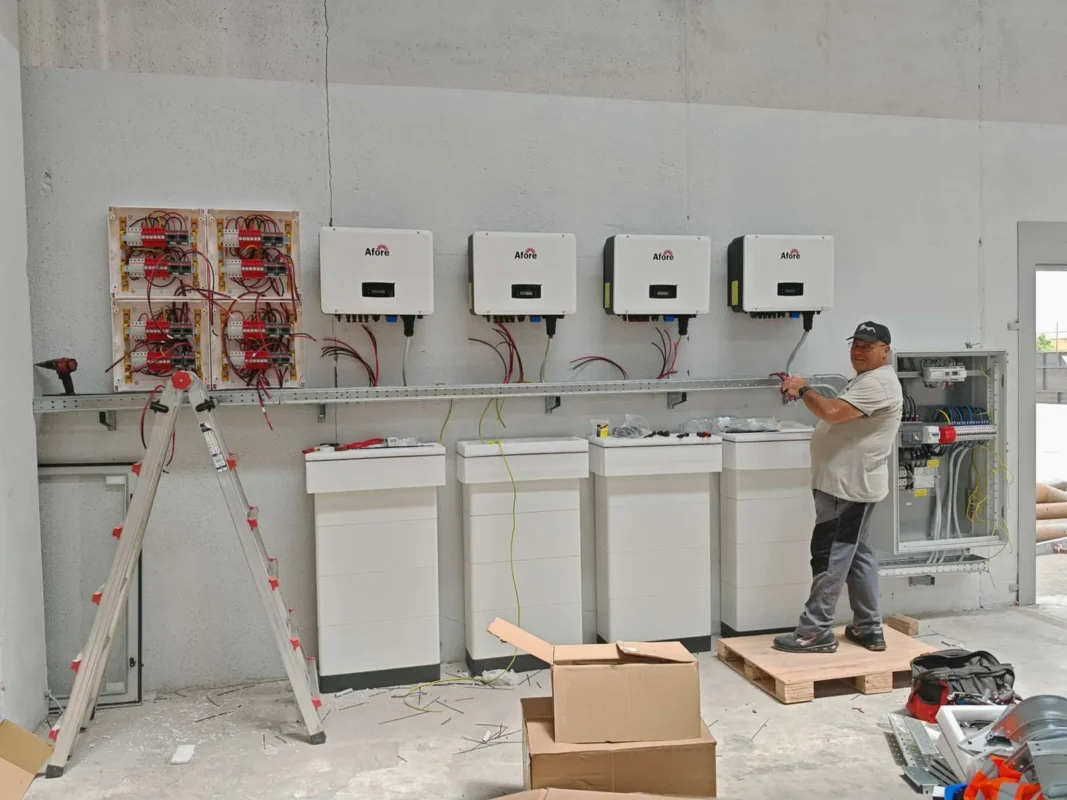
Hybrid inverters are commonly selected when battery storage is central to the project. In DC-coupled designs, PV energy can charge the battery before being converted to AC, reducing conversion stages in some operating modes. In AC-coupled systems, PV power is converted to AC and then converted again for battery charging through a battery inverter or power conversion system.
The practical difference is not only efficiency. DC-coupled hybrid systems can simplify control architecture and may reduce component count. AC-coupled systems can offer retrofit flexibility and may be easier to add to existing PV assets. For microinverter-based systems, batteries are generally added through AC coupling, which can work well but requires additional controls, metering, and commissioning checks.
For B2B projects, the key question is whether storage is a future option or a core revenue driver. If storage is central to demand-charge reduction, export control, backup power, or energy arbitrage, hybrid architecture often provides a cleaner design path. If storage is uncertain and the roof is complex, microinverters may still be viable, but the future battery retrofit plan should be engineered before the initial PV system is sold.
Commercial battery integration should be evaluated as a complete system architecture decision rather than as an isolated battery-selection exercise. Storage topology affects inverter selection, export control, backup capability, energy-management strategy, commissioning workflow, and future scalability.
In a DC-coupled hybrid architecture, PV and battery systems share a common hybrid inverter platform. This configuration is commonly selected for:
DC-coupled systems may improve charging efficiency because PV energy can charge batteries before AC inversion occurs.
Microinverter systems typically pair with AC-coupled battery storage because PV generation already converts to AC at the module level. In this architecture, a separate battery inverter manages charging and discharging independently from the PV microinverters.
This configuration is often evaluated for:
Conventional string inverter systems may integrate storage through a separate AC-coupled power conversion system (PCS). This approach separates PV generation and battery operation into different inverter platforms while enabling large-scale storage deployment flexibility.
Larger commercial and industrial energy-storage projects frequently deploy dedicated PCS architecture integrated with:
This approach is commonly evaluated in large C&I or microgrid-capable projects where storage functionality becomes a primary operational asset.
Commercial buyers should confirm inverter compatibility with the intended battery voltage range because some hybrid inverters only support specific battery classes or manufacturer ecosystems.
Battery chemistry affects:
Commercial systems commonly evaluate lithium iron phosphate (LFP) chemistry for improved thermal stability and long-cycle operation.
Battery sizing should distinguish between:
High-power applications such as peak shaving may require different sizing logic than long-duration backup systems.
Battery C-rate capability affects:
Commercial backup systems should verify whether transfer time aligns with facility operational requirements, particularly for sensitive equipment or business-continuity applications.
Some commercial systems require black-start functionality, allowing batteries and inverters to restart portions of the facility after a full outage without utility grid presence.
Battery communication compatibility between inverter, EMS, and battery management system (BMS) is critical for stable operation and warranty compliance.
Commercial storage projects should verify whether export limitation is controlled through:
Some utilities or jurisdictions restrict PV-only charging, grid charging, or battery export behavior depending on tariff structure and incentive rules.
Commercial operators may require configurable charging behavior for:
Commercial battery systems increasingly participate in:
Compatibility with these programs may influence inverter and EMS selection.
Before finalizing commercial storage architecture, buyers should verify:
Commercial storage economics are highly site-specific. A manufacturing plant with high daytime loads may use most solar energy directly and need limited storage. A warehouse with low daytime consumption but high evening demand may need batteries to improve self-consumption. A facility facing high demand charges may use storage to reduce short-duration peaks that dominate the electricity bill.
Hybrid inverter systems can simplify these use cases because PV and battery operation are coordinated in one energy management framework. However, hardware alone does not guarantee savings. EPCs should model interval load data, tariff structure, demand-charge windows, export rules, and battery cycling assumptions.
For example, a cold-storage facility may have predictable load spikes from refrigeration equipment. A properly sized hybrid PV-plus-storage system may reduce demand charges by discharging during those peaks. A microinverter system could also contribute solar generation, but if storage is required, the design will need AC-coupled batteries and a control strategy that responds fast enough to site demand.
Commercial storage economics depend heavily on correct battery and inverter sizing rather than battery capacity alone.
Key buying criteria include:
Systems optimized for peak shaving may prioritize high discharge power, while self-consumption optimization may prioritize usable storage duration.
Backup power is often misunderstood in commercial PV sales. A grid-tied PV system does not automatically provide power during an outage. Backup capability requires appropriate inverter functions, batteries, transfer equipment, protection coordination, and code-compliant system design.
Hybrid inverters may offer backup or emergency power supply functions depending on model, certification, and system configuration. However, commercial sites often require more than an inverter setting. Whole-site backup may involve significant switchgear, generator coordination, load shedding, and engineering review. Critical-load backup is usually more practical because only selected circuits are supported.
Microinverter-based systems can support backup when paired with compatible storage and controls, but they do not inherently solve resilience requirements. EPCs should define whether the customer needs non-backup grid-tied PV, critical-load backup, or whole-site resilience before selecting equipment.
Commercial resilience planning should distinguish between several fundamentally different operational goals rather than treating all storage systems as “backup-capable.”
Standard grid-tied PV systems shut down during utility outages and provide no backup capability.
Export-limited systems manage grid export behavior but still may not provide outage backup functionality.
Some battery systems focus exclusively on economic optimization such as:
These systems may still shut down during outages if backup capability is not included.
Critical-load backup architectures support selected circuits or operational loads during outages. These systems often require:
Whole-site backup systems attempt to maintain operation across larger facility sections and may require:
Microgrid-capable commercial systems coordinate:
These systems typically include advanced EMS and islanding capability for extended resilience operation.
Facilities with sensitive equipment should verify acceptable transfer time during outage transitions.
Black-start support determines whether the system can restart without grid presence after a full shutdown event.
Not all battery systems provide backup functionality automatically. Buyers should confirm:
Many commercial backup systems require:
These requirements can materially affect project cost and installation complexity.
Yes, microinverters can be used with commercial battery storage, but usually through AC-coupled battery systems rather than native DC-coupled storage. This means the project may need additional battery inverters, meters, communications gateways, and energy management equipment.
The benefit is flexibility. AC-coupled storage can be retrofitted to existing microinverter PV systems and can work across distributed rooftop layouts. The trade-off is added component count and control complexity. Commissioning teams must verify metering direction, communication stability, grid-code settings, battery dispatch logic, and monitoring integration.
For EPCs, the important question is not whether microinverters can work with batteries. They can. The question is whether the complete AC-coupled design meets the project’s efficiency, cost, control, backup, and service requirements.
Inverter performance should be evaluated at system level. Datasheet efficiency is useful, but real-world yield depends on shading, orientation, temperature, soiling, clipping, availability, and monitoring quality.
Hybrid and string-based inverters often achieve high peak and weighted conversion efficiency, especially on uniform commercial arrays. Where all modules operate under similar conditions, centralized architectures can deliver strong energy yield with lower equipment cost per watt.
Microinverters may produce more energy where mismatch is material. Shading from HVAC units, parapets, antennas, skylights, or neighboring structures can reduce string-level performance if not properly managed. Because microinverters operate independently at the module level, one shaded module does not drag down an entire string in the same way.
The yield advantage of microinverters is therefore site-dependent. On a clean, uniform ground mount, the gain may be small and may not justify the higher equipment count. On a complex roof with repeated partial shading, the additional energy and troubleshooting value may support the business case.
Monitoring has operational value in commercial solar. Microinverters usually provide module-level monitoring, allowing O&M teams to identify a specific module or device that is underperforming. This can reduce diagnostic time, especially for distributed rooftops or portfolios with many small sites.
Hybrid inverter systems typically provide inverter-level or string-level data unless additional monitoring, optimizers, or smart combiner equipment is used. For larger C&I systems, this may be sufficient if the design is uniform and faults can be isolated through string monitoring and periodic inspection.
The right monitoring approach depends on the O&M model. A commercial asset owner with many small rooftops may value module-level visibility. A portfolio manager operating larger sites may prefer a fleet dashboard with alarms, performance ratios, battery state of charge, export control status, and revenue reporting.
Failure modes differ significantly. If a microinverter fails, the production loss is usually limited to one module. This can improve system availability at the energy-output level. However, replacing the failed device may require rooftop access, module removal, fall protection, and scheduling coordination.
If a hybrid inverter fails, a larger block of PV capacity may be affected, and battery operation may also be interrupted. The production-loss exposure is higher per device. On the other hand, replacement may be easier if the inverter is ground-mounted or located in an equipment room, and fewer devices must be managed across the project life.
Commercial buyers should evaluate mean time to repair, spare parts availability, warranty claim procedures, truck-roll costs, site access restrictions, and safety requirements. The real OPEX impact is rarely determined by failure rate alone.
EPCs should model inverter performance with professional PV design and simulation tools rather than relying on generic efficiency claims. A good model should include shade analysis, roof orientation groups, string layout, inverter clipping, module temperature, soiling assumptions, degradation, downtime, and expected system availability.
For storage projects, the model should also include battery dispatch logic, tariff periods, demand charges, export limits, round-trip efficiency, and battery degradation. These assumptions directly influence ROI and should be documented clearly in commercial proposals.
The strongest inverter decision is usually the one that aligns technical performance with the financial model. If the PPA rate, lease savings, or EPC performance guarantee depends on specific energy output, inverter architecture should be validated through project-specific simulation.
Commercial PV systems must satisfy grid interconnection requirements, electrical codes, safety standards, and local utility approval processes. Inverter procurement without compliance verification can delay projects and expose EPCs to costly redesign.

Grid-tied commercial PV projects may need anti-islanding protection, voltage and frequency ride-through, power factor control, reactive power capability, export limitation, and remote disconnection functions. In some markets, larger systems must comply with advanced grid-support requirements.
Hybrid systems may require additional approval because storage changes import/export behavior. The utility may want to know whether the battery can export to the grid, whether it only charges from PV, and how export limits are enforced. Metering and controls must be configured correctly, particularly where incentives or interconnection agreements restrict battery operation.
Microinverter systems must also comply at the system aggregation level. Even if each device is certified, the complete installation must meet utility requirements through proper design, protection, and commissioning.
Applicable standards vary by market. In the United States, commercial inverter projects commonly involve requirements related to IEEE 1547, UL 1741, and the National Electrical Code. International projects may involve IEC-based safety and performance standards, local grid codes, and regional interconnection requirements.
In Europe, grid connection requirements may reference local implementations of European network codes and national standards. In other regions, utilities may maintain their own approved inverter lists or require specific test certificates.
B2B buyers should verify certification before procurement, not during commissioning. Required documents may include test reports, declarations of conformity, grid-code setting files, installation manuals, firmware documentation, and utility acceptance records.
Before procurement or interconnection approval, EPCs and commercial buyers should verify:
Some certifications apply only to specific inverter variants rather than an entire product family. Procurement teams should verify certification status at the exact model-number level.
Utility approval or grid-support functionality may depend on specific firmware revisions. Firmware mismatches can delay interconnection approval or affect export-control compliance.
Many jurisdictions maintain approved equipment databases. Commercial projects should confirm that the selected inverter appears on the applicable utility or regulator-approved list.
Commercial interconnection often requires validated anti-islanding certification aligned with local grid standards.
Los servicios públicos pueden ser necesarios:
The U.S., EU, Australia, Southeast Asia, and other markets may apply different requirements for:
Commercial procurement should therefore align inverter selection with local regulatory expectations rather than assuming global certification equivalence.
Rooftop safety requirements influence inverter architecture. Microinverters often support module-level shutdown architectures because DC conversion occurs at the module level and rooftop DC voltage is limited by design. This can simplify compliance in jurisdictions with strict rapid shutdown requirements.
Hybrid and string-based systems may require additional module-level power electronics or rapid shutdown devices depending on local code. Arc-fault protection, disconnects, grounding, surge protection, labeling, firefighter access, and cable routing must all be included in the balance-of-system design.
The safety hardware can materially affect installed cost and labor. A hybrid inverter may appear less expensive at the device level, but rapid shutdown devices, combiner equipment, and additional wiring may change the total installed comparison. EPCs should compare complete code-compliant systems, not isolated inverter prices.
In jurisdictions with module-level rapid shutdown requirements, microinverters may simplify compliance.
In other markets, rapid shutdown requirements may differ, so the installed system should be evaluated against local code.
Commercial buyers and EPCs should verify:
Because rapid shutdown rules differ significantly across regions, compliance verification should occur during both design and procurement stages.
The most common procurement risks include buying inverter models without local certification, relying on incomplete documentation, assuming firmware supports required grid-code functions, or selecting products without utility approval history in the target market.
Distributors and resellers should verify certificates, warranty terms, regional support capability, firmware update policy, monitoring access, and technical documentation before adding products to their portfolio. EPCs should confirm that the exact model and firmware version match the project’s interconnection requirements.
Commercial inverter procurement should verify:
Procurement teams should verify whether certification applies to the exact SKU rather than a broader product family.
Grid-support functionality and utility approval may depend on specific firmware revisions, particularly in export-controlled commercial projects.
Utilities may reject systems using equipment not listed within approved interconnection databases.
Commercial interconnection often requires validated anti-islanding compliance documentation aligned with regional grid standards.
Projects in applicable jurisdictions should verify that the complete rapid shutdown system—not only individual components—meets listing requirements.
Arc-fault protection expectations may vary by jurisdiction and voltage class.
Commercial procurement should confirm availability of:
The U.S., EU, and other international markets may apply substantially different rules for:
These differences can materially affect commercial procurement strategy and deployment timelines.
Commercial inverter deployments should validate:
Three-phase commercial systems may require more advanced coordination between inverter controls, switchgear, metering infrastructure, and utility interconnection logic than residential PV systems.
Commercial projects should verify that export-control capability satisfies the interconnection agreement and utility operating requirements.
This includes validation of:
Inverter architecture affects field workflow. For EPCs and installers, the right technical choice must also be buildable, repeatable, and supportable under real project conditions.
Microinverter systems shift more work to the rooftop. Installers must mount devices, connect modules, manage AC trunk cabling, verify branch circuits, and map each module to the monitoring platform. This can simplify some DC safety concerns, but it increases rooftop handling and coordination.
Hybrid inverter systems centralize conversion and storage interfaces. Installers must manage string design, DC cabling, combiner boxes where used, battery connections, protection devices, meters, and communications. The rooftop may have fewer electronics, but the electrical room or inverter area requires more detailed coordination.
The best workflow depends on labor skills, site access, project scale, and installation repeatability. On a small complex roof, microinverters may save design and troubleshooting time. On a large uniform roof, centralized architecture may reduce device handling and improve installation productivity.
Microinverter installations require coordinated AC trunk routing across module rows. On large commercial rooftops, trunk placement must account for:
Commercial installers should complete module mapping during installation rather than after commissioning. Accurate mapping improves:
Communication infrastructure should be planned during the design phase, particularly on large rooftops where gateway signal strength may degrade across long distances or obstructed roof sections.
Because electronics are installed beneath modules, replacement workflows may require partial module removal during service events. Labor exposure increases further on:
Commercial commissioning is a major risk point. Hybrid inverter commissioning may include firmware updates, grid-code configuration, battery commissioning, meter setup, CT orientation checks, backup function testing, export control validation, monitoring activation, and communication verification.
Microinverter commissioning focuses on gateway communication, module mapping, AC branch verification, device detection, monitoring portal activation, and performance checks. The process can be straightforward when the installer is trained, but errors in mapping or communication can create long-term O&M confusion.
For both architectures, commissioning checklists are essential. B2B buyers should evaluate whether the supplier provides clear wiring diagrams, configuration guides, local-language documentation, remote support, and escalation procedures.
Architecture affects stocking strategy. Microinverter projects require many identical devices plus trunk cables, connectors, gateways, and accessories. This can support standardized kits, but missing accessories can delay installation.
Hybrid inverter projects usually involve fewer main inverter units but more project-specific components, especially when batteries are included. Compatibility between inverter, battery, meter, EMS, transfer equipment, and protection devices must be confirmed before quoting.
Resellers should consider SKU complexity, lead times, return handling, spare parts policy, and installer training. A product line with attractive pricing but weak documentation can create after-sales burden and margin erosion.
Commercial inverter selection must include lifecycle service planning. The lowest upfront cost may not be the best choice if it increases downtime, troubleshooting time, or warranty friction.
Hybrid systems concentrate service around inverter areas, combiner equipment, meters, batteries, and communications hardware. Preventive maintenance may include thermal inspections, firmware updates, ventilation checks, torque checks, filter cleaning where applicable, and battery system inspections.
Microinverter systems distribute electronics across the rooftop. Monitoring can identify specific module-level issues, but physical replacement may require roof access and module handling. This may be manageable on low-slope roofs with safe access, but expensive on high, congested, or restricted roofs.
A strong O&M strategy should define inspection frequency, alarm response, spare parts storage, access procedures, safety requirements, and warranty claim responsibilities.
Warranty length is only one part of warranty value. Commercial buyers should evaluate exclusions, labor reimbursement, shipping terms, diagnostic requirements, RMA procedures, replacement lead time, and whether the supplier has regional technical support.
Microinverters often come with long device-level warranties, which can be attractive for long-life PV assets. Hybrid inverters may have shorter standard warranties but may offer extensions. For commercial projects, the bigger question is how quickly a failed device can be diagnosed and replaced, and who pays for labor and lost production.
EPC contracts should clearly define downtime responsibilities, performance guarantees, monitoring obligations, and customer communication procedures.
Monitoring requirements are different for a single commercial roof and a multi-site portfolio. EPCs and asset managers may need API access, multi-site dashboards, alarm settings, role-based permissions, long-term data retention, export reports, and integration with asset management platforms.
Microinverters provide high-resolution module-level data, which is useful for diagnostics but can create data volume at scale. Hybrid inverter platforms may provide stronger visibility into battery state of charge, energy flows, grid import/export, and dispatch behavior.
For B2B buyers, monitoring should be evaluated as operational infrastructure, not as a sales feature. The platform must support the team responsible for performance reporting and maintenance response.
Commercial microinverter systems generate module-level production data across every panel position. Large systems may produce substantial alert volume, requiring stronger fleet-management workflows and analytics filtering.
Microinverter architectures distribute electronic components across the rooftop at every module position. Although individual failures affect smaller portions of production, total device count increases the statistical likelihood of isolated service events over system life.
Commercial rooftop service access can become a significant O&M cost driver for module-level electronics. Sites with restricted roof access, lift requirements, tenant scheduling, or elevated safety procedures may experience higher truck-roll and labor costs than centralized inverter systems.
A reliable commercial ROI model should evaluate both energy-production performance and long-term operational cost exposure.
The financial comparison between hybrid inverters and microinverters should be based on total installed cost and lifecycle value. Unit price alone is not sufficient.

Microinverters generally increase per-module electronics cost. However, they may reduce some DC-side design complexity and provide integrated module-level shutdown and monitoring benefits. On complex roofs, these benefits may offset part of the higher equipment cost.
Hybrid inverters often provide lower cost per watt on larger commercial systems, especially where arrays are uniform and storage is planned. However, the project may require compatible batteries, protection equipment, meters, communications hardware, transfer equipment, and more detailed engineering.
A fair comparison should include inverter hardware, batteries where applicable, BOS equipment, safety devices, cabling, labor, commissioning, monitoring subscriptions, warranty extensions, and expected service cost.
Commercial PV margins can be affected by small differences in labor productivity and rework. A system that looks cheaper in procurement may become more expensive if commissioning is difficult or if field teams lack training.
Microinverters may simplify certain design issues but require disciplined rooftop installation and mapping. Hybrid systems may reduce device count but require more detailed electrical coordination, especially with storage and backup functions.
Soft costs include engineering design time, permitting, interconnection documentation, utility studies, commissioning, troubleshooting, and customer handover. B2B buyers should compare complete project delivery cost, not only product price.
Lifecycle economics include inverter replacement cycles, service labor, monitoring costs, spare parts, warranty claim time, battery maintenance, and production losses. A lower CAPEX architecture may not deliver the lowest LCOE if it increases downtime or service complexity.
For hybrid systems, the risk is concentrated failure. One inverter issue may affect a larger block of production. For microinverters, the risk is distributed device management. Individual failures may have limited production impact, but rooftop service can be costly.
The right choice depends on site access, project scale, O&M contract structure, and the financial value of energy production.
ROI is project-specific. Hybrid inverters may improve returns where storage enables demand-charge reduction, higher self-consumption, backup value, or export-limit management. Microinverters may improve returns where module-level optimization increases yield, reduces troubleshooting time, or enables a difficult roof to be used effectively.
A simplified comparison can help frame the decision:
The best ROI model should use local tariffs, load profiles, export rules, incentives, financing cost, degradation assumptions, and O&M estimates.
Commercial inverter ROI comparison should follow the same lifecycle framework used throughout the economics section rather than relying on generalized payback statements.
The annual value framework remains:
Annual value=self-consumed solar savings+export revenue+demand-charge savings+backup/resilience value−O&M cost−monitoring cost−expected downtime loss
Hybrid inverter ROI often improves when:
Microinverter ROI may improve when:
| ROI input category | Hybrid or string-based architecture | Microinverter architecture |
|---|---|---|
| Coste de instalación | Often lower cost per watt on large uniform roofs | Often higher hardware and rooftop electronics cost |
| Expected energy production | Strong performance on uniform layouts | Improved mismatch and shading performance |
| Truck-roll cost | Fewer centralized service locations | More distributed rooftop service points |
| Warranty labor coverage | May depend on centralized inverter replacement terms | May involve multiple module-level replacement events |
| Downtime risk | Larger production impact if central inverter fails | Smaller production impact per isolated failure |
| Monitoring fees | Often string-level by default | Frequently includes module-level monitoring ecosystem |
Lifecycle ROI should therefore be modeled around actual commercial operating conditions rather than simplified assumptions about inverter category alone.
Commercial PV financial modeling should evaluate total operational value rather than focusing only on simple electricity-offset calculations.
The annual operational value can be modeled as:
Annual value=self-consumed solar savings+export revenue+demand-charge savings+backup/resilience value−O&M cost−monitoring cost−expected downtime loss
This framework is particularly important for commercial hybrid inverter and storage projects because demand-charge reduction, export limitation, and resilience value may materially affect project economics beyond pure energy production.
Commercial lifecycle economics should quantify operational exposure rather than treating O&M as a flat percentage assumption.
Service frequency affects:
Module-level architectures may reduce production impact per failure event while potentially increasing the number of rooftop service events over time.
Replacement labor varies significantly depending on:
High or restricted-access rooftops can materially increase lifecycle maintenance cost.
Downtime cost should include:
Commercial operators may reduce downtime risk by maintaining spare:
Spare-parts planning becomes increasingly important for large commercial fleets.
Manufacturers may cover hardware replacement while limiting:
Financial models should therefore separate hardware warranty coverage from real operational service cost.
For EPCs, installers, resellers, and distributors, inverter selection is also a supply-chain and after-sales decision. A technically suitable product can still create commercial risk if documentation, training, warranty support, or compatibility is weak.
Commercial buyers should evaluate supplier experience, financial stability, certification coverage, commercial project references, and product roadmap. Datasheet efficiency and price are not enough.
A strong supplier should provide complete technical documentation, local grid-code support, warranty clarity, firmware update history, training resources, and responsive technical service. For storage projects, the supplier should also provide verified compatibility lists and integration guidance.
Microinverters can support standardized commercial kits and broad installer adoption, especially for small-to-mid rooftops. The channel model may depend on repeatable accessories, gateway availability, and installer familiarity.
Hybrid inverter lines usually require deeper technical selling. The reseller must understand batteries, meters, EMS platforms, backup design, grid-code settings, and commercial tariffs. This can create higher-value opportunities, but it also increases training and support requirements.
Distributors should assess SKU range, accessory completeness, lead times, warranty process, and the likely after-sales burden before committing to a product portfolio.
Compatibility is a major B2B issue. Hybrid inverters may require approved batteries, smart meters, communication protocols, transfer equipment, and protection devices. Microinverter systems require gateways, trunk cabling, monitoring platforms, and compatible AC-coupled storage if batteries are planned.
Compatibility should be confirmed before quoting. EPCs should avoid assuming that devices will work together because they share general communication standards. The exact model, firmware version, and regional certification can matter.
A structured supplier review reduces project risk. The most important tender questions are technical and operational rather than promotional.
A single-project decision may not be the same as a portfolio decision. EPCs and asset owners should consider how inverter architecture affects repeatability across multiple sites.
Microinverters can be attractive for distributed commercial portfolios because they support flexible rooftop layouts and consistent module-level monitoring. This can be useful for retail chains, schools, and small commercial properties with varied roof conditions.
Hybrid and string-based systems can be more efficient for larger standardized blocks, especially when projects share similar roof layouts and storage requirements. They may reduce cost per watt and simplify centralized energy management.
The portfolio decision should consider procurement standardization, installer training, monitoring consistency, spare parts strategy, and O&M workflow.
Commercial energy demand is changing. Many facilities are planning EV charging, demand response, electrified heating, or expanded production loads. These changes can alter the value of storage and energy management.
Hybrid inverters may provide a clearer route for PV-plus-storage projects because battery control is part of the system architecture. Microinverter systems can still support future storage, but retrofit planning should account for AC-coupled battery capacity, switchgear, meter placement, and site load growth.
If EV charging is expected, the inverter decision should be made alongside load studies and energy management planning. PV alone may reduce energy consumption from the grid, but batteries and controls may be needed to manage peak demand.
Many EPCs benefit from internal selection rules. For example, they may specify hybrid inverters for storage-led C&I projects above a defined size, microinverters for highly complex rooftops below a certain capacity, and string-based systems with additional safety devices for uniform arrays.
Standardization reduces engineering time, procurement errors, training burden, and commissioning risk. However, rules should remain flexible enough to account for local code, utility requirements, roof complexity, and customer objectives.
Professional buyers do not need to choose one architecture for every project. A strong commercial PV portfolio may include hybrid inverters for storage-ready industrial sites and microinverters for complex distributed rooftops.
The most mature approach is to treat inverter selection as an engineering and commercial decision. The best architecture is the one that supports the site’s energy goals, meets grid and safety requirements, can be installed efficiently, and delivers the best lifecycle economics.
For B2B solar teams comparing hybrid inverters and microinverters, the right answer starts with the project’s constraints. If the site is large, uniform, storage-driven, and focused on centralized energy management, hybrid inverter architecture will often be the stronger commercial fit. If the site is distributed, shaded, multi-orientation, or requires granular module-level diagnostics, microinverters may justify their higher device count and cost.
The most reliable decision process is to model both architectures using actual roof conditions, interval load data, utility rules, code requirements, installation workflow, and O&M assumptions. In commercial PV, inverter selection is not a component preference. It is a system-level decision that shapes project risk, energy yield, service cost, and long-term financial performance.
When evaluating a hybrid inverter vs microinverter B2B decision, the best option usually depends on project scale, storage goals, and rooftop complexity. Hybrid systems are often favored in commercial installations because they support battery integration, centralized monitoring, and easier future upgrades, while microinverters perform well on rooftops with shading or multiple orientations. In most large-scale projects, a commercial solar architecture comparison shows that centralized designs provide better operational simplicity and lower long-term service costs for industrial and multi-building applications.
The biggest difference in string vs micro for business projects is usually the balance between upfront investment and long-term performance. String systems generally cost less because they use fewer electronic components and require simpler installation labor, making them attractive for warehouses, factories, and office rooftops. Microinverters may increase total system cost due to module-level electronics, but they can improve energy harvest in challenging rooftop layouts where shading or panel mismatch affects production consistency.
Many EPCs choose hybrid systems because the cost-benefit of hybrid inverters becomes more attractive when battery storage, backup power, and future expansion are part of the project roadmap. Instead of adding separate storage conversion equipment later, hybrid platforms simplify system integration from the beginning. Commercial clients also value the ability to expand energy storage gradually without redesigning the entire solar infrastructure, which helps reduce installation complexity and improve project flexibility over time.
Efficiency differences between microinverters and string systems are usually smaller than many buyers expect, especially with modern inverter technology. In uniform commercial rooftops with minimal shading, centralized systems often maintain excellent conversion performance and stable output. A proper LCOE solar comparison should consider not only inverter efficiency ratings but also installation conditions, energy yield stability, maintenance requirements, and operational lifespan when determining the most economical design for a commercial site.
Microinverters have become more durable in high-temperature environments, but rooftop heat exposure still affects long-term electronics performance. Because every unit is mounted directly beneath a solar module, thermal stress can accumulate over years of operation in tropical or industrial climates. This is why discussions around maintenance of micro vs string systems remain important for commercial asset owners, particularly when planning service access, replacement logistics, and long-term operational reliability across large rooftop arrays.
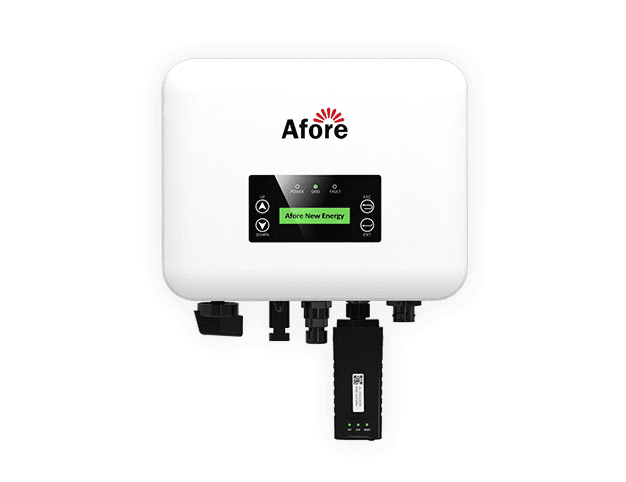
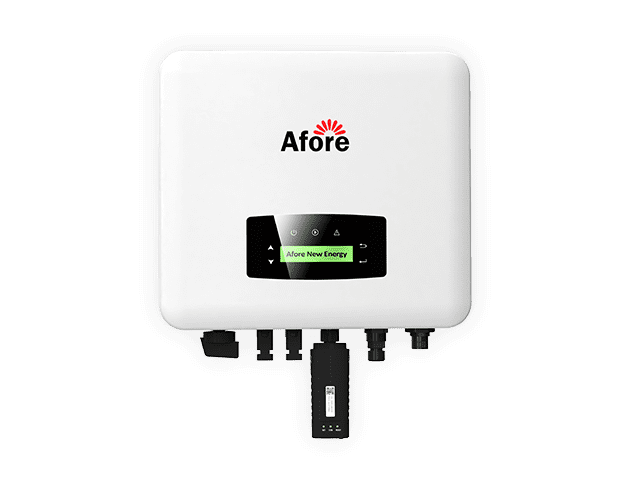
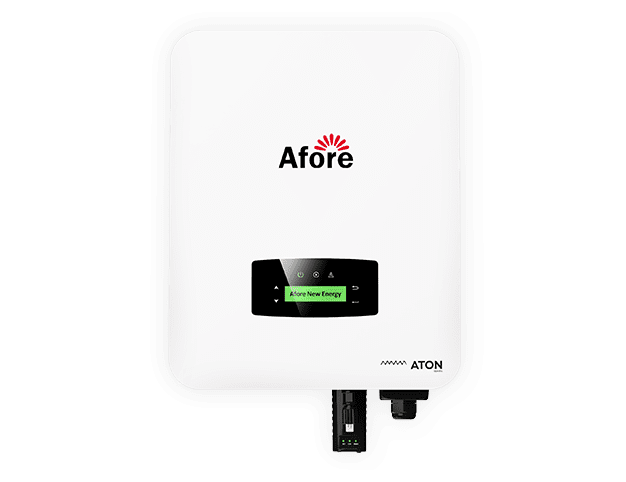
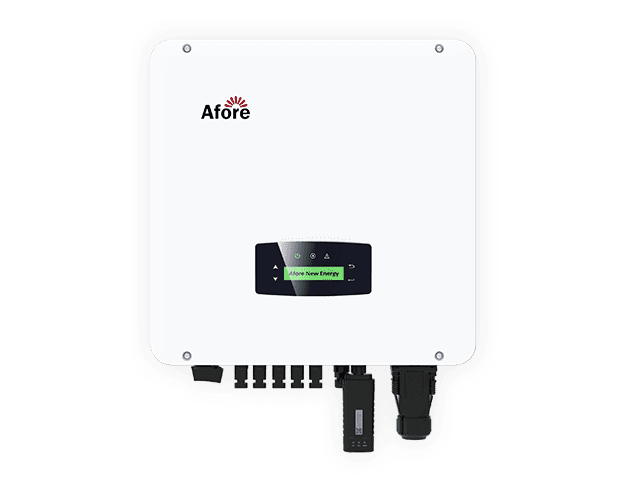
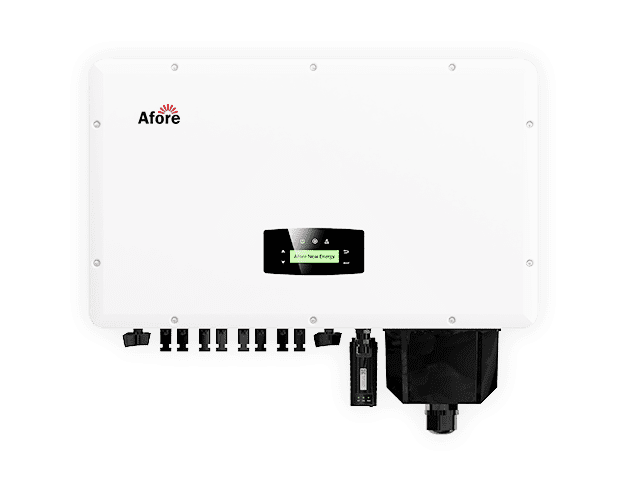
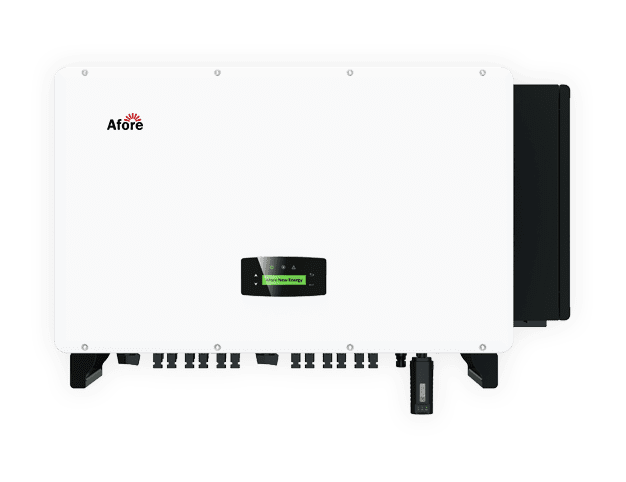
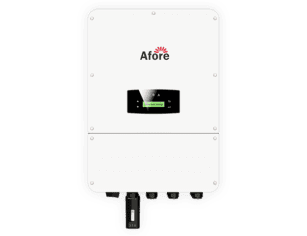
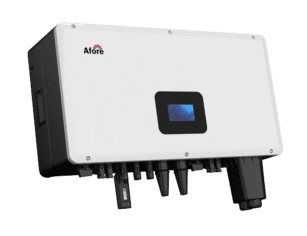
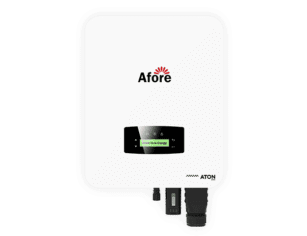
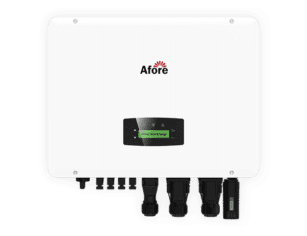
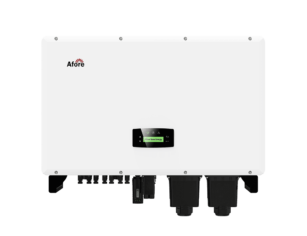
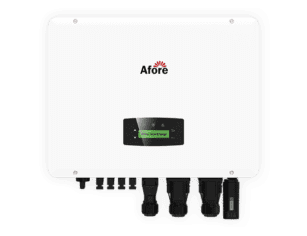
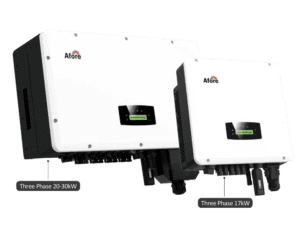
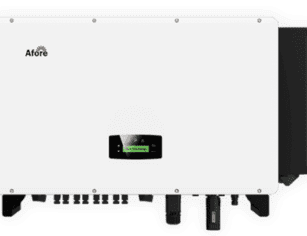
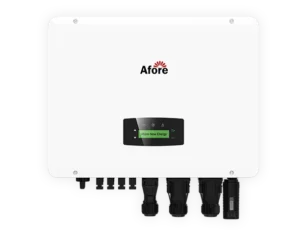
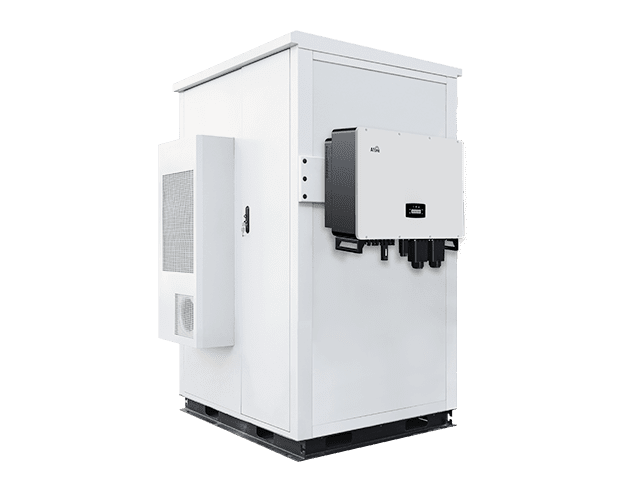
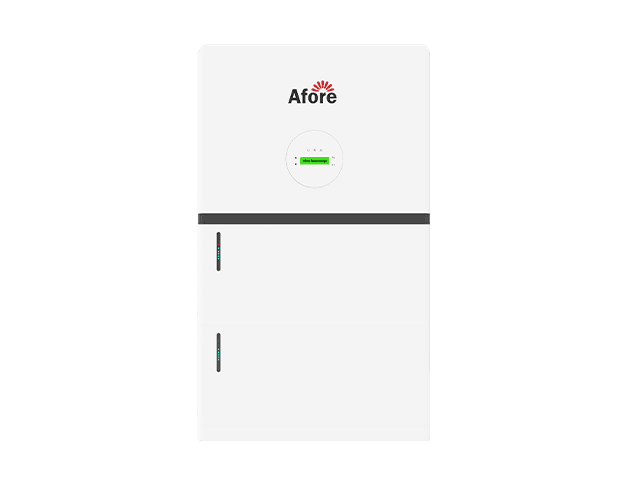
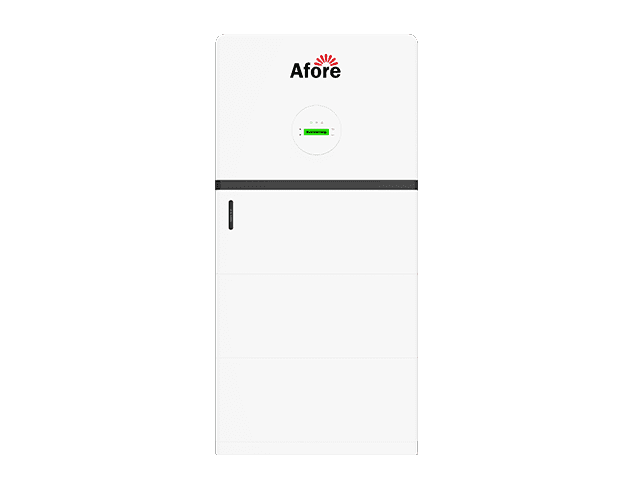
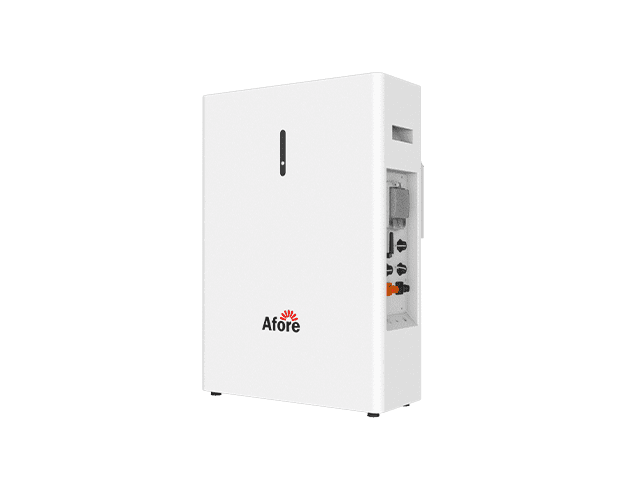
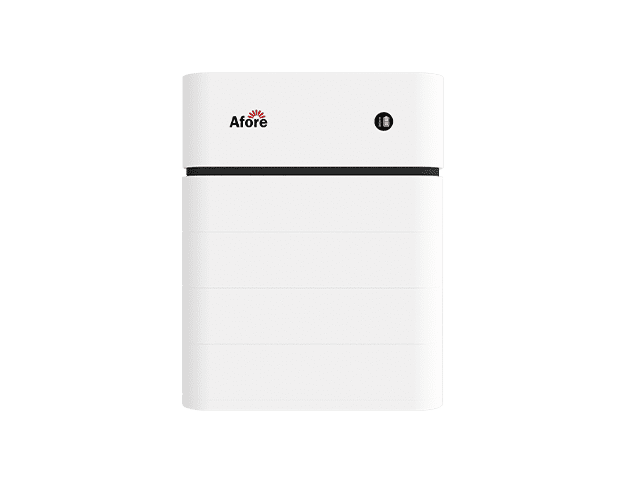
Hybrid systems are highly scalable because they support phased expansion without requiring major redesigns to the original power infrastructure. Businesses can start with solar generation and later integrate batteries, EV charging, or advanced energy management functions as operational demands increase. Many installers also highlight Afore string inverter advantages in commercial projects due to flexible system sizing, centralized monitoring, and compatibility with evolving grid-interactive energy strategies supported by modern commercial PV ROI study models.
https://www.energy.gov/eere/solar/solar-integration-inverters-and-grid-services-basics
https://standards.ieee.org/standard/1547-2018.html
https://www.nfpa.org/codes-and-standards/nfpa-70-standard-development/70








 Turkish
  Romanian