




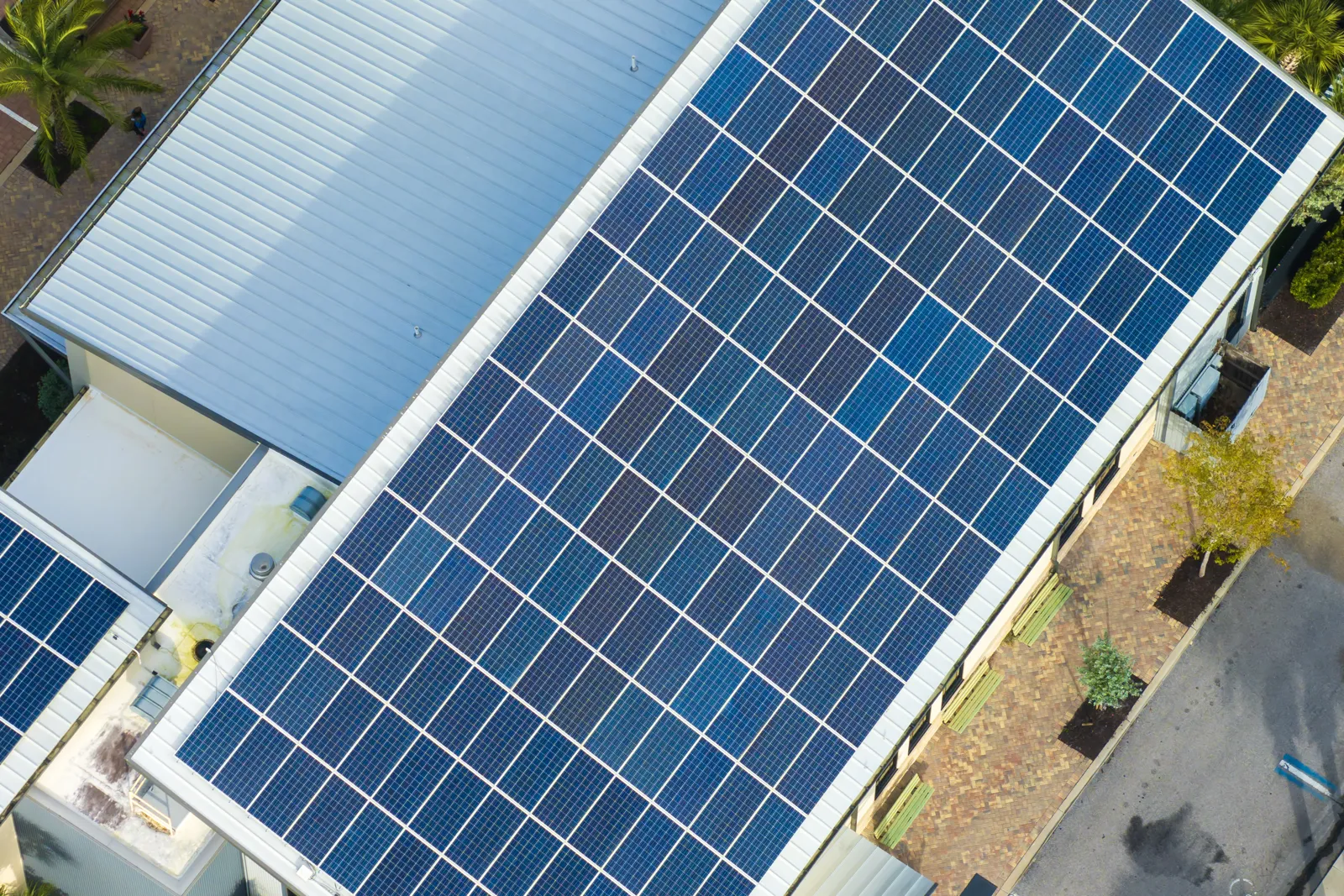
For EPCs, solar installers, resellers, and commercial or industrial project owners, low voltage vs high voltage ess is not a simple battery specification question. As the core of professional B2B energy storage design, it affects inverter selection, DC cable sizing, protection design, installation labor, commissioning risk, safety procedures, future expansion, and the financial performance of a PV-plus-storage project.
A low-voltage energy storage system is often associated with 48 V or 51.2 V lithium battery modules, although some product categories extend higher depending on the market and application. A high-voltage ESS usually uses stacked battery modules operating at several hundred volts, and larger commercial or utility-style systems may operate at even higher DC ranges depending on the inverter, PCS, and system architecture. Formal voltage definitions vary by electrical code, DC or AC context, and regional standard, so EPCs should always verify the actual manufacturer voltage range rather than relying only on the terms “low voltage” or “high voltage.”
In practical commercial PV design, the core difference is straightforward: for the same power output, a lower battery voltage requires higher current. Higher current increases conductor size, heat generation, voltage drop, and protection-device requirements. A high-voltage battery storage architecture reduces current for the same power, which can improve efficiency and scalability, especially in medium and large C&I solar storage solutions. However, high voltage also introduces stricter insulation, commissioning, lockout/tagout, arc-risk, and technician-training requirements.
The best choice depends on the site. A small retail shop needing backup and basic self-consumption may achieve better economics with a low-voltage lithium battery system because it is simpler and easier to service. A warehouse, factory, EV charging hub, or commercial building with peak-shaving requirements will often benefit from a high-voltage ESS because the system must deliver higher power, operate efficiently, and expand over time.
Understanding the essential differences between two mainstream ESS types helps industry buyers and installers make targeted selections for diverse PV projects.
The main difference between low-voltage and high-voltage ESS is the operating voltage of the battery system and the resulting current required to deliver power. A 10 kW load supplied by a 48 V battery system may require more than 200 A before conversion losses and system derating are considered. The same 10 kW load supplied from a 500 V battery bus requires roughly 20 A. This electrical relationship, expressed as power equals voltage multiplied by current, explains why voltage architecture has such a large impact on system design, which serves as the core basis for commercial battery voltage comparison and practical analysis of 48V vs 400V battery systems.
In commercial energy storage, low-voltage ESS commonly refers to modular 48 V or 51.2 V-class battery systems used with compatible hybrid inverters or battery inverters. These systems are familiar to many installers and can be practical for small commercial buildings, telecom backup, rural sites, and light self-consumption applications.
High-voltage ESS typically uses battery modules connected in series to create a battery string operating at several hundred volts. In larger PV energy storage system design, this voltage range can align more efficiently with commercial inversores híbridos, power conversion systems, and DC bus architectures. The result is lower current, smaller cable cross-sections in many cases, reduced current-related losses, and better suitability for higher power output.
A practical comparison is shown below. Actual limits vary by manufacturer, local code, and system certification.
| Factor de diseño | Low-voltage ESS | High-voltage ESS |
|---|---|---|
| Common battery class | 48 V / 51.2 V modules | Several hundred volts or higher |
| Current at same power | Más alto | Baja |
| Typical fit | Small commercial, telecom, backup, rural sites | Medium and large C&I, peak shaving, EV charging, industrial loads |
| Cable and busbar demand | Often larger due to high current | Often lower current, but higher insulation rating |
| Complejidad de la instalación | Usually simpler | Higher training and commissioning discipline |
| Escalabilidad | Good for small modular systems | Stronger for larger rack or cabinet systems |
| Safety focus | Short-circuit current, overheating, terminal torque | Insulation, arc risk, pre-charge, HV isolation |
| Main economic advantage | Lower complexity at small scale | Better lifecycle value at larger scale |
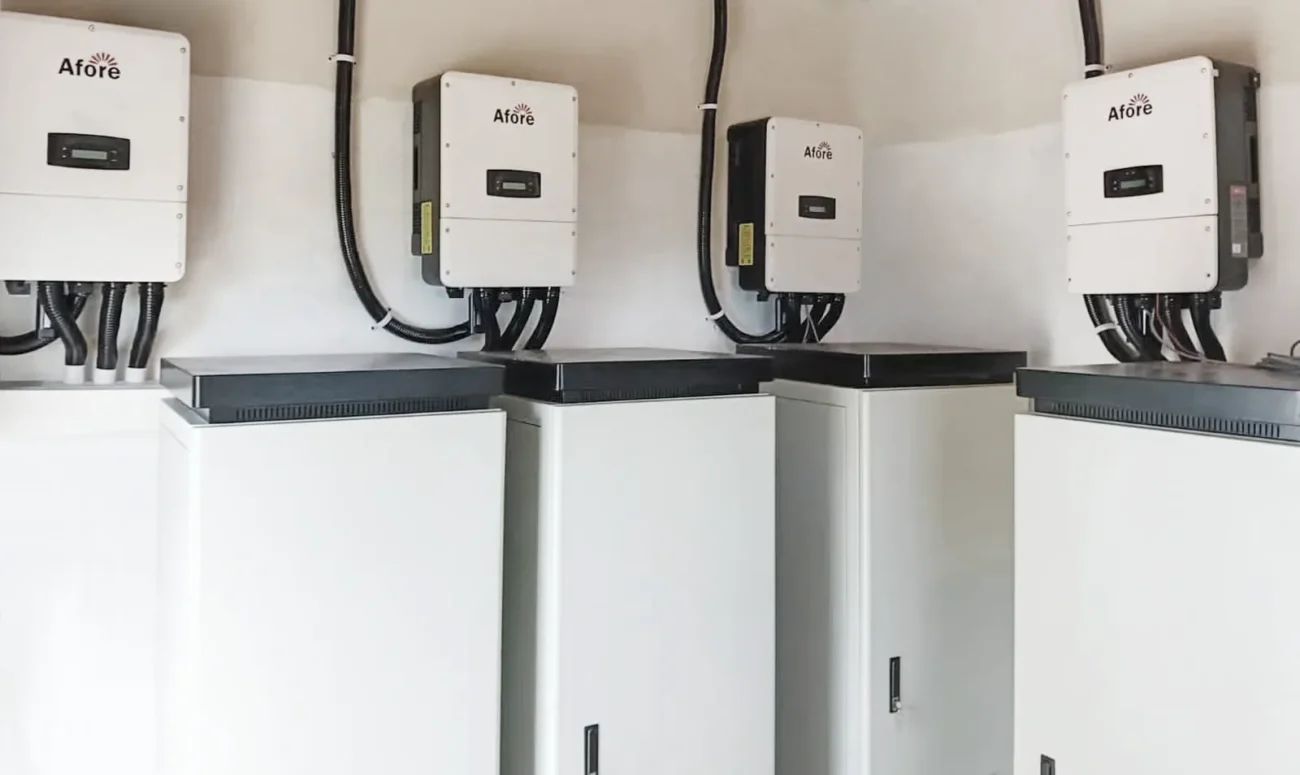
EPCs should consider low-voltage ESS when the project is relatively small, the load profile is predictable, and installation simplicity is more important than maximum power density. This includes small offices, retail shops, farms, remote buildings, telecom sites, and backup-focused systems where the battery does not need to deliver large discharge power for long periods.
Low-voltage systems are often easier to handle on site because modules are smaller and more familiar to technicians. Replacement can also be more straightforward in small installations, especially where the project owner needs a practical service model rather than a complex centralized battery room. For resellers and installers, the broader familiarity of 48 V-class battery systems can reduce training barriers and support faster deployment in small projects.
However, low voltage should not be selected only because the battery unit price appears lower. At higher power levels, the system may require larger DC cables, more robust busbars, higher current-rated fuses and breakers, and more attention to thermal management. These balance-of-system costs can offset the apparent product-level savings.
High-voltage ESS is generally better for commercial PV projects where the system must deliver higher power, support longer cable runs, integrate with commercial PCS or hybrid inverters, and remain scalable over the project life. This is common in warehouses, manufacturing facilities, logistics centers, multi-building sites, cold storage facilities, commercial campuses, and EV charging locations.
For peak shaving, the battery must respond quickly and discharge at meaningful power levels during short demand spikes. A high-voltage battery storage system is usually better suited to that role because it can deliver higher power with lower current stress. For time-of-use optimization and PV self-consumption, high-voltage architecture can also support larger usable capacity blocks and better system-level efficiency, although total performance still depends on inverter topology, HVAC consumption, control strategy, and battery chemistry.
High-voltage ESS is not automatically superior in every project. It requires appropriate design, certified equipment, skilled commissioning, and stronger safety procedures. But when the project scale justifies it, high-voltage architecture often provides better long-term value through reduced losses, easier expansion, and stronger compatibility with commercial energy management systems.
To design a stable, efficient and cost-effective PV energy storage system, it is necessary to sort out core technical principles first, and then match suitable design schemes according to actual project conditions.
The electrical foundation of the low voltage vs high voltage ESS decision is simple but important. For a given power output, lower voltage requires higher current. Higher current increases I²R losses, meaning losses rise with the square of current. If current doubles, resistive heating can increase by four times, assuming resistance remains constant.
This has practical implications for commercial PV projects. Higher current may require larger cable cross-sections, shorter cable routes, stricter derating, better ventilation around conductors, and more careful termination. It can also increase voltage drop, especially where battery cabinets or racks are installed away from the inverter or electrical room.
High-voltage ESS reduces current for the same power output. In larger systems, this can improve round-trip efficiency and reduce heat stress in conductors and power electronics, directly reflecting the outstanding efficiency of HV storage in commercial PV scenarios.
Technical studies and government energy-storage cost models commonly show that system-level performance depends on much more than battery cells alone, including PCS efficiency, auxiliary loads, and operating strategy.
The key point for EPCs is that voltage architecture should be evaluated at the system level. Cell efficiency, battery-module efficiency, inverter efficiency, cable losses, HVAC loads, and EMS dispatch logic all affect the delivered value of the commercial battery energy storage system.
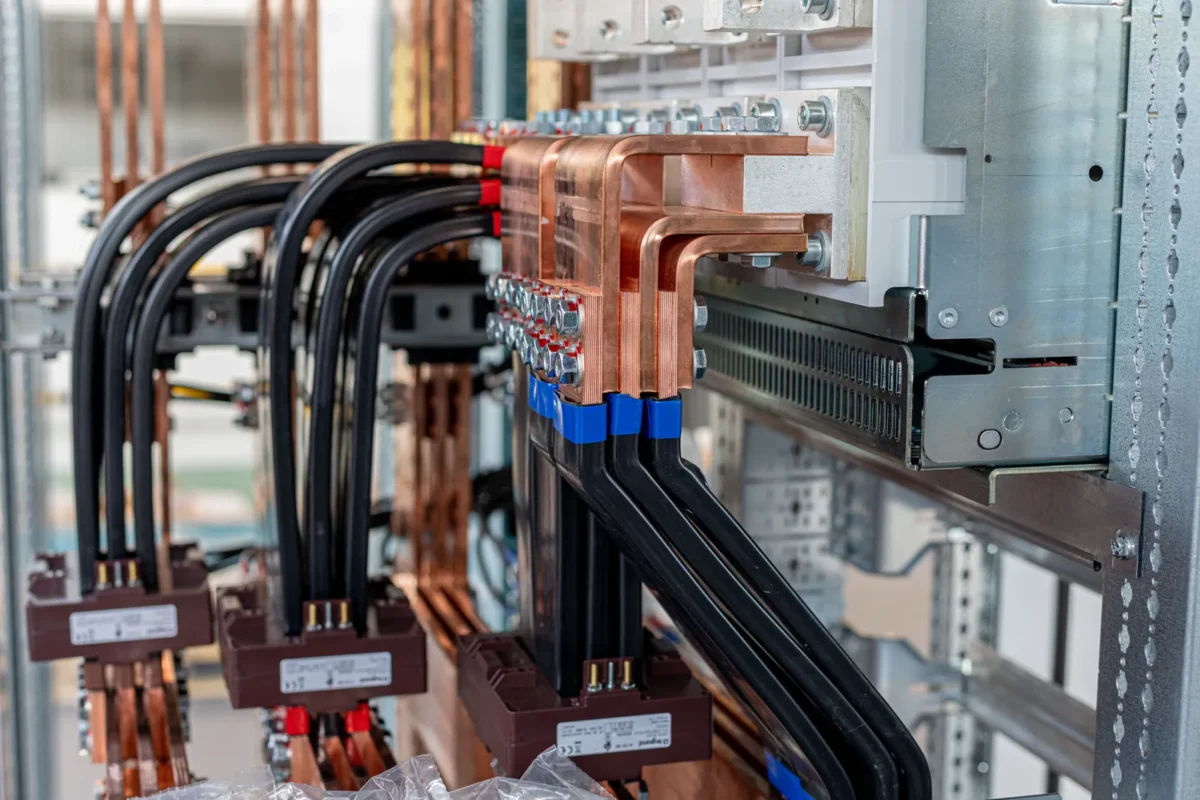
Battery voltage must match the operating range of the inverter or power conversion system. A low-voltage lithium battery system usually requires an inverter designed for that battery voltage class. A high-voltage ESS requires an inverter or PCS with an appropriate DC input range, pre-charge logic, BMS communication compatibility, and safety functions.
In professional PV projects, compatibility is not limited to voltage. The battery management system must communicate correctly with the inverter or PCS through supported protocols such as CAN or RS485, depending on the product design. Firmware versions, battery addressing, charge and discharge limits, temperature alarms, SOC reporting, and protection events must all be recognized by the inverter or EMS.
Many commissioning delays in C&I solar storage solutions are caused not by the battery chemistry but by communication mismatch. A battery may physically connect to an inverter yet fail to operate correctly if the firmware version is unsupported, the BMS protocol is not validated, or the inverter cannot interpret the battery’s operating limits. For EPCs, a verified compatibility list and written supplier confirmation are essential before procurement.
The project architecture also matters. In a DC-coupled system, PV and battery energy may share parts of the DC conversion path, which can improve PV-to-battery charging efficiency in some designs. In an AC-coupled system, the battery connects through a separate battery inverter or PCS on the AC side, which can simplify retrofits and allow storage to be added to existing PV assets.
A commercial PV storage system should be sized around the business objective, not around a generic battery capacity. EPCs should begin with the site’s load profile, PV generation curve, grid export limits, tariff structure, backup requirements, and expected cycling pattern.
For a backup-focused small commercial site, the key design question may be how many critical loads must operate and for how long. In this case, low-voltage ESS may be commercially reasonable if the required discharge power is modest. For a factory trying to reduce demand charges, the key question is how much power must be discharged during short peak intervals. In that case, high-voltage ESS is often more appropriate because power capability is as important as energy capacity.
A simplified sizing view is useful, but rigid thresholds should be avoided because manufacturer designs and grid rules vary.
| Project profile | Common priority | Likely ESS fit |
|---|---|---|
| Small shop or office backup | Simplicity and basic autonomy | Low-voltage ESS often suitable |
| Telecom or rural facility | Modular replacement and reliability | Low-voltage ESS often suitable |
| Medium commercial PV with peak shaving | Higher discharge power and efficiency | High-voltage ESS often preferred |
| Factory or warehouse | Demand management and scalability | High-voltage ESS usually preferred |
| EV charging hub or microgrid | High power, fast response, EMS integration | High-voltage ESS usually preferred |
The battery should also be evaluated by usable capacity, not only nominal capacity. Depth of discharge limits, temperature derating, minimum reserve SOC, inverter power limits, and warranty throughput can all reduce the capacity available for daily operation.
Voltage architecture directly affects balance-of-system cost. In low-voltage systems, higher current may increase the required cable size, cable tray capacity, busbar rating, fuse rating, disconnect rating, and installation labor. These factors become more significant as power output increases.
High-voltage systems can reduce current and cable losses, but they require equipment rated for higher DC voltage. This includes DC disconnects, fuses, insulation, surge protection, contactors, pre-charge circuits, insulation monitoring, and appropriately rated test equipment. The cost advantage therefore depends on project scale. On a small scale, low-voltage simplicity may reduce total installed cost. At larger scale, high-voltage architecture may reduce BOS cost and improve lifecycle efficiency enough to justify the added safety and commissioning requirements.
For EPCs comparing quotations, the correct metric is not battery price per kWh alone. It is total installed cost per usable kWh and usable kW, including protection devices, cables, enclosures, HVAC, commissioning, monitoring, and future service requirements.
Different project scales and usage goals decide the most suitable ESS type for on-site deployment.
Low-voltage ESS can be a practical fit for small commercial buildings where the electrical load is moderate and installation access is limited. A retail shop with daytime PV generation and evening consumption may use storage primarily for self-consumption and short backup. A farm office or rural workshop may need a simple storage system for outages or weak-grid conditions. A telecom facility may prioritize modular replacement and reliable autonomy over high discharge power.
In these scenarios, low-voltage battery modules can be easier to transport, mount, and replace. Installers may already be familiar with the wiring practices, torque requirements, and inverter setup. For resellers, low-voltage systems can also be easier to support across many small sites if the product ecosystem is standardized.
The limitation appears when the customer wants the system to grow. Adding more battery modules in parallel can increase capacity, but inverter limits, current limits, cable sizing, and communication constraints may restrict expansion. EPCs should check the maximum number of parallel battery strings, allowable current, recommended cable length, and supported inverter capacity before promising future upgrades.
High-voltage ESS becomes more attractive as project power increases. In a warehouse, demand charges may be driven by brief peaks from HVAC, refrigeration, compressors, elevators, or production equipment. In a factory, peak shaving and time-of-use arbitrage may require high discharge power during specific operating windows. In a logistics center, PV generation may be high during the day while EV charging or equipment loads create power peaks.
These applications require more than stored energy. They require a storage system that can discharge at the right power level, respond quickly, communicate with an energy management system, and operate reliably under frequent cycling. High-voltage battery storage is often preferred because it aligns better with commercial inverters and centralized PCS designs.
It also supports cleaner expansion planning. A project may begin with one cabinet or rack group and later add capacity if the facility expands or tariff conditions change. Expansion must still follow manufacturer rules for module matching, SOC alignment, firmware version, and cabinet configuration. But compared with large arrays of low-voltage parallel strings, high-voltage rack or cabinet architecture is often more manageable in larger C&I deployments.
The low voltage vs high voltage ESS decision interacts with whether the system is AC-coupled or DC-coupled. AC-coupled storage connects to the AC side through a battery inverter or PCS. This can be attractive for retrofit projects because it allows storage to be added to an existing PV installation without redesigning the PV DC string architecture. It can also simplify metering and control in some commercial buildings.
DC-coupled storage connects on the DC side, depending on inverter topology. It may improve efficiency when charging the battery directly from PV because fewer conversion stages are required. It can also help manage export limits by storing excess PV before conversion to AC. However, DC-coupled systems require careful compatibility between PV strings, battery voltage, hybrid inverter input range, and protection design.
High-voltage ESS is common in larger DC-coupled or PCS-based architectures because the battery voltage can better align with commercial inverter operating ranges. Low-voltage ESS is more common in smaller hybrid systems where the inverter is designed specifically for 48 V-class batteries.
The correct ESS voltage depends on the business case. Backup-focused systems prioritize reliable operation during outages, safe isolation, black-start capability where required, and clear definition of critical loads. Self-consumption projects prioritize energy capacity, cycling efficiency, and the ability to store daytime PV for later use. Peak-shaving systems prioritize power output, response time, and control accuracy.
For example, a small clinic may need backup for lighting, IT, refrigeration, and essential equipment. A low-voltage ESS may be sufficient if the critical load panel is modest. A manufacturing plant, however, may need to reduce a 300 kW demand spike for 30 minutes during production startup. A high-voltage ESS would generally be more suitable because the project is driven by power, not just energy.
This is why EPCs should model the load profile before selecting voltage architecture. Choosing a battery voltage before understanding the load often leads to oversizing, redesign, or poor ROI.
Strict safety norms and regulatory compliance are prerequisites for stable grid-connected operation of energy storage systems.
Commercial battery energy storage systems must comply with product safety, electrical, fire, and grid-interconnection requirements. Relevant standards may include IEC 62619 for industrial lithium battery safety, IEC 62933 for electrical energy storage systems, UL 1973 for stationary battery safety, UL 9540 for ESS safety, UL 9540A for thermal runaway fire propagation testing, NFPA 855 for stationary energy storage installation, and local grid or building codes.
The required certification set depends on country, utility, building type, system size, indoor or outdoor installation, and whether the ESS provides backup or grid services. EPCs should confirm not only that a certificate exists but also that it applies to the exact battery model, inverter or PCS combination, enclosure configuration, and installation method being quoted. Standards information for battery safety and ESS installation should be checked directly with recognized standards organizations, such as IEC and NFPA.
Commercial projects are often delayed when certification scope is unclear. A battery cell certificate is not the same as a battery-module certificate, and a module certificate is not always sufficient for a complete ESS installation. The integration of battery, BMS, inverter, enclosure, fire protection, and control system must be considered.
High-voltage ESS requires disciplined safety design. The main risks include electric shock, arc flash, insulation failure, DC arcing during switching, incorrect commissioning sequence, and stored-energy hazards. Because DC arcs can be difficult to extinguish, protection-device selection and isolation procedures are critical.
A high-voltage system should include appropriate DC disconnects, contactors, pre-charge circuits, fuses, insulation monitoring, emergency shutdown functions, and clear lockout/tagout procedures. Technicians need suitable personal protective equipment, voltage-rated tools, and test instruments. Commissioning should follow a formal sequence that verifies battery-module order, DC polarity, grounding or isolation configuration, BMS communication, inverter settings, and emergency stop functions.
High-voltage ESS is safe when designed, installed, and maintained correctly. The risk arises when project teams treat it like a larger version of a low-voltage battery. It is not. The commissioning process is more sensitive, and the consequences of incorrect handling are higher.

Low voltage does not mean risk-free. A 48 V battery system can deliver very high short-circuit current. Poor terminal torque, undersized cables, loose connectors, inadequate fusing, or poor ventilation can cause overheating and thermal events. In dense battery installations, high current can become a serious safety and reliability issue.
Installers should verify cable ratings, fuse coordination, breaker capacity, terminal torque, enclosure IP rating, battery spacing, ambient temperature limits, and ventilation. They should also confirm that battery modules are compatible in age, firmware, SOC, and capacity when paralleled. Mixing modules without manufacturer approval can cause imbalance and nuisance shutdowns.
For small commercial projects, the simplicity of low-voltage ESS is an advantage only if installation quality remains high. Many avoidable failures come from basic workmanship issues rather than advanced technical problems.
Standards depend on region and application. In the United States, electrical installation, fire-code requirements, utility interconnection rules, and equipment safety listings may all apply. In Europe and other IEC-oriented markets, relevant IEC standards, national grid codes, CE-related requirements, and local fire-safety rules may govern the installation. For grid-connected systems, interconnection requirements can include anti-islanding, power quality, ride-through behavior, metering, and remote-control capability.
For systems providing grid services, aggregation, or demand response, additional energy-market rules may apply. In the U.S., FERC Order 2222 is relevant to distributed energy resource participation in wholesale markets, although implementation varies by region.
The practical advice is simple: verify the local electrical code, fire code, grid interconnection requirements, product certifications, inverter approvals, and utility documentation before procurement. Compliance should be confirmed before equipment is ordered, not after it arrives on site.
On-site construction difficulty and later maintenance convenience are key factors affecting project overall efficiency.
Low-voltage ESS is usually more familiar to installers. The commissioning process may still require battery addressing, inverter setup, communication checks, SOC calibration, and firmware verification, but the safety procedures are generally less complex than high-voltage commissioning.
High-voltage ESS typically requires more advanced training. Technicians must understand series-connected battery strings, pre-charge behavior, contactor logic, insulation resistance, DC isolation, and emergency shutdown. They must also follow the correct module stacking sequence and verify that all communication and power connections are made before energization.
A typical professional commissioning process includes visual inspection, mechanical torque verification, polarity checks, insulation tests where required, BMS addressing, firmware confirmation, inverter communication validation, grid-code setting verification, controlled first charge, controlled first discharge, and monitoring-platform activation. Skipping these steps can cause nuisance alarms, battery lockout, inverter faults, or unsafe operating conditions.
Commercial PV projects must treat ESS placement as part of the electrical and building design. Battery cabinets or racks need adequate clearance, access for service, cable routing, emergency access, and environmental protection. Indoor installations may require fire separation, ventilation, gas detection, or suppression depending on local rules and system type. Outdoor installations need suitable IP ratings, corrosion resistance, shade or thermal protection, and drainage planning.
Temperature directly affects battery performance and cycle life. High ambient temperature accelerates degradation, while low temperature may reduce charge acceptance or require heating. HVAC or forced-air cooling may improve battery life but adds auxiliary energy consumption and maintenance requirements.
The correct enclosure design depends on chemistry, cabinet format, project size, local climate, fire-code requirements, and service access. EPCs should avoid placing battery systems where future maintenance will be difficult, even if the initial installation appears convenient.
Battery logistics can affect project delivery. Low-voltage modules are often easier to carry into small electrical rooms or remote buildings. This is useful where forklifts or lifting equipment cannot be used. For distributed small commercial sites, modular low-voltage systems can simplify replacement and spare-parts planning.
High-voltage ESS often arrives as rack-based or cabinet-based equipment. This can streamline large installations if the site has proper access, foundations, lifting equipment, and cable routes. However, logistics must be planned early. Cabinet weight, shipping restrictions, crane access, floor loading, and weather exposure during installation can all affect schedule and cost.
Expansion should also be planned from day one. If the project owner expects to add PV capacity, EV charging, or production equipment, the EPC should reserve physical space, inverter capacity, switchgear capacity, monitoring channels, and cable routes. Future expansion is much cheaper when the original design allows for it.
The most common commissioning problems are predictable. They include inverter-BMS mismatch, incorrect battery addressing, wrong DC polarity, incomplete firmware updates, communication cable errors, undervoltage lockout, unbalanced modules, incorrect grid-code settings, and incomplete meter configuration.
These issues can delay project handover and create disputes between the battery supplier, inverter supplier, EPC, and project owner. To reduce risk, EPCs should use a pre-commissioning checklist, request factory acceptance documentation, confirm compatibility before shipment, and ensure that supplier technical support is available during energization.
For commercial projects, commissioning quality directly affects revenue. A storage system that cannot operate during the first billing cycle may miss demand-charge savings or backup-readiness targets.
System operating performance and long-term operation maintenance directly decide the whole-life economic benefit of energy storage projects.
Round-trip efficiency and energy losses over project lifeHigh-voltage ESS can reduce current-related losses, especially in larger systems. However, total round-trip efficiency is determined by the full energy path. Battery cell losses, BMS consumption, DC cabling, PCS efficiency, transformer losses, HVAC loads, and EMS dispatch strategy all matter.A high-voltage system with poor thermal management or inefficient controls may underperform a well-designed lower-voltage system at smaller scale. Likewise, a low-voltage system pushed to high current for long periods may suffer from excess heat and reduced efficiency.
Unified industry-standard performance assumptions for commercial PV energy storage are defined as follows, covering mainstream application scenarios:
Professional buyers should request measured system-level efficiency data where available. They should also ask whether the stated efficiency includes auxiliary consumption, temperature conditions, operating power level, and conversion stages. Cell-level efficiency alone is not enough for financial modeling.
The battery management system is central to ESS reliability. It monitors cell and module voltage, temperature, current, SOC, SOH, balancing status, alarms, and protection events. In high-voltage systems, the BMS also coordinates contactors, pre-charge functions, insulation monitoring, and string-level protection.
For commercial PV projects, remote diagnostics are increasingly important. EPCs and fleet operators need access to event logs, operating history, alarm codes, SOC and SOH trends, charge/discharge records, and firmware status. Cloud monitoring, local data export, API access, and EMS integration can reduce truck rolls and improve uptime.
Monitoring should be evaluated during procurement. A low battery price is less attractive if the system provides limited diagnostics and every fault requires a site visit.
Battery lifecycle value depends on usable capacity, cycle life, allowable depth of discharge, C-rate limits, temperature conditions, and warranty throughput. Many lithium ESS products advertise high cycle numbers, but those figures are valid only under specific conditions. Daily peak shaving at high C-rate and high ambient temperature may produce different degradation than moderate self-consumption cycling.
EPCs should compare warranties based on the actual operating profile. Important details include the warranted energy throughput, remaining capacity at warranty end, maximum operating temperature, required maintenance, communication requirements, and exclusions for improper installation or unsupported inverter use.
The financial model should calculate cost per usable kWh over the warranty period, not simply battery price per nominal kWh.
Low-voltage ESS may be easier to maintain in small sites because modules are simpler to isolate, remove, and replace. Installers may not need the same level of high-voltage certification, and spare modules can be stocked for distributed service networks.
High-voltage ESS can be easier to manage across larger commercial portfolios because monitoring is often more centralized and system architecture is more standardized. Faults can be diagnosed at rack, string, or cabinet level, and service planning can be integrated into a broader O&M workflow.
The easier option depends on technician training, spare-parts availability, supplier support, monitoring quality, and the number of sites being managed. For a single small business, low-voltage serviceability may be attractive. For an EPC managing multiple C&I storage assets, standardized high-voltage platforms may reduce long-term O&M complexity.
System operating performance and long-term operation maintenance directly decide the whole-life economic benefit of energy storage projects.
Low-voltage ESS may look cheaper at the battery-product level. However, total installed cost includes cables, busbars, protection devices, enclosures, inverter compatibility, labor, commissioning, monitoring, and future service. At higher power levels, the additional copper, current-rated protection, and labor can reduce or eliminate the product-price advantage.High-voltage ESS may have higher equipment complexity, but it can reduce cable losses and improve power scalability in larger installations. It may also integrate more naturally with commercial PCS platforms and energy management systems. For medium and large C&I projects, total lifecycle cost is often more relevant than initial battery price.
Based on official NREL energy storage cost benchmarks, the core cost gap between low voltage and high voltage ESS is summarized in the table below:
| Cost & Energy Item | Low Voltage ESS | High Voltage ESS | NREL Benchmark Note |
|---|---|---|---|
| DC Conductor Cost | Higher, large-size cables required | Lower, smaller cable specifications fit | Current rise directly boosts copper material input |
| Protection Devices Cost | High-current rated fuse, breaker with high expense | Standard high-voltage protective devices, moderate cost | LV needs overcurrent reinforced protection |
| PCS/Inverter Cost | Low-cost dedicated low-voltage inverter | High-efficiency commercial-grade PCS, higher unit price | HV matches mainstream large-scale storage inverter |
| Commissioning Labor Cost | Low technical threshold, lower labor fee | Strict safety operation, skilled labor required, higher cost | HV needs insulation test and lockout-tagout procedures |
| Auxiliary Energy Consumption | Moderate heat loss, basic auxiliary power | Lower running loss, stable auxiliary energy input | Large-scale HV system has better overall energy saving effect |
Extended installed cost classification for commercial ESS projects covers five core categories: battery pack cost, PCS equipment cost, balance-of-system (BOS) cost, engineering-procurement-construction cost and long-term operation & maintenance cost. Each category varies obviously in quota allocation between low voltage and high voltage energy storage solutions, which is the core basis for overall project budget accounting and investment return calculation.A quotation comparison should separate nominal capacity, usable capacity, continuous power, peak power, included BOS components, commissioning scope, monitoring fees, warranty coverage, and expansion limits.
OPEX includes preventive maintenance, inspection, monitoring subscriptions, HVAC energy use, spare parts, firmware management, and eventual module replacement. Battery degradation also has economic value because reduced usable capacity may reduce demand-charge savings or backup duration over time.
Replacement planning should be part of the original financial model. Project owners should understand whether battery modules can be replaced individually, whether future modules must match the original type, and whether the supplier commits to spare-parts availability. For high-voltage systems, replacement may require trained personnel and a formal shutdown procedure. For low-voltage systems, replacement may be simpler but still must follow manufacturer instructions.
The main ROI drivers for C&I solar storage are peak shaving, demand-charge reduction, time-of-use arbitrage, increased PV self-consumption, backup value, avoided diesel generator use, and grid-service participation where allowed. Voltage choice affects ROI indirectly through efficiency, CAPEX, uptime, scalability, and maintenance cost.
A high-voltage ESS may improve ROI in a large project by reducing losses, supporting higher discharge power, and enabling future expansion. A low-voltage ESS may improve ROI in a small project by reducing complexity, simplifying installation, and avoiding unnecessary high-voltage design costs.
The correct financial model should include tariff structure, maximum demand charges, PV generation profile, load variability, expected cycling, degradation, downtime assumptions, and replacement cost.
High-voltage ESS does not always deliver better payback. For small loads, the added safety procedures, equipment complexity, and technician requirements may not be justified. A low-voltage ESS can deliver better economics when the project requires modest power, simple backup, and limited expansion.
For larger C&I sites, high-voltage ESS often provides stronger lifecycle value because current-related losses, cable costs, and scalability constraints become more important. The payback advantage appears when the facility needs higher power discharge, frequent cycling, and commercial-grade monitoring.
The decision should be validated through site-specific modeling. Voltage alone does not determine payback; the use case does.
Scientific purchasing standards and reliable supplier resources help projects avoid hidden risks and achieve stable long-term cooperation.
Resellers and distributors should evaluate more than battery price. Important criteria include voltage range, usable capacity, maximum charge and discharge power, compatible inverter list, communication protocols, certification scope, warranty terms, monitoring platform, firmware update policy, technical documentation, and spare-parts availability.
Channel readiness matters. A product may perform well technically but still create business risk if installers lack training, documentation is incomplete, warranty claims are unclear, or technical support is slow. For commercial PV storage, downtime affects financial performance, so after-sales support is part of the product value.
EPCs should evaluate supplier track record, regional service capability, RMA process, commissioning support, warranty transparency, and technical response time. Commercial project owners expect predictable operation for many years. If a battery system fails during a high-demand billing period, the financial impact can be significant.
A bankable supplier should provide clear installation manuals, electrical diagrams, commissioning procedures, certificates, monitoring documentation, and fault-resolution processes. For high-voltage ESS, supplier-assisted commissioning may be valuable, especially for first projects or complex grid-connected installations.
Commercial PV storage depends on validated compatibility between batteries, inverters, PCS platforms, meters, EMS software, and grid-control systems. Communication mismatch can cause commissioning delays, limited operating modes, inaccurate SOC reporting, or warranty disputes.
Before procurement, EPCs should obtain written confirmation that the selected battery model, inverter or PCS model, firmware version, and EMS configuration are supported together. For projects with export control, peak shaving, or backup transfer, the metering and control logic should also be reviewed.
EPCs should compare quotations using the technical and commercial variables that affect delivered performance. The following checklist is useful during bid evaluation:
| Quotation item | Por qué es importante |
|---|---|
| Usable capacity, not only nominal capacity | Determines real operating value |
| Continuous and peak power rating | Determines peak-shaving and backup capability |
| C-rate limits | Affects discharge performance and degradation |
| Battery voltage range | Must match inverter or PCS |
| Certification scope | Must cover project requirements |
| Warranty throughput | Determines lifecycle economics |
| Included BOS components | Affects total installed cost |
| Monitoring fees | Affects OPEX |
| Commissioning support | Reduces handover risk |
| Expansion limit | Determines long-term flexibility |
A lower-priced quotation may be more expensive over the project life if it requires additional BOS, has limited warranty coverage, or lacks verified compatibility.
Reasonable layout planning lays a solid foundation for system capacity expansion and multi-project unified deployment.
Low-voltage systems can support modular expansion, but current, cable, inverter, and communication limits eventually become constraints. Adding more parallel strings may increase capacity, but it can also complicate current sharing, protection coordination, and battery balancing.
High-voltage systems are often better suited to scalable rack or cabinet designs. However, expansion must follow manufacturer rules. New modules may need to match existing modules in voltage, SOC, firmware, capacity, and age. Adding cabinets may require PCS capacity, switchgear capacity, EMS configuration, and updated protection studies.
EPCs should clarify expansion rules before selling a phased project. “Expandable” does not mean unlimited.
For EPCs and resellers working across multiple commercial sites, standardization reduces risk. Using repeatable ESS architectures improves procurement efficiency, installer training, commissioning workflows, spare-parts planning, monitoring setup, and performance benchmarking.
A portfolio of small retail sites may benefit from standardized low-voltage ESS packages. A portfolio of warehouses or manufacturing sites may benefit from standardized high-voltage cabinets and PCS configurations. The best architecture depends on site similarity, tariff structure, available space, and O&M strategy.
High-voltage ESS is often preferred in EV charging hubs, microgrids, diesel-PV-storage hybrid systems, and industrial backup because these applications require higher power density, fast response, and advanced control. The battery must interact with chargers, generators, PV inverters, grid meters, and EMS platforms.
Low-voltage ESS can still play a role in edge loads, small backup circuits, telecom assets, or distributed smaller systems within a larger facility. In some projects, a combination of architectures may be used, but mixed-voltage systems require careful engineering and clear responsibility for controls and maintenance.
High-voltage ESS generally offers stronger expansion potential for growing C&I loads because it supports higher power, lower current, and more centralized system design. It is usually the better fit where the owner expects EV charging, production expansion, or larger PV capacity in the future.
Low-voltage ESS may be attractive for phased small deployments where simplicity, modular replacement, and lower initial complexity are more important. Before deciding, EPCs should model future load growth, inverter headroom, switchgear capacity, cable routes, battery-room space, and grid interconnection limits, while also keeping an eye on the booming residential HV battery trend to support diversified business layout.
Combining actual project conditions can help practitioners quickly lock in the most suitable energy storage solution.
For small commercial backup and light self-consumption, low-voltage ESS often provides the best balance of cost, simplicity, and serviceability. This is especially true when critical loads are modest and the customer does not require major future expansion.
For medium and large C&I solar storage, high-voltage ESS often becomes the stronger option. The benefits of lower current, improved scalability, higher power capability, and better integration with commercial PCS platforms become more important as system size increases.
Rigid thresholds can be misleading because product designs and local codes vary. Instead, EPCs should evaluate the ratio of required power to capacity, cable distances, installation environment, inverter compatibility, grid rules, and long-term expansion needs.
Before finalizing the ESS voltage architecture, project teams should verify the following items:
This checklist helps reduce redesign, commissioning delays, and warranty disputes.
Choose low-voltage ESS when the project prioritizes simplicity, smaller scale, lower installation complexity, modular serviceability, and broad installer familiarity. It is often the practical choice for small commercial backup, telecom, rural facilities, and light self-consumption projects.
Choose high-voltage ESS when the project prioritizes high power output, efficiency, reduced current, commercial-grade integration, scalability, and long-term lifecycle value. It is usually the stronger option for factories, warehouses, EV charging hubs, commercial buildings, and industrial sites with demand-charge management or future expansion plans.
The best decision is not based on voltage alone. It is based on load profile, PV capacity, inverter compatibility, safety compliance, installation environment, O&M strategy, and financial modeling.

Low-voltage ESS generally has lower electric shock and arc-risk exposure, but it is not completely free of safety hazards.Excessively high operating current will easily trigger equipment overheating and short circuit risks on site.It may also lead to poor terminal connection performance and even serious thermal runaway issues.High-voltage ESS needs standardized safety operations, professional insulation design and skilled operators.As long as it follows industry norms to finish design and on-site commissioning work strictly, it can run safely.Both types of energy storage systems need standardized construction to eliminate potential safety troubles.
High-voltage ESS indeed shows higher operating efficiency in medium and large commercial PV projects.It effectively cuts down power loss caused by high current and matches mainstream commercial inverters well.This perfect compatibility also enables smooth linkage with various professional PCS equipment on the market.The overall system efficiency will also be affected by internal inverter structure and daily HVAC power consumption.Besides, battery material, wiring layout and EMS control strategy will also change actual energy utilization rate.We need to combine multiple practical factors to judge its real working efficiency in actual scenarios.
High-voltage ESS indeed shows higher operating efficiency in medium and large commercial PV projects.It effectively cuts down power loss caused by high current and matches mainstream commercial inverters well.This perfect compatibility also enables smooth linkage with various professional PCS equipment on the market.The overall system efficiency will also be affected by internal inverter structure and daily HVAC power consumption.Besides, battery material, wiring layout and EMS control strategy will also change actual energy utilization rate.We need to combine multiple practical factors to judge its real working efficiency in actual scenarios.
The most common wrong operation is simply judging product quality only by the nominal kWh price of batteries.Buyers often ignore the core practical usable capacity and actual continuous power output parameters of products.They also fail to verify whether the battery can be perfectly matched with local mainstream inverter models.Project-side certification qualification, complete BOS supporting cost and official warranty terms are easily overlooked.Professional remote monitoring function and on-site formal commissioning service also get ignored in quotation comparison.Comprehensive multi-dimensional comparison is the core key to avoid wrong selection of energy storage equipment.
The most common wrong operation is simply judging product quality only by the nominal kWh price of batteries.Buyers often ignore the core practical usable capacity and actual continuous power output parameters of products.They also fail to verify whether the battery can be perfectly matched with local mainstream inverter models.Project-side certification qualification, complete BOS supporting cost and official warranty terms are easily overlooked.Professional remote monitoring function and on-site formal commissioning service also get ignored in quotation comparison.Comprehensive multi-dimensional comparison is the core key to avoid wrong selection of energy storage equipment.
https://www.nfpa.org/codes-and-standards/nfpa-855-standard-development/855
https://www.ferc.gov/media/ferc-order-no-2222








 Turkish
  Romanian