



Solar inverter warranty and lifespan directly affect PV system availability, operating expenditure, financing assumptions, and lifecycle costs. For commercial and industrial projects, the inverter is not simply another equipment line in the bill of materials. It is a critical power-conversion asset whose failure can interrupt PV electricity production, trigger contractual obligations, and require specialist labor or replacement logistics.
Modern commercial and utility-scale solar inverters typically have an expected service life of around 15–20 years. This assumes proper equipment selection, installation, operation, and maintenance. However, standard commercial inverter warranty periods are usually much shorter, commonly 5–12 years. Paid extensions may increase coverage to 15–25 years, depending on the inverter architecture, product, supplier, country, and service package.
This difference is important because a warranty does not guarantee uninterrupted inverter operation throughout the coverage period. Nor does a five-year warranty mean that the equipment is expected to fail in year six. Capacitors, fans, relays, power semiconductors, and control boards can require repair before the complete inverter reaches the end of its technical life. Conversely, an inverter may remain functional after its warranty expires but become uneconomic to operate because of repair costs, poor efficiency, unavailable parts, communications obsolescence, or changing grid requirements.
For EPC companies, installers, and asset owners, the goal is not simply to choose the longest warranty. It is to align equipment reliability, contractual coverage, service capacity, redundancy, spare-parts strategy, and replacement planning with the project’s revenue model and operating environment.
Key Commercial Factors Affecting Inverter Warranty and Lifespan: warranty term, design life, service life, and economic life. Treating these terms as interchangeable can lead to unrealistic financial models and poorly allocated project risk.
| Метрика | Typical commercial benchmark | What it means |
|---|---|---|
| Standard inverter warranty | 5–12 years | Contractual defect coverage, subject to conditions and exclusions |
| Extended inverter warranty | 15–25 years | Additional paid coverage, often with scope limitations |
| Expected technical service life | Approximately 15–20 years | Realistic operating duration under suitable conditions, potentially including repairs |
| Common planning assumption | Replacement around years 12–15 | Conservative lifecycle assumption for a 25–30-year PV asset |
| Field failure rate in studied fleets | Approximately 0.5%–4% annually | Historical planning input, not a universal forecast |
A 15–20-year service-life estimate should not be interpreted as a maintenance-free lifetime. An inverter may undergo fan replacement, board repair, relay replacement, or another component-level intervention while the main enclosure and power-conversion platform remain in service.
Solar inverter lifetime varies substantially by climate, thermal design, loading profile, grid quality, maintenance practices, and inverter generation. A naturally cooled unit installed in a shaded electrical room does not experience the same stress as a fan-cooled inverter exposed to rooftop heat, salt mist, and repeated grid disturbances. Even nominally identical products can therefore have different field lives.
Utility-scale research has reported annual inverter failure rates of approximately 0.5%–4% in studied fleets, depending on equipment design and operating environment. Individual events may cause days or weeks of downtime, particularly when replacement equipment or specialist technicians are not locally available. These figures are useful for reserve and spares planning, but they should not be applied mechanically to every project. Climate, architecture, fleet age, failure definition, and service arrangements materially affect the result.
Many commercial three-phase string inverters are supplied with approximately five years of standard coverage. Depending on the product and country, extensions may be available to 10, 15, or 20 years. Some central inverter packages begin with five or ten years and can be extended through a separate warranty or long-term service agreement.
Module-level power electronics may be offered with warranty periods of 20–25 years. However, buyers must verify that the published term applies to commercial installations, the destination country, and the specific operating configuration. A long warranty printed in a global brochure may not match the legally applicable regional terms.
Hybrid and battery inverters require additional care. Their product warranties are separate from battery capacity-retention or energy-throughput warranties. The inverter may have one coverage period, while the connected battery has another, with different operating limits and claim procedures.
The warranty term is the period during which the manufacturer provides a defined remedy for eligible defects. It is a contractual obligation subject to exclusions, evidence requirements, geographic restrictions, and claim deadlines.
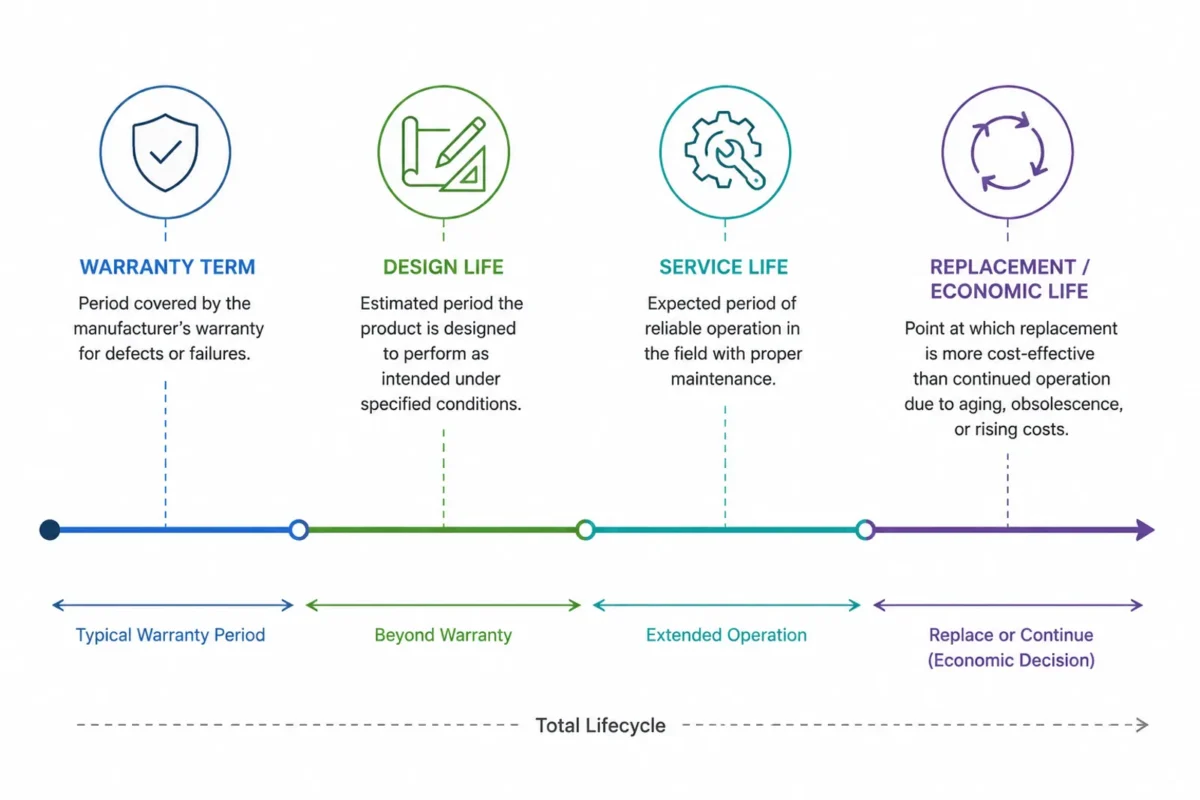
Design life is an engineering objective. It may be based on expected component stress, environmental conditions, operating hours, and reliability calculations. A stated 20-year design life is not automatically a guarantee of 20 years of uninterrupted operation.
Service life is the period during which the inverter can remain functional in the field. It may include repairs and component replacements. It is affected by operating conditions, maintenance practices, and long-term component availability.
Economic life ends when continued operation is less attractive than replacement or repowering. An inverter can still function technically but become economically obsolete because efficiency has declined, repairs are expensive, communications are unsupported, or replacement equipment offers better functionality. Changes to grid-code requirements can also bring the economic replacement point forward.
Commercial PV modules commonly have performance warranties extending for 25–30 years, while standard inverter warranties are considerably shorter. Module product warranties may also be longer than the inverter’s initial coverage.
As a result, many 25–30-year project models include at least one inverter replacement. A common conservative assumption is replacement around years 12–15, although the actual timing may be earlier or later. The model should also distinguish between replacing the entire inverter fleet, replacing units as they fail, and refurbishing critical components.
This warranty mismatch has design consequences. EPCs should allow sufficient service space, cable flexibility, switchgear compatibility, and communications adaptability for future inverter replacement. Designing only for initial installation can make mid-life replacement significantly more expensive.
Architecture determines both failure concentration and the operational value of warranty coverage. Warranty coverage that is adequate for a distributed string inverter system may be insufficient for projects where one central unit represents a large share of plant capacity.
Commercial string inverters commonly begin with around five years of standard coverage, with extensions frequently available to 10, 15, or 20 years. Their distributed architecture limits the production impact of an individual failure. If one unit trips, the rest of the plant can normally continue operating.
Replacement can also be comparatively straightforward when units are accessible and local stock is available. However, a large project may contain dozens or hundreds of inverters. The asset manager must then control serial numbers, registration records, firmware versions, alarms, replacement histories, and separate warranty claims.
A distributed design reduces failure concentration but increases administrative and monitoring complexity. It may also create a larger exposure to recurring model-specific faults if the entire fleet uses one product generation.
Central inverters used in large ground-mounted projects often have standard warranty periods of five or ten years. Extensions to 15 or 20 years may be offered through warranty packages or service agreements.
The main risk is outage concentration. A single central-unit failure can remove a substantial block of plant capacity. Repair may require specialist technicians, power modules, control boards, cooling components, lifting equipment, or coordinated shutdowns.
For this reason, response-time commitments can be as important as the nominal warranty term. A hardware replacement delivered after several weeks may satisfy the product warranty while still causing substantial revenue loss. Utility-scale owners should assess guaranteed response times, remote diagnostics, board-level repair capability, regional inventory, and escalation procedures.
Some microinverters have limited warranties of 20–25 years, which aligns more closely with module performance warranties. Their distributed architecture also prevents a single device failure from removing a large section of plant capacity.
However, warranty length alone does not establish lower lifecycle risk. A commercial rooftop can contain thousands of electronic devices. Replacement labor may require roof access, fall protection, production-area coordination, module removal, and weather-dependent scheduling. Communications gateways and monitoring platforms can also become critical dependencies.
Commercial buyers should verify whether labor is covered, whether replacement requires an authorized installer, and whether the warranty applies equally to residential and C&I projects. They should also evaluate how failed units will be located and accessed over the roof’s operating life.
Hybrid and battery inverters may experience more complex operating conditions than conventional PV inverters. Frequent charging cycles, backup operation, mode changes, and thermal cycling can increase component stress. The warranty may also define permitted batteries, communication protocols, operating modes, and firmware versions.
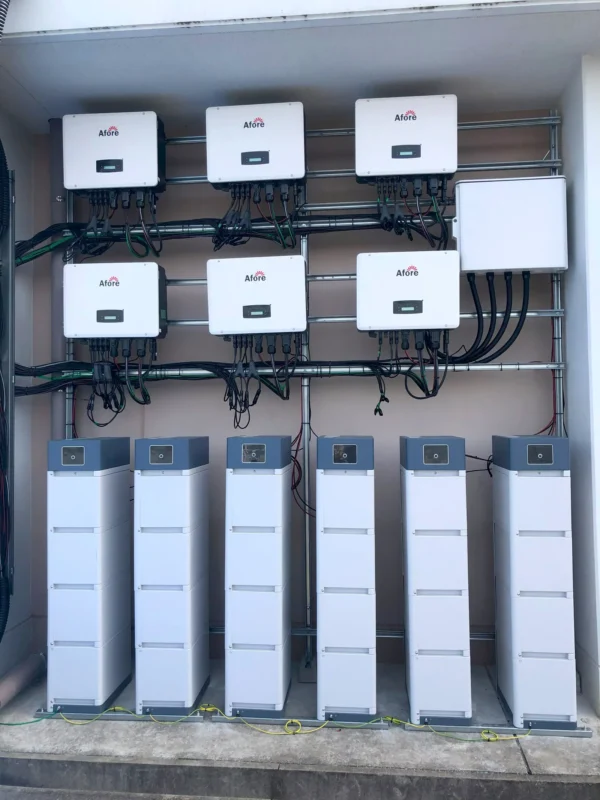
Future storage expansion should be considered during procurement. Adding an unapproved battery, changing operating controls, or installing unsupported firmware may affect warranty rights. Contracts should establish who is responsible for compatibility checks and whether later battery additions require written supplier approval.
| Архітектура | Typical coverage pattern | Main lifecycle concern |
|---|---|---|
| Commercial string | Around 5 years standard; extensions often available | Number of units and claims to manage |
| Central | Commonly 5 or 10 years; longer service packages available | High production impact per failure |
| Module-level electronics | In some cases 20–25 years | Roof access and large device count |
| Hybrid or battery inverter | Product-specific term separate from battery warranty | Compatibility, cycling, and operating-mode restrictions |
A warranty certificate should be viewed as a risk-allocation agreement rather than simply a product feature. The headline period has limited value unless the buyer understands the remedy, exclusions, logistics, and evidence required to make a successful claim.
A standard product warranty generally covers defects in materials and workmanship during normal use. The manufacturer usually retains the right to choose the remedy. That may include repairing the unit, providing a new or refurbished replacement, supplying an equivalent model, or offering compensation under defined conditions.
This coverage is different from an energy-yield guarantee, availability commitment, EPC performance guarantee, or O&M service-level agreement. A manufacturer may replace a defective inverter without compensating the owner for lost production. It may also supply equivalent hardware without paying for engineering changes required to integrate the replacement.
Procurement teams should examine whether replacement devices are new, refurbished, or functionally equivalent. If the original product has been discontinued, the proposed substitute may have different dimensions, connector arrangements, communications protocols, or grid settings.
Hardware-only coverage can leave the project exposed to substantial ancillary costs. Depending on the contract, excluded or capped expenses may include diagnosis, removal, reinstallation, technician travel, freight, customs, cranes, scaffolding, roof access, electrical reconnection, commissioning, and disposal.
These costs can exceed the value of a replacement string inverter, particularly on inaccessible roofs or remote sites. For central units, lifting logistics and specialist labor can be material even when the power module itself is supplied at no charge.
The warranty should therefore be evaluated alongside the physical replacement method. An inverter placed behind production equipment, above a fragile roof area, or inside a restricted electrical room may be expensive to remove. Good service access reduces both inverter replacement cost and outage duration.
Common exclusions include improper installation, inadequate ventilation, operation beyond temperature or altitude limits, unauthorized repairs, unapproved firmware, incompatible equipment, and failure to follow maintenance instructions. Damage caused by flooding, corrosion, lightning, abnormal surges, or grid conditions beyond specified limits may also be excluded.
The EPC should connect each exclusion to a design control. Environmental limits should be checked during equipment selection. Ventilation and clearances should be verified during installation. Surge protection should be coordinated across the DC and AC systems. Grid settings and firmware versions should be recorded at commissioning.
Without this connection, the owner may discover after a failure that an apparently valid warranty claim is disputed because the original installation evidence is incomplete.
Some warranty extensions or enhanced service benefits require registration within a defined period. The warranty start date may be linked to manufacture, shipment, commissioning, grid connection, or online registration. These dates are not always identical.
Commercial buyers should verify transferability if the asset is sold. They should also confirm geographic validity and extension purchase deadlines. Other key points include claim notification periods, replacement-unit coverage, and whether a replacement receives a new warranty term.
The latter distinction can be significant. If an inverter fails near the end of a ten-year term, a replacement may receive only the remaining months rather than a new ten-year warranty.
Warranty length cannot compensate for unsuitable equipment selection or poor installation. Inverter durability is strongly affected by component design, thermal conditions, contamination, electrical stress, and the ability to repair the equipment quickly.
DC bus capacitors are recognized wear-sensitive components. Their degradation can be accelerated by heat, ripple current, voltage stress, and component quality. Research on PV inverter reliability highlights the importance of thermal stress and component-level aging when evaluating inverter lifetime. Power semiconductors such as IGBTs and diodes are exposed to electrical and thermal cycling, while grid-interface relays undergo repeated switching.
Control boards can fail because of component aging, moisture, contamination, power-supply faults, or communications problems. In some cases, the complete inverter is replaced even though only one board has failed. This makes modular construction and board availability important procurement considerations.
For large projects, buyers should examine whether field technicians can replace power modules, fans, capacitors, or control boards. They should also ask how long critical parts will remain available and whether diagnostic tools require manufacturer authorization.
High operating temperature accelerates component aging. A commonly used accelerated-aging rule of thumb is that a 10°C increase in operating temperature can roughly halve capacitor life. Actual results depend on capacitor design, duty cycle, internal temperature, cooling performance, and other operating conditions, so this should be treated as an engineering approximation rather than a universal prediction.
Fan failure, blocked filters, direct sunlight, poor ventilation, and rooftop heat can all increase internal temperature. Even when an inverter remains within its stated operating range, sustained operation near the upper limit may increase derating hours and component stress.
EPCs should review temperature derating curves, not only the maximum ambient-temperature value. They should consider solar loading on the enclosure, air recirculation between adjacent units, indoor heat rejection, and the effect of dust accumulation on cooling performance.
An enclosure’s IP rating is important, but it does not describe every environmental risk. Condensation can occur inside an apparently well-sealed enclosure. Salt mist and industrial pollutants can accelerate corrosion. Fine conductive dust may affect cooling paths or electronics, while repeated temperature swings create expansion and contraction stress.
Site assessment should consider environmental factors such as humidity, flooding, salt exposure, dust, chemical contamination, and altitude. Grid stability and operating temperature should also be evaluated. The inverter’s corrosion classification, derating curves, cooling design, and approved installation environment should match these conditions.
Surge protection also requires system-level coordination. Installing a surge protection device does not guarantee that all transient damage is covered. The EPC should verify AC and DC protection levels, earthing, cable routing, lightning risk, and replacement indicators for protective devices.
Fleet failure rates are probability inputs, not forecasts for individual units. A 1% annual failure rate does not mean every inverter lasts 100 years. It means that approximately 1% of the observed fleet experiences a defined failure in a year, subject to the study’s data quality and definitions.
Architecture changes the availability impact. Ten small failures spread across a large string-inverter fleet may create less production loss than one prolonged central-inverter outage. On the other hand, managing many small interventions can increase labor and administrative costs.
Availability modelling should therefore combine failure frequency with capacity lost per event, detection time, technician response, spare availability, repair duration, and recommissioning time.
The most reliable procurement strategy combines appropriate architecture, conservative thermal design, supplier due diligence, serviceability, and contract scope. Maximum efficiency ratings and warranty duration alone are not enough.
String architecture usually limits the capacity affected by one failure and can simplify replacement. It is often well suited to complex C&I roofs, phased projects, and plants where access to individual units is straightforward.
Central architecture involves fewer assets to monitor but concentrates outage risk. It can be appropriate where project scale, electrical design, and centralized maintenance capability support specialist service.
The choice should account for roof layout, plant size, redundancy, equipment access, local technical skills, cable architecture, environmental exposure, and the value of lost production. There is no universally superior option.
The DC/AC ratio affects both energy capture and inverter loading. A high ratio can improve asset utilization but may increase the number of hours spent near rated output or in clipping conditions. Reactive-power obligations can further reduce active-power headroom or increase thermal loading.
This does not mean that conservative DC oversizing is inherently harmful. The actual effect depends on climate, irradiance profile, inverter design, cooling capacity, and grid requirements. EPCs should model expected operating hours across temperature and power ranges rather than considering only nameplate capacity.
Manufacturer derating curves should be checked for ambient temperature, altitude, grid voltage, and reactive-power operation. A design that is compliant at standard test conditions may experience frequent thermal derating at the actual site.
A 20-year extended inverter warranty provides limited protection if the supplier cannot support the product throughout that period. Due diligence should cover financial stability, regional service operations, authorized repair networks, RMA turnaround, product continuity, cybersecurity support, firmware availability, and spare-parts commitments.
Market exit and product discontinuation are realistic risks over a 20-year horizon. Procurement teams should understand which legal entity provides the warranty and whether local distributors are merely claim intermediaries.
A reliable виробник сонячних інверторів should be assessed through evidence of service execution, not only shipment volume or brand recognition. Reference projects, local response capability, parts availability, and documented claim performance are more useful than general marketing claims.
The suitable warranty depends on project scale, access cost, climate, grid quality, debt tenor, PPA duration, holding period, redundancy, and downtime exposure.
A ten-year extension may be attractive for an industrial site where even a short outage has a high financial impact or causes missed energy targets. By contrast, a portfolio owner with standardized string inverters, regional spares, and in-house technicians may prefer a shorter warranty and self-insured replacement reserve.
The key comparison is not “five years versus twenty years.” It is the present value of coverage, uncovered costs, failure risk, downtime, supplier continuity, and alternative replacement strategies.
Installation quality influences both service life and warranty enforceability. A technically suitable inverter can still underperform or fail prematurely if placed in an unsuitable environment.
Outdoor inverters should be installed with the required clearances and, where appropriate, protection from direct solar loading. Indoor installations need adequate heat rejection. Roof-mounted equipment should be assessed for local surface temperature, not only regional ambient temperature.
Cable routing should avoid unnecessary mechanical stress and allow future disconnection. Equipment should be protected from flood exposure and vehicle impact. Sufficient working space should be retained for safe removal and replacement.
Future logistics should be considered during design. If a crane, building shutdown, or removal of other equipment is required to replace an inverter, a nominally free warranty unit may still create a costly intervention.
EPCs should retain serial numbers, registration confirmations, as-built drawings, torque records, insulation-resistance results, polarity tests, protection settings, grid approvals, firmware versions, and commissioning reports. Dated photographs should show equipment location, clearances, cable entries, labels, and enclosure condition.
Monitoring records should establish the initial operating baseline. Environmental and grid settings should also be documented. These records help demonstrate that the inverter was installed and operated in accordance with instructions.
Documentation should remain accessible after ownership transfer or O&M contractor changes. Storing critical records only in an installer’s proprietary portal creates avoidable claim risk.
IEC 62109 addresses the safety of power converters used in photovoltaic systems. IEC 61727 and IEC 62116 are relevant to utility interface and anti-islanding considerations. These standards do not prescribe inverter warranty length, but compliance supports safe design, certification, and grid connection.
Local requirements remain decisive. Grid operators may define reactive-power control, voltage behavior, harmonics, anti-islanding, communications, and fault-ride-through obligations. Procurement teams must verify that the selected inverter and firmware are approved for the project’s connection category.
Grid requirements can evolve during a project’s life. An inverter may need new reactive-power functions, voltage control, anti-islanding settings, or fault-ride-through behavior. Some changes can be implemented through firmware; others may require recertification, communication upgrades, or hardware replacement.
Poland provides a useful example. Poland’s transmission and distribution requirements define technical behavior for connected generation but do not mandate a solar inverter warranty period.
Contracts should state who pays for mandatory firmware changes, remote support, testing, and recertification. They should also clarify whether an update requested by an operator remains covered after the original product warranty expires.
Effective solar inverter O&M reduces detection time, supports claim evidence, and may prevent minor thermal or electrical issues from becoming major failures. Maintenance frequency should follow the equipment manual and actual site conditions rather than a universal interval.
Maintenance should reflect whether the inverter is naturally or mechanically cooled, indoor or outdoor, and exposed to dust, humidity, heat, or corrosive contaminants. Relevant tasks include inspecting fans, filters, vents, seals, terminals, surge protection devices, cable entries, corrosion, alarms, and signs of overheating.
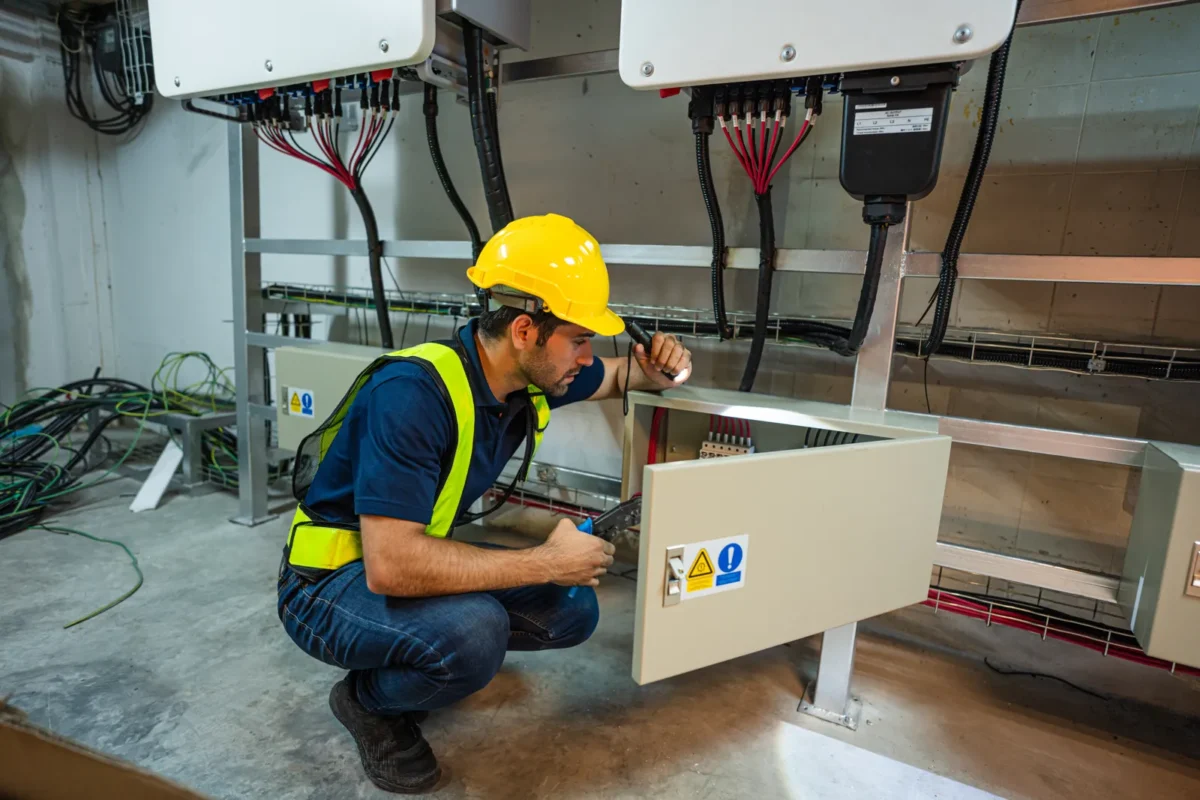
Loose connections and degraded cooling components can create both reliability and warranty concerns. Maintenance work should be documented, particularly where the warranty requires periodic inspections.
Unauthorized repairs should be avoided. If a third party opens or modifies the inverter without approval, the manufacturer may dispute later claims.
Useful indicators include internal temperature, fan speed, thermal-derating hours, conversion efficiency, insulation alarms, restart frequency, recurring error codes, voltage imbalance, and communication availability.
Trend analysis is generally more informative than isolated alarms. Rising internal temperature at the same ambient conditions may indicate cooling degradation. Increasing restart frequency may signal grid instability, insulation problems, or developing component faults.
Predictive monitoring has practical potential, but independent evidence quantifying how much it extends total inverter life remains limited. It should therefore be treated as a tool for earlier detection and better intervention planning rather than a guaranteed lifespan extension.
High-downtime-cost sites may hold complete string inverters or critical central-inverter boards even when failures are under warranty. An RMA can take weeks, while a local spare may restore production within hours or days.
Site-level stock offers the fastest response but ties up capital and may become obsolete. A regional warehouse can support several projects more efficiently, provided transport and customs are predictable. Supplier-held inventory reduces owner carrying cost but requires credible service-level commitments.
Spares should be stored correctly, tracked by firmware and hardware revision, and tested where appropriate. Inventory value should be compared with expected production loss, mobilization cost, and supplier lead time.
Standard product warranties generally do not compensate the owner for lost generation, reduced availability, or missed revenue. They provide a remedy for an eligible product defect.
This gap can be managed through EPC availability guarantees, O&M response-time agreements, performance liquidated damages, business-interruption insurance, and clearly defined spare-parts obligations. Each contract should specify how availability is calculated and which events are excluded.
Back-to-back contracting is particularly important. An EPC may owe the owner compensation for downtime even though the manufacturer only owes replacement hardware. The EPC must understand and price that mismatch.
An extended inverter warranty should be evaluated as a financial risk-transfer product. Its value depends on the probability and cost of eligible failures, the breadth of coverage, and the supplier’s ability to perform.
The analysis should consider several factors, including extension price, covered components, labor exclusions, and expected failure probability. It should also account for replacement costs, downtime impact, remaining project life, discount rates, and supplier risk.
Extended-warranty pricing varies widely by product, market, term, and coverage scope.

An extension is more attractive when equipment is difficult to access, production value is high, replacement logistics are expensive, and the supplier has strong local service capacity. It is less attractive when coverage is hardware-only, the fleet is highly redundant, replacement prices are expected to fall, or the owner already holds standardized spares.
Commercial models should compare at least three cases.
| Сценарій | Financial assumption | Main risk |
|---|---|---|
| Standard warranty and planned replacement | Reserve for replacement around years 12–15 | Earlier-than-planned failure |
| Extended coverage to 15–20 years | Upfront premium or service fee | Exclusions, supplier continuity, and downtime |
| Self-insurance with spares | Replacement reserve plus inventory | Owner retains failure and obsolescence risk |
Sensitivity analysis should test earlier failure, delayed RMA, falling equipment prices, inflation in labor costs, grid-code changes, and different discount rates. It should also consider whether replacing only failed units creates a mixed fleet with multiple firmware versions and monitoring interfaces.
Inverter lifecycle cost includes more than replacement hardware. Corrective maintenance, technician mobilization, freight, recommissioning, lost generation, and financing timing all affect value.
Utility-scale studies have found that inverters can represent approximately 20%–50% of unscheduled O&M expenditure. Consequently, optimistic assumptions about failure timing or zero-cost warranty replacement can materially understate LCOE and overstate project NPV.
The financial model should recognize expenses in the years when they are expected to occur. A replacement in year 15 has a different present value from an identical replacement in year eight, but early downtime may have a greater impact during the debt-repayment period.
The manufacturer’s product warranty addresses eligible equipment defects. EPC workmanship obligations cover design and installation responsibilities. Performance guarantees address system output or availability, while O&M agreements define monitoring, response, and maintenance duties.
These contracts should be reviewed together. Important issues include warranty pass-through, claim administration, liability caps, availability definitions, liquidated damages, response times, and responsibility for uncovered labor.
If the EPC provides a longer or broader promise than the manufacturer, it retains the difference. Similarly, an O&M provider cannot meet a rapid restoration commitment without access to spares, trained personnel, and authorization to perform repairs.
A structured evaluation helps procurement teams compare offers that use different terminology and service models. All terms should be confirmed using current regional documents rather than global brochures.
| Due-diligence area | Required confirmation |
|---|---|
| Term | Standard duration, start date, and extension options |
| Scope | Parts, complete unit, labor, travel, freight, and commissioning |
| Exclusions | Environment, grid events, maintenance, firmware, and third-party equipment |
| Claims | Notice period, documentation, diagnostics, and RMA process |
| Replacement | New or refurbished unit, equivalent model, and remaining warranty term |
| Ownership | Registration, transferability, and geographic validity |
| Service | Response time, local technicians, escalation, and remote support |
| Long-term support | Spare-parts duration, firmware availability, and product continuity |
Procurement should also verify whether claim frequency or compensation is capped and whether repeated failures trigger a stronger remedy. Verbal service commitments should be included in the contract.
| Project type | Primary risk | Appropriate commercial approach |
|---|---|---|
| C&I rooftop | Difficult access and high labor cost | Strong labor coverage, accessible installation, and local spares |
| Industrial site | High value of lost production or grid-quality issues | Extended support, telemetry, surge coordination, rapid response |
| Remote ground-mounted plant | Long technician and freight lead times | Site or regional spares and clear service commitments |
| Utility-scale portfolio | Concentrated outages and fleet-scale O&M | Board-level repair, regional inventory, portfolio data analysis |
The matrix should be adjusted for climate severity, project tenor, fleet size, local technical capacity, and PPA exposure. A humid coastal roof and a dry inland ground-mounted project may require different enclosure, maintenance, and warranty strategies even at the same capacity.
Fleet standardization reduces training, monitoring, firmware, and spare-parts complexity. Technicians gain familiarity with recurring faults, and inventory can support multiple sites.
However, standardization creates concentration risk. A product defect, supplier exit, cybersecurity issue, or discontinued platform can affect the entire portfolio. Vendor diversification reduces this exposure but increases operational complexity.
Portfolio owners should use actual operating data to refine future purchases. Relevant metrics include failure rate by model and climate, RMA duration, repeat error codes, repair cost, derating hours, and production lost per event.
Expiry does not require immediate replacement. The owner can continue operating the inverter, purchase paid repair services, refurbish components, replace failed units, or undertake planned repowering.
Planning should begin before expiry. The owner should confirm electrical compatibility, physical dimensions, communications protocols, monitoring integration, grid certification, spare availability, and recommissioning requirements. Waiting until a failure occurs can turn a manageable replacement into an extended outage.
Repowering may be attractive when new equipment provides higher efficiency, improved grid support, better monitoring, or lower maintenance requirements. However, the engineering assessment must cover string voltage, current limits, protection settings, transformer compatibility, and permitting.
Treat the inverter as a serviceable and potentially replaceable asset from the beginning of the project. Select architecture according to failure concentration and access, verify regional warranty terms, preserve commissioning evidence, monitor thermal and electrical indicators, and model both extended coverage and self-insured replacement.
The strongest commercial strategy is not necessarily the longest warranty. It is the combination of suitable equipment, controlled operating conditions, enforceable contract scope, responsive local service, available spares, and a funded replacement plan that protects PV production throughout the project’s economic life.
Commercial and utility-scale solar inverters typically last around 15–20 years when properly selected, installed, and maintained. Actual lifespan depends on factors such as temperature, operating conditions, maintenance quality, and component reliability. Some units may operate beyond this range, while others may require earlier repair or replacement.
A solar inverter should be replaced when keeping it in operation becomes less cost-effective than installing new equipment. This decision usually considers repair frequency, expected downtime, efficiency performance, spare-part availability, and compatibility with current system requirements. Some projects plan replacement during mid-life stages, while others continue using existing units if reliability and operating costs remain acceptable.
A suitable warranty period depends on the project’s risk profile rather than a fixed number of years. Commercial inverters often include initial coverage with optional extensions, but buyers should evaluate what the warranty actually includes, such as parts, service support, and replacement conditions. The right choice varies based on site accessibility, operating environment, investment period, and the manufacturer’s long-term support capability.
Installers evaluate inverter reliability by looking at technical performance, operating conditions, and long-term service support. They usually consider product testing data, cooling design, environmental protection, repair options, supplier response capability, and historical field experience. A reliable inverter is not only one with good specifications but also one that can be supported effectively throughout the project lifecycle.
No, an extended warranty can reduce some equipment-related risks but does not remove every potential cost or operational issue. Coverage may differ depending on contract terms and may not include items such as transportation, labor, site access, or production losses. Project owners should also consider supplier reliability, claim response time, and future equipment compatibility when evaluating extended coverage.








 Turkish
  Romanian