





A deep cycle battery for solar is not selected only by nameplate capacity. In commercial and industrial PV projects, the battery must match the site’s load profile, inverter architecture, cycling strategy, operating environment, safety requirements, grid rules, and lifecycle cost targets. A battery bank that looks adequate on a datasheet can still underperform if it is paired with the wrong inverter, operated outside its recommended depth of discharge, installed in a hot enclosure, or dispatched without regard to warranty limits.
For EPCs, PV installers, system integrators, resellers, and commercial project owners, battery selection has direct consequences for commissioning risk, usable energy, O&M workload, warranty exposure, and return on investment. The right storage design can increase solar self-consumption, reduce peak demand, improve resilience, and support off-grid or hybrid operation. The wrong design can create nuisance shutdowns, premature degradation, fire safety concerns, or expensive replacement cycles.
This guide explains how to evaluate a solar deep cycle battery from a professional PV system perspective. It covers chemistry selection, usable capacity, sizing, inverter and EMS integration, safety compliance, installation, monitoring, warranty control, procurement, and lifecycle economics.
A solar deep cycle battery is designed to charge and discharge repeatedly over many cycles. This is different from a starter battery, which is built to deliver a short, high-current burst and then quickly return to a full state of charge. In a PV storage system, the battery may discharge every evening, support critical loads during grid outages, absorb surplus daytime solar generation, or help reduce demand peaks during business hours.
For solar applications, the most important battery metrics are not just amp-hours or nominal kWh. EPCs need to evaluate usable capacity, depth of discharge, cycle life, calendar life, charge and discharge rate, temperature range, round-trip efficiency, and warranty conditions. A 100 kWh battery that can only be used safely to 50% depth of discharge does not provide the same operational value as a 100 kWh battery designed for deeper cycling. Likewise, two batteries with the same usable capacity can produce very different economics if one delivers more cycles, higher efficiency, and lower maintenance over the project life.
The U.S. Department of Energy explains in its Solar Plus Storage 101 guide that solar-plus-storage systems increase the value of PV generation by storing electricity for later use, improving resilience, and supporting electricity cost reduction where tariffs and controls make that possible. For commercial systems, that value depends heavily on how the battery is integrated and dispatched, not simply on whether storage is added.
A regular automotive battery is optimized for engine starting. It typically operates near full charge and is not designed for frequent deep discharge. Using this type of battery in a solar PV system can lead to rapid degradation, loss of capacity, and early failure.
Standby batteries are also different. Some backup batteries are designed for float service, where they remain charged for long periods and discharge only during occasional outages. They may be suitable for limited emergency backup, but they are not always appropriate for daily solar cycling. Commercial PV systems often need batteries that can tolerate variable charging from solar generation, repeated partial cycling, long discharge durations, inverter surge loads, and communication with charge controllers or hybrid inverters.
A true deep cycle solar battery bank is specified around expected duty cycle. For an off-grid telecom site, this may mean daily cycling with several hours of autonomy. For a warehouse PV system, it may mean shallow but frequent discharge for demand charge management. For a commercial microgrid, it may include grid-forming capability, generator coordination, and critical load support.
Commercial solar battery storage is most often deployed where the battery creates measurable operational or financial value. Backup applications in commercial systems should be clearly distinguished, including:
Many commercial systems only back up selected critical loads such as IT systems, lighting, or refrigeration rather than the entire facility. Not all PV-plus-storage systems provide outage power by default. Backup capability requires island-capable inverter architecture, transfer switching logic, and properly designed critical load circuits.
A system designed for self-consumption or demand charge reduction does not automatically provide emergency backup functionality.
However, a single battery system cannot be fully optimized for all objectives at the same time. Different applications require different design priorities, and trade-offs are always involved.
| Use case | Primary design priority |
|---|---|
| Self-consumption | Energy capacity, midday charging window, PV utilization |
| Demand charge reduction | Power rating (kW), fast dispatch, billing interval control |
| Backup / resilience | Autonomy duration, critical load segregation, reserve SOC |
| Microgrid / diesel offset | Generator coordination, cycling strategy, grid-forming capability |
A battery designed for short-duration demand shaving (e.g., 15-minute peak events) is often much smaller in kWh but higher in kW compared to a system designed for 4-hour backup supply.
In self-consumption projects, the battery stores excess daytime PV generation and discharges when the facility load exceeds solar production. In peak shaving applications, the battery discharges during short periods of high demand to reduce utility demand charges. For example, a system designed for 15-minute demand shaving may prioritize high power output over energy capacity, while a 4-hour backup system requires significantly larger energy storage but lower instantaneous power density. In backup power applications, the battery supports selected loads during grid outages, often alongside a generator or hybrid inverter system.
Deep cycle batteries are also used in off-grid solar battery systems for telecom towers, farms, water pumping, remote monitoring stations, islanded facilities, and rural commercial loads. In agricultural PV, batteries may support irrigation controls, cold storage, or pumping schedules. In microgrids, they may stabilize renewable generation, reduce diesel generator runtime, and support power quality.
The key point is that the use case determines the battery specification. A battery used once a month for backup does not face the same cycling requirement as a battery dispatched every day for time-of-use optimization. A battery supporting refrigeration compressors or pumps must handle surge power as well as energy capacity. A remote site without regular maintenance access may justify a higher upfront battery cost if it reduces service visits and replacement risk.
This guide introduces deep cycle batteries as an entry point to solar storage design. However, in many commercial and industrial projects, selection must move beyond battery chemistry and into full energy storage system (ESS) architecture.
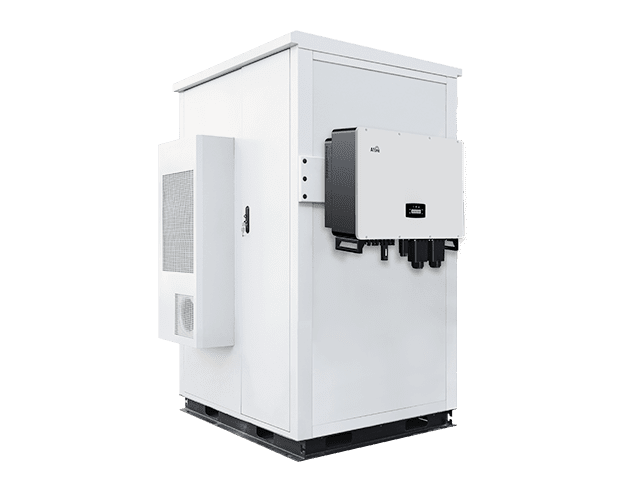
Not every commercial storage project can be designed as a simple battery bank. The decision between a discrete battery bank and an integrated battery energy storage system (BESS) should be based on project scale, deployment environment, and system complexity. A practical decision framework includes:
If a project requires utility-facing controls, outdoor cabinetized deployment, or multi-string thermal and safety management, it should be evaluated as a certified integrated BESS rather than a discrete battery-bank assembly. Under-specifying system architecture at this stage can lead to permitting delays, insurance rejection, or commissioning failure.
A small deep cycle solar battery bank may be suitable for a remote equipment shelter or modest backup load. However, a manufacturing site using storage for peak shaving, resilience, and grid export control usually needs a more engineered system. Under-specifying storage at this scale can create permitting delays, insurance concerns, commissioning failures, and operational instability.
Usable capacity is the practical amount of energy that can be discharged while keeping the battery within its recommended operating window. It is more important than nominal capacity because it determines how much energy the system can actually deliver.
Depth of discharge, or DoD, defines how much of the battery’s capacity is used in a cycle. Lead-acid batteries are commonly operated at lower DoD to preserve life, while lithium-based systems, especially LiFePO4 solar battery systems, usually allow higher usable DoD. However, the correct operating limit should always come from the manufacturer’s datasheet and warranty terms.
| Battery type | Typical commercial design consideration | Practical implication |
|---|---|---|
| Flooded lead-acid | Lower usable DoD, maintenance required | Larger nominal bank may be needed for the same usable kWh |
| AGM / gel | Sealed, reduced maintenance, sensitive to charge settings | Useful for smaller backup or remote sites with moderate cycling |
| Lithium / LiFePO4 | Higher usable DoD, BMS controlled, lower maintenance | Often stronger lifecycle value in frequent-cycling projects |
Autonomy targets should be based on the required backup duration and load criticality. A retail facility may only need battery support for IT systems, lighting, and payment infrastructure. A cold storage site may need longer backup for refrigeration loads. A telecom site may require autonomy through poor weather periods, especially if generator access is difficult.
Oversizing can improve battery life by reducing daily DoD, but it also increases CAPEX. Undersizing reduces upfront cost but can increase degradation, downtime, and customer dissatisfaction. Commercial sizing should therefore be based on measured or modeled load data rather than rough assumptions.

Cycle life describes how many charge-discharge cycles a battery can deliver before reaching a defined end-of-life capacity, often around 70% or 80% of original capacity depending on the product and test method. Calendar life reflects degradation over time even if the battery is not cycled heavily. Both matter in commercial PV. For procurement and system modeling, designers should also consider:
These assumptions directly affect lifecycle cost calculations and ROI accuracy.
End-of-life (EOL) thresholds may vary depending on warranty terms and application type, so design assumptions should not rely on a single universal value.
Cycle life depends on operating temperature, depth of discharge, charge and discharge rate, state-of-charge window, and maintenance quality. For example, a system used for daily energy arbitrage may still operate at 80% retained capacity, while a backup system may fail to meet required runtime if it was originally sized assuming beginning-of-life performance.
NREL has emphasized in battery storage analysis that lifecycle economics depend strongly on cycling profile, operating window, and temperature rather than nominal capacity alone.
Warranty alignment is critical. Some manufacturers define warranty by years, cycles, energy throughput, or a combination. A battery used for daily peak shaving may consume its warranted throughput faster than a battery used for standby backup. EPCs should compare the expected dispatch profile with warranty limits before finalizing the specification.
Battery sizing cannot be based only on kWh. Commercial facilities often have motors, pumps, elevators, HVAC systems, compressors, industrial machinery, refrigeration equipment, or large lighting loads that create high short-term demand. The battery and inverter must support both continuous power and surge requirements.
C-rate expresses charge or discharge current relative to battery capacity. Storage duration is another key design metric. It defines how long a battery can deliver rated power. For example:
This ratio between power (kW) and energy (kWh) is often called the power-to-energy ratio and directly defines system behavior.
Demand shaving applications typically favor shorter duration systems, while load shifting and resilience-oriented systems often require longer duration storage.
A 1C discharge means the battery discharges its full nominal capacity in one hour. A 0.5C discharge means discharge over two hours. Batteries designed for long-duration backup may not be suitable for high-power peak shaving unless the power rating is adequate.
A common design error is calculating that a facility needs 200 kWh of backup, then selecting a battery without checking whether it can deliver the required kW. If the inverter demands more current than the battery can safely provide, the system may trip, derate, or operate outside warranty.
Round-trip efficiency measures how much energy is delivered after charging and discharging losses. If 100 kWh is charged into the battery and 90 kWh is later delivered, the round-trip efficiency is 90%. Lithium battery for solar storage applications generally offers higher round-trip efficiency than flooded lead-acid systems, although exact values vary by product, operating temperature, charge rate, inverter efficiency, and system architecture.
Efficiency affects project economics. In a commercial self-consumption project, every percentage point of storage loss reduces the amount of solar energy available to offset grid purchases. In diesel hybrid systems, lower efficiency may increase generator runtime. In peak shaving, efficiency influences how much PV energy must be stored to achieve the required demand reduction.
Lead-acid may still be relevant where upfront cost is tightly constrained, cycling is limited, local technicians are familiar with the technology, and maintenance access is reliable. However, for high-cycle C&I applications, higher efficiency and longer service life often make lithium-based systems more attractive over the full project horizon.
Flooded lead-acid batteries have long been used in solar energy storage because they are widely available, relatively low cost, and supported by mature supply chains. They are familiar to many technicians and can be serviceable in remote regions where advanced electronics support is limited.
Their limitations are significant. Flooded batteries require electrolyte inspection, watering, ventilation, corrosion control, and periodic maintenance. They are sensitive to chronic undercharging, which can cause sulfation and capacity loss. They also require careful charge control, temperature compensation, and suitable battery room design because hydrogen gas can be produced during charging.
For commercial PV, flooded lead-acid batteries can still be appropriate in cost-sensitive off-grid installations where maintenance is planned and local skills are available. They are less attractive for indoor C&I facilities, high-cycle peak shaving, or projects where O&M access is limited.
AGM and gel batteries are sealed lead-acid options. They reduce maintenance compared with flooded batteries because they do not require watering under normal operation. They also avoid open electrolyte handling, which can simplify installation in some sites.
However, sealed lead-acid batteries are not maintenance-free from a design perspective. They are sensitive to incorrect charging voltage, excessive temperature, and overcharging. Gel batteries in particular require appropriate charge settings to avoid damage. AGM batteries can deliver good power performance but may still have shorter cycle life than many lithium systems in daily cycling applications.
These batteries are often considered for smaller commercial backup systems, remote monitoring sites, security systems, telecom support loads, or applications where moderate cycling and simple installation are priorities.
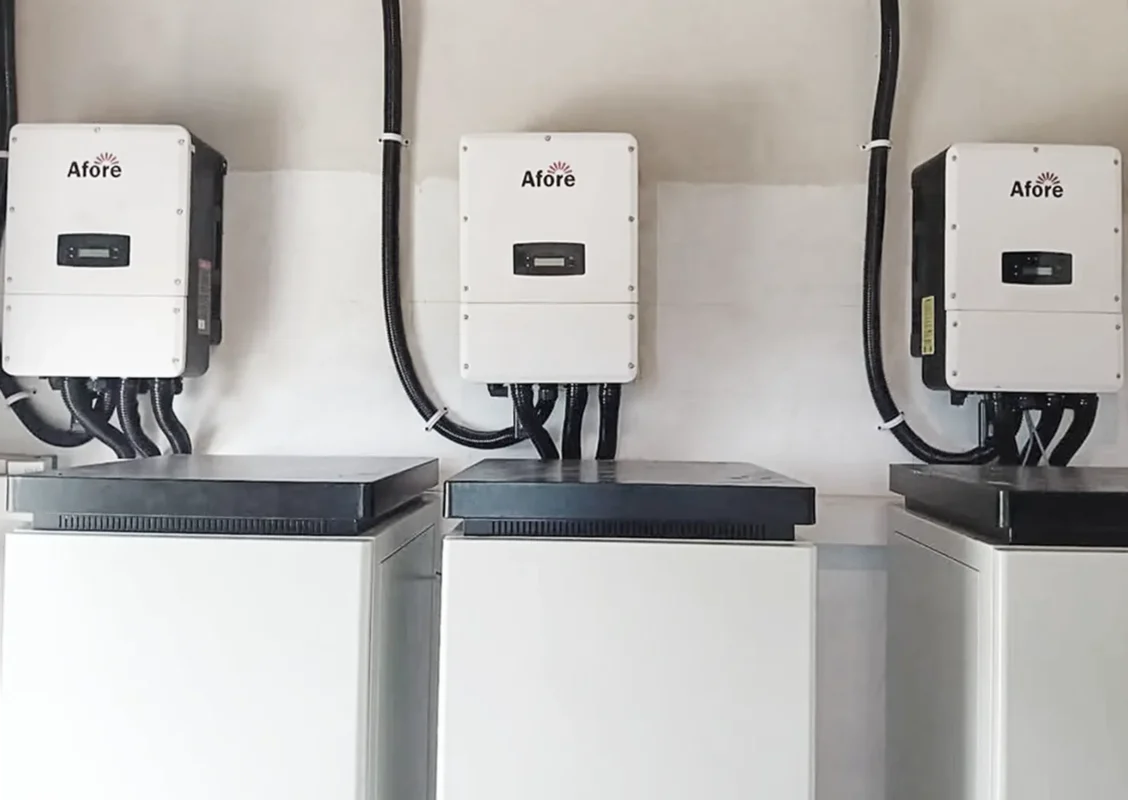
Lithium iron phosphate, commonly known as LFP or LiFePO4, has become a common choice for new commercial solar battery storage projects. LFP systems typically provide higher usable capacity, longer cycle life, better round-trip efficiency, and lower routine maintenance than flooded lead-acid systems. They also perform well in modular cabinet designs and are widely used in scalable PV-plus-storage architectures.
A lithium system requires a battery management system (BMS) as a mandatory safety and control component. The BMS manages cell protection, balancing, thermal limits, and operating boundaries to ensure safe operation within design limits. The BMS protects cells from overcharge, overdischarge, overtemperature, undertemperature charging, excessive current, and cell imbalance. In commercial systems, the BMS should communicate reliably with the inverter or energy management system so charge limits, discharge limits, state of charge, alarms, and fault conditions are handled correctly.
Lithium battery selection should include verification of safety certification, inverter compatibility, communication protocol support, thermal operating range, enclosure rating, and service support. A technically strong lithium product can still create project risk if it is not approved for the selected inverter or cannot provide documentation required for permitting and insurance.
Battery chemistry selection is not an isolated technical decision. It is constrained by approved documentation, insurer acceptance, and inverter pairing availability. Chemistry options must be evaluated within the constraints of system certification and compatibility requirements. Battery chemistry should not be treated as a simple CAPEX comparison. EPCs should compare technologies based on lifecycle cost, expected cycling frequency, site temperature, maintenance capability, replacement logistics, available space, safety compliance, warranty terms, and customer reliability expectations.
A high-cycle commercial peak shaving project may justify lithium because lower maintenance, higher efficiency, and longer cycle life reduce total cost of ownership. A remote low-cycle backup system may favor sealed lead-acid if the load is modest and budget is constrained. A rural microgrid may require a more nuanced choice, balancing local serviceability, generator integration, temperature exposure, and spare availability.
Sizing starts with the load, not the battery. In practice, sizing methodology depends on system architecture.
For small commercial or remote DC battery-bank systems:
For larger commercial and industrial ESS systems:
Both approaches use load as the starting point, but system architecture determines how sizing is translated into hardware specifications.
Storage duration should be explicitly defined during sizing. It is calculated as the ratio of energy capacity (kWh) to power output (kW).
For example:
This definition helps align battery design with actual operational requirements. A key design checkpoint is to confirm that battery kW rating, inverter kW rating, and discharge duration match the actual utility billing interval or expected backup event profile.
| Sizing input | Why it matters |
|---|---|
| Daily or critical load consumption | Determines energy required in kWh |
| Required backup hours or autonomy | Defines storage duration |
| Peak and surge power | Determines inverter and battery discharge capability |
| Design DoD | Converts usable kWh into nominal battery capacity |
| Inverter and system efficiency | Accounts for conversion losses |
| Temperature derating | Adjusts capacity and lifetime expectations |
| Future load growth | Avoids premature system undersizing |
A simplified formula is:
Nominal battery capacity = required usable energy ÷ (design DoD × system efficiency)
For example, if a facility requires 120 kWh of usable backup energy, the design DoD is 80%, and system efficiency is 90%, the nominal battery capacity would be approximately 167 kWh. This is only an initial estimate. The design must then be checked against power rating, charge rate, PV recharge window, temperature, redundancy requirements, and warranty conditions.
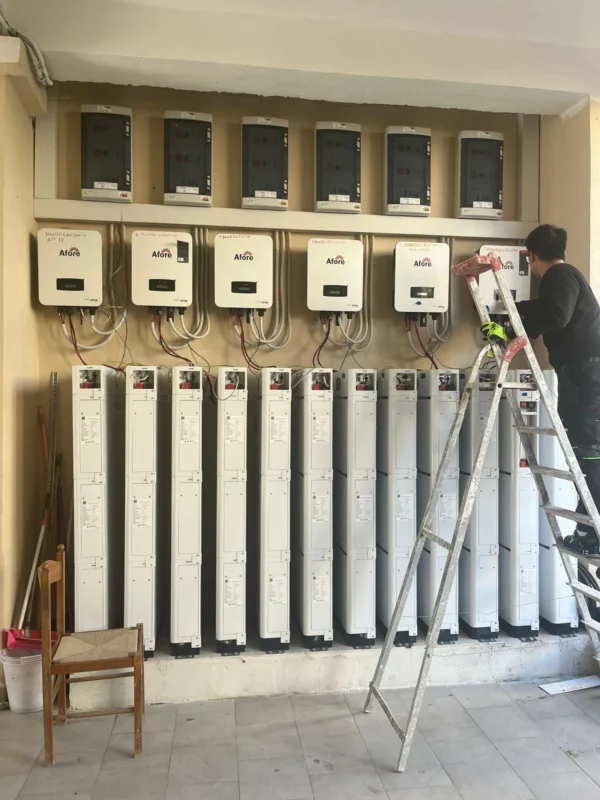
AC-coupled storage connects the battery inverter to the AC side of the PV system. This approach is common in retrofits because it can be added to existing PV installations without replacing the PV inverter. It also allows flexible placement and can simplify integration with building loads. However, energy may pass through multiple conversion stages, which can reduce efficiency.
DC-coupled storage connects the battery on the DC side, often through a hybrid inverter or DC battery interface. This can improve PV-plus-storage efficiency in some new-build systems and may allow recovery of clipped PV energy that would otherwise be lost when PV output exceeds inverter capacity. DC coupling can also simplify certain off-grid or hybrid designs.
The best architecture depends on project type. A retrofit warehouse PV system may favor AC coupling to avoid replacing existing inverters. A new off-grid agricultural system may favor DC coupling for charging efficiency and simpler energy flow. A larger C&I project may use integrated battery cabinets with dedicated power conversion systems and EMS controls.
Small commercial and remote systems often use 12V, 24V, or 48V battery-bank configurations. These systems are typically suitable for telecom sites, remote monitoring stations, or small off-grid installations.
For these systems, DC-coupled battery banks remain common due to simplicity and lower cost.
For larger commercial and industrial projects, storage design typically shifts toward higher-voltage integrated ESS platforms. These systems reduce current levels, improve efficiency, and simplify installation at scale.
For small remote and telecom systems, low-voltage battery-bank design may still apply. For most commercial buildings and industrial sites, storage selection usually shifts to higher-voltage integrated ESS platforms.
Inverter compatibility is defined by three key factors: voltage range matching, power rating alignment, and charge/discharge control logic compatibility. For commercial and industrial systems, these requirements are typically addressed through hybrid solar inverter solutions designed for coordinated battery and inverter operation. All three must be satisfied to ensure stable operation under real load conditions. System architecture selection (battery bank vs integrated ESS) often determines inverter compatibility requirements more than battery voltage alone. The battery voltage range must match the inverter or battery inverter. The inverter must also support the correct charging profile, current limits, protection logic, and communication interface. For lithium systems, compatibility between the BMS and inverter is especially important. Without proper communication, the inverter may not respond correctly to battery limits or fault conditions.
Commercial energy needs change. Facilities add equipment, extend operating hours, install EV chargers, expand cold storage, or increase automation. Battery systems should therefore be designed with expansion in mind where future growth is likely.
Scalability requires more than physical space. EPCs should verify whether the manufacturer supports parallel expansion, whether new modules can be added to older batteries, whether firmware versions remain compatible, and whether expansion affects warranty or certification. Mixing old and new batteries without manufacturer approval can create imbalance and warranty disputes.
For larger projects, modular battery cabinets, spare conduit capacity, planned ventilation or HVAC capacity, and EMS expandability can reduce future upgrade costs. The procurement stage should confirm not only today’s configuration but also the approved path for future capacity additions.
A compatible inverter-battery pairing is essential for safe and reliable operation. Communication may use CAN, RS485, Modbus, Ethernet-based protocols, or manufacturer-specific interfaces. The protocol alone is not enough; the inverter and battery must be tested or approved to work together.
Communication allows the BMS to share state of charge, state of health, maximum charge current, maximum discharge current, voltage limits, temperature warnings, and fault alarms.
A practical checklist for communication compatibility includes:
Testing under real operating conditions is often required to confirm stable long-term interoperability.
In a lithium system, this information helps the inverter avoid operating the battery outside safe limits. In commercial systems, it also supports remote monitoring, alarm escalation, and performance reporting.
Without proper communication, a system may still operate in a basic voltage-based mode, but this increases design risk. It may be acceptable for some lead-acid systems but is rarely ideal for modern lithium commercial storage.
For off-grid or DC-coupled systems, the MPPT charge controller must be sized for PV input voltage, array current, battery voltage, and maximum charging current. It must also support the correct charging profile for the selected battery chemistry.
Lead-acid batteries require appropriate bulk, absorption, float, and sometimes equalization settings. Temperature compensation is important because charging voltage requirements change with battery temperature. Lithium systems use different charging logic and may require BMS-controlled charge limits, especially in low-temperature conditions.
Incorrect charge controller selection can reduce battery life or create commissioning failures. Common problems include PV voltage exceeding controller limits, charge current exceeding battery limits, incorrect absorption time, missing temperature sensors for lead-acid, or incompatible lithium charge settings.
For many commercial PV projects, the EMS is where storage value is created. The EMS decides when to charge, when to discharge, which loads to prioritize, whether to reserve capacity for backup, and how to respond to tariff signals. Different value stacks significantly change EMS behavior and therefore directly influence battery sizing and dispatch strategy. For example:
As a result, two systems with identical battery capacity may behave completely differently depending on EMS configuration and tariff structure.
In peak shaving, the EMS must forecast or detect demand peaks and discharge before the utility billing interval locks in a high demand charge. In time-of-use optimization, it must decide whether stored energy is more valuable later in the day. In backup systems, it must maintain a minimum reserve state of charge. In hybrid diesel systems, it may coordinate generator starts, battery charging windows, and load shedding.
A battery that is technically sound can still deliver poor ROI if the EMS dispatch strategy is wrong. Commercial storage should be evaluated as an integrated system of PV, battery, inverter, controls, tariff structure, and load behavior.
Compatibility between deep cycle batteries and existing solar inverters depends heavily on system architecture. For small commercial or remote DC battery-bank systems, direct compatibility may be possible if voltage range and charge profiles align. For larger commercial and industrial ESS systems, compatibility is determined by inverter-BMS communication, system-level certification, and approved integration pathways rather than simple electrical matching. Retrofit feasibility depends on the existing inverter type, battery voltage, charging algorithm, communication capability, anti-islanding compliance, grid interconnection rules, and whether the original system was designed for storage integration. System resilience is also determined by islanding capability, automatic transfer equipment, and critical load panel design. These components define whether the system can continue operating during a grid outage. For example, a battery system designed only for demand management may reduce electricity costs but provide zero outage support if islanding functionality is not included in the system architecture.
A standard grid-tied PV inverter usually cannot connect directly to a battery bank. Retrofitting storage may require an AC-coupled battery inverter, a hybrid inverter replacement, transfer switching, critical load panels, or utility approval. For commercial projects, the retrofit design should be reviewed against electrical code, protection requirements, export limits, and existing warranties.
Battery systems must comply with applicable local electrical codes, battery installation rules, inspection procedures, and utility requirements. These vary by country, region, municipality, and project scale. Commercial projects typically require attention to disconnects, overcurrent protection, grounding, bonding, cable routing, labeling, emergency shutdown, working clearances, and documentation.
For international EPCs and resellers, compliance documentation is not a formality. It affects permitting, insurance, tender eligibility, and customer acceptance. Products that lack recognized certification or installation guidance may create delays even if the technical specifications appear attractive.
Battery safety requirements differ not only by chemistry, but also by certification scope and system level integration, including cells, modules or racks, complete battery energy storage systems (BESS), and installed site configuration. Flooded lead-acid systems require ventilation, acid spill management, corrosion-resistant installation practices, and separation from ignition sources. Sealed lead-acid batteries reduce electrolyte handling but still require temperature control and proper charging.
Lithium systems require BMS protection, certified enclosures, fault detection, thermal management, and emergency response planning appropriate to the project scale. Authorities Having Jurisdiction (AHJs) and insurers may require documentation beyond a standard battery datasheet, especially for commercial or industrial installations. Required documentation may include fire suppression strategy, installation spacing design, emergency response procedures, and thermal management design basis for the full system. UL 9540 and related fire safety testing frameworks are widely referenced in battery energy storage evaluation, especially where authorities, insurers, or project owners require evidence of system-level safety.
Indoor installations require careful review of fire-rated rooms, access control, clearances, and ventilation. Outdoor installations require enclosure ratings, sun exposure management, flood risk assessment, dust protection, and service access.
As with battery chemistry selection, certification pathways and bankability requirements are strongly influenced by insurer acceptance, inverter compatibility, and approved documentation scope. For commercial PV procurement, certification is part of bankability. Buyers should request test reports, declarations of conformity, transport documentation, battery safety certifications, inverter compatibility lists, installation manuals, warranty terms, and commissioning procedures.
Common certification expectations may include UL, IEC, CE, UN transport testing, and local grid or electrical approvals where applicable. Certification should be understood at multiple levels, including cell-level testing, module or rack-level validation, full BESS system certification, and final installed configuration compliance.
In addition to certifications, bankability reviews often require documentation covering fire suppression strategy, installation spacing requirements, emergency response planning, and thermal management design basis. Requirements differ by market, but the underlying principle is consistent: documentation quality reduces project risk.
A low-cost battery without suitable certification may be difficult to permit, insure, finance, or include in a formal tender. EPCs should treat documentation gaps as commercial risk, not only technical risk.
Grid-tied commercial PV-plus-storage systems may require interconnection review, anti-islanding compliance, export limitation, metering configuration, and utility approval. In some markets, storage may be treated differently depending on whether it charges from PV only, from the grid, or both.
Export control can be particularly important where the utility limits reverse power flow. Additional project constraints may include non-export requirements, restrictions on grid charging, demand charge interval definitions, standby charges, and whether the system is operated for backup-only or market-dispatched applications. The EMS and inverter must be configured to prevent unauthorized export while still allowing the battery to meet site objectives. Metering must also align with tariff rules, especially when the battery participates in self-consumption, demand reduction, or time-of-use strategies.
A battery site assessment should evaluate ambient temperature, humidity, dust, flood risk, ventilation, structural loading, access routes, lifting requirements, security, and service clearance. Batteries are heavy assets, and placement affects both safety and long-term maintainability.
Temperature is one of the most critical site variables because it directly affects battery performance, usable capacity, and long-term degradation rate. High temperatures accelerate aging and reduce cycle life, while low temperatures can limit charging capability and available discharge capacity, especially in lithium-based systems. High temperatures accelerate degradation for many battery types. Low temperatures can reduce available capacity and may restrict lithium charging. Outdoor enclosures may need shading, insulation, HVAC, or active thermal control depending on climate.
The site should also support emergency access and clear labeling. A technically correct design can become difficult to maintain if cabinets are installed without adequate working space or if technicians cannot safely isolate equipment.
Balance-of-system components are often where storage projects fail in practice. Cable sizing, DC disconnects, fuses, breakers, busbars, battery racks, surge protection, monitoring devices, grounding, and labeling must match system current, fault levels, and code requirements.
Undersized cables can cause voltage drop, overheating, and nuisance shutdowns. Poor torque control can create hot connections. Inadequate fusing can increase fault risk. Missing labels can delay maintenance and inspections. For commercial systems, BOS design should be documented with drawings, settings, torque records, test results, and as-built updates.
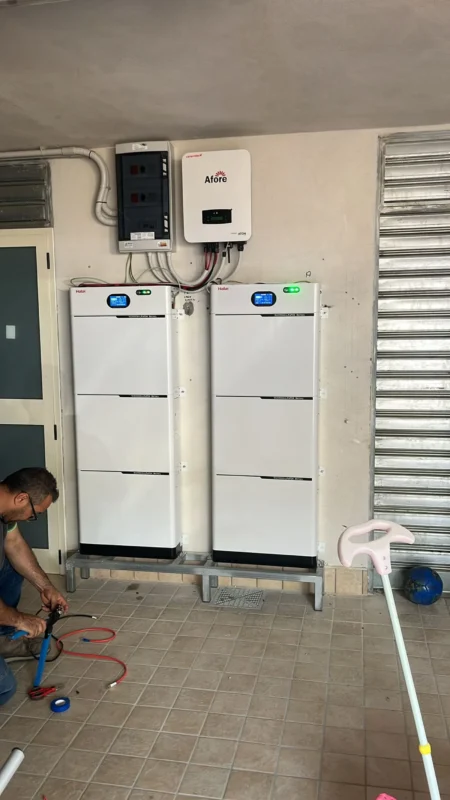
Commissioning should be repeatable and documented. It is not enough to confirm that the battery turns on. EPCs should verify firmware versions, inverter-battery communication, polarity, insulation resistance, grounding, protection settings, SOC calibration, alarm reporting, charge and discharge behavior, thermal monitoring, and emergency shutdown operation.
A practical acceptance test should include controlled charging and discharging under expected operating modes. The EMS should be tested for backup reserve, demand control, export limitation, generator coordination if applicable, and remote monitoring. Documentation should be handed over to the owner, including operating limits, warranty conditions, maintenance intervals, emergency procedures, and support contacts.
Many battery failures are caused by avoidable installation and configuration errors. These include mixing old and new batteries, mixing chemistries, using incorrect charge settings, installing batteries in poorly ventilated rooms, undersizing cables, failing to torque terminals correctly, placing batteries in high-temperature locations, omitting service clearance, and commissioning without alarm validation.
For resellers and EPCs, these mistakes can become warranty disputes. Manufacturers may reject claims if logs show over-discharge, excessive temperature, unauthorized expansion, or operation with unapproved inverter settings. Good installation practice is therefore also warranty protection.
The lifespan of a solar deep cycle battery depends on chemistry, depth of discharge, cycle frequency, temperature (which is one of the most influential field degradation factors), charge rate, maintenance quality, and operating strategy.
For procurement and system modeling, battery life should be evaluated using explicit assumptions. Key parameters include annual cycle count, average depth of discharge (DoD), expected capacity retention at year 5, year 10, or end of warranty, and whether system augmentation or full replacement is planned during the lifecycle.
These assumptions directly impact lifecycle cost modeling and ROI accuracy. In commercial PV projects, ignoring degradation curves can lead to overestimated long-term savings and undersized replacement planning.
Lead-acid systems may deliver acceptable life in low-cycle or well-maintained applications but often degrade faster under daily deep cycling. Lithium systems can last longer in frequent cycling applications when operated within BMS and warranty limits.
Service life should be modeled conservatively. A battery advertised with high cycle life under laboratory conditions may not achieve the same result in a hot mechanical room, with aggressive dispatch, poor ventilation, or inconsistent maintenance. Commercial proposals should clearly state assumptions for DoD, cycles per year, operating temperature, end-of-life capacity, and replacement timing.
Commercial PV owners benefit from remote monitoring because battery degradation is gradual and can be difficult to detect from utility bills alone. Important metrics include state of charge, state of health, voltage, current, temperature, cycle count, energy throughput, alarms, imbalance, and charge/discharge limits.
Monitoring data helps identify abnormal behavior before downtime occurs. For example, one battery string may run hotter than others, a cabinet may show reduced capacity, or the EMS may discharge too deeply during tariff events. These patterns can be corrected if detected early.
Monitoring also supports warranty claims. Accurate logs can prove that the system operated within approved limits and that maintenance was performed as required.
Flooded lead-acid batteries require the most hands-on maintenance. Tasks may include watering, electrolyte inspection, equalization charging where appropriate, terminal cleaning, corrosion control, ventilation checks, and capacity testing. Technician training is important because poor maintenance can shorten life or create safety hazards.
AGM and gel batteries reduce routine maintenance but still require inspection, temperature control, correct charging parameters, and periodic performance checks. They should not be treated as assets that can be installed and ignored.
Lithium systems generally require less mechanical maintenance, but they depend on electronics, firmware, BMS communication, and thermal management. O&M planning should include software updates where approved, alarm response procedures, spare parts strategy, and remote diagnostics.
Warranty risk is a commercial issue, not only a technical one. Common exclusions include over-discharge, operation outside temperature limits, incorrect inverter settings, unauthorized firmware changes, improper installation, physical damage, poor ventilation, and unsupported system expansion.
EPCs and resellers should evaluate local support before selecting a battery supplier. Important questions include response time, RMA process, spare module availability, technical training, commissioning support, documentation quality, and compatibility guidance. In commercial projects, the cost of downtime and truck rolls can exceed the initial price difference between battery options.
The lowest upfront price does not always produce the lowest cost per usable kWh. Lifecycle cost includes equipment, installation, BOS, controls, efficiency losses, maintenance labor, replacement frequency, downtime, disposal, recycling, and financing effects.
A simplified lifecycle comparison should consider how much usable energy the battery will deliver over its service life. A battery with higher CAPEX may be more economical if it delivers more cycles, higher usable DoD, lower energy losses, and fewer maintenance visits.
| Economic factor | Why it changes battery value |
|---|---|
| Cycle life | Determines replacement frequency |
| Round-trip efficiency | Affects delivered solar energy |
| Maintenance labor | Impacts OPEX and service cost |
| Usable DoD | Changes required nominal capacity |
| Warranty throughput | Limits revenue-generating operation |
| Downtime risk | Affects business continuity and customer satisfaction |
Battery ROI depends on the local tariff, facility load profile, solar generation curve, and dispatch strategy. Tariff structures can significantly impact storage value. Some tariffs reduce the economic benefit of storage if charging and discharging are not aligned with billing methodologies such as demand intervals or time-of-use rules. In addition, system design must consider whether PV-charged energy and grid-charged energy are treated differently under local tariff rules, as this can affect both operating strategy and financial return. Additional constraints may include non-export requirements, limits on grid charging, demand interval definitions, standby charges, and whether the system is intended for backup-only or market-dispatched operation. Different value stacks also reshape how the battery should be sized and operated. A system optimized for demand charge reduction may prioritize power output over energy capacity, while a self-consumption system typically requires larger storage duration to maximize solar utilization. Similarly, backup-oriented systems often oversize energy capacity to ensure reliability during outages, even if this reduces short-term financial ROI. Common value streams include increased self-consumption, peak shaving, demand charge reduction, time-of-use shifting, backup resilience, diesel generator displacement, and reduced curtailment.
For example, a factory with short but expensive demand peaks may achieve strong value from a battery sized for power delivery rather than long-duration energy. A supermarket may value resilience for refrigeration and business continuity. A remote agricultural site may prioritize diesel savings and reduced maintenance visits. A building with flat tariffs and few outages may struggle to justify storage unless there are grid constraints, resilience needs, or incentive programs.
The financial model should reflect real operating behavior. Overly optimistic assumptions about daily cycling, tariff savings, or battery life can distort payback.
Procurement should evaluate manufacturer track record, datasheet transparency, certifications, warranty terms, lead time, channel support, training, documentation quality, spare parts, and inverter compatibility. For formal commercial tenders, technical risk can be as important as unit price.
Datasheets should specify capacity at relevant discharge rates, usable energy, operating temperature, cycle life assumptions, communication protocols, protection functions, enclosure rating, and warranty conditions. Vague specifications increase risk during design, commissioning, and claims.
Resellers should also consider after-sales capability. A product that cannot be supported locally may damage customer trust, even if it performs well in theory.
Lithium is often the stronger lifecycle choice for high-cycle commercial PV storage because it typically offers higher usable capacity, longer cycle life, higher efficiency, and lower routine maintenance. This is especially relevant for peak shaving, self-consumption, microgrids, and daily dispatch.
Lead-acid may still be viable in selective cases: low-cycle backup, strict CAPEX constraints, remote regions with established lead-acid service capability, or projects where replacement planning is acceptable. However, designers must account for lower usable DoD, maintenance labor, ventilation, and shorter practical life under deep cycling.
The best ROI decision is not “lithium versus lead-acid” in isolation. It is the chemistry, system architecture, operating strategy, warranty, and O&M model that best match the site’s financial and technical requirements.
A deep cycle battery for solar should be specified as part of the complete PV storage system, not as a standalone component. The most reliable commercial projects start with the load profile and business objective, then align battery chemistry, usable capacity, inverter compatibility, EMS control logic, safety compliance, installation quality, monitoring, warranty terms, and lifecycle economics. For EPCs and project owners, this system-level approach is the difference between adding batteries and delivering bankable solar storage performance.
Battery sizing depends on both energy (kWh) and power (kW), since both determine duration and peak load support. A basic workflow includes interval load data, separation of critical and non-critical loads, and defining usable energy for required duration. Design must also account for DoD, system efficiency losses, temperature derating, and future load growth. Peak and surge power must be verified to ensure inverter and battery compatibility. These factors together determine the final usable system size, not nameplate capacity alone.
Lithium is generally better for frequent cycling due to higher efficiency, deeper usable capacity, and longer cycle life. Lead-acid can still be suitable for standby or low-cycle backup where cost is the main constraint. The choice depends on application, not chemistry alone. Key comparison factors include usable capacity, maintenance requirements, and lifecycle cost. Each technology performs best under different operating profiles.
Yes, but only if system compatibility is confirmed. Residential retrofit systems are usually simpler, while commercial systems require engineering review and sometimes utility approval. Most grid-tied PV inverters cannot connect directly to batteries. Common solutions include AC-coupled storage, hybrid inverter upgrades, or full ESS integration. Final design depends on inverter type, load requirements, and backup expectations.
Battery lifespan should be evaluated in both years and cycles, since both define real performance. Backup-only systems typically last longer than daily cycling systems. Temperature is one of the most important factors affecting degradation. High heat accelerates aging, while low temperatures can limit performance. Actual lifespan depends on chemistry, usage pattern, and operating conditions.
Failures usually come from configuration, environmental, and operational issues. Common causes include incorrect settings, incompatible inverter pairing, and poor protection design. Environmental factors like high temperature and poor ventilation also accelerate degradation. Operational issues include deep discharge, improper cycling, and mixing old and new batteries. Poor EMS dispatch can further increase wear by causing inefficient or excessive cycling.
https://www.energy.gov/eere/solar/articles/solar-plus-storage-101








 Turkish
  Romanian