




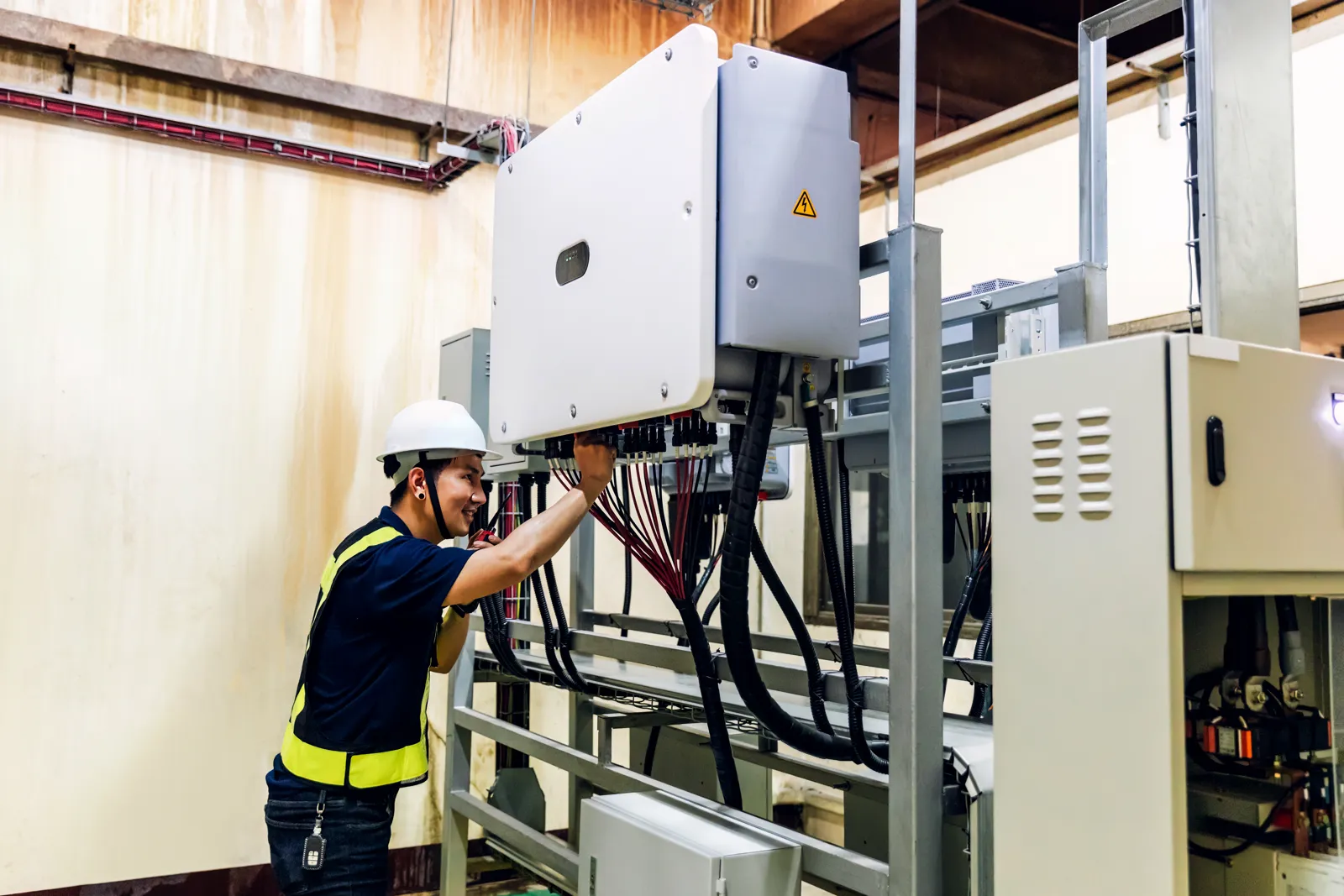
Battery inverters are a critical interface between battery energy storage systems, PV generation, site loads, and the utility grid. In commercial and industrial solar projects, they do far more than convert electricity from one form to another. They determine how quickly a battery can charge or discharge, how reliably backup loads are supported, how accurately export limits are controlled, how the site responds to grid events, and how well the overall storage investment performs over time.
For EPCs, installers, system integrators, resellers, and commercial project owners, battery inverter selection is therefore not a simple product choice. A poorly matched inverter can reduce usable battery capacity, create commissioning delays, limit revenue from demand charge management or grid services, and increase warranty risk. In some markets, an inverter that does not meet local grid-code requirements can also delay interconnection approval or force costly redesign.
This guide explains how battery inverters work in commercial PV and energy storage systems, where they fit in AC-coupled and DC-coupled architectures, which technical specifications matter, and how to evaluate installation, monitoring, compliance, supplier support, and lifecycle economics. The focus is practical decision-making for professional solar and storage projects rather than household backup or hobbyist systems.
A battery inverter converts DC power from a battery system into AC power that can serve site loads or be exported to the grid where allowed. In bidirectional operation, it also converts AC power back into DC power to charge the battery from the grid, from PV generation through the AC bus, or from another approved source. In many commercial systems, the battery inverter is also referred to as an energy storage inverter, bidirectional inverter, or power conversion system, often shortened to PCS.
In grid-connected and backup applications, battery inverters may operate in different control modes. A grid-following inverter requires an existing grid voltage and frequency reference to synchronize and operate. It depends on the utility grid or a stable AC source such as a generator or microgrid backbone.
A grid-forming inverter can establish voltage and frequency on its own. This capability is important in islanded operation, backup systems, and microgrids where the utility grid is not present. Not all battery inverters support grid-forming functions, and this must be confirmed at the design stage.
For example, in grid-tied peak shaving applications, the battery inverter typically operates in grid-following mode to reduce demand during tariff peaks. In critical-load backup systems, the inverter may switch to islanded operation and supply selected loads during grid outage. In microgrid applications, grid-forming inverters can stabilize voltage and frequency while coordinating multiple energy sources such as PV, batteries, and generators.
In a battery energy storage system, the inverter works closely with the battery management system. The BMS supervises cell voltage, temperature, state of charge, safety limits, and battery rack status. The inverter executes charging and discharging commands within those limits. If the BMS detects an unsafe condition, such as excessive temperature, overvoltage, undervoltage, or communication failure, it can restrict or stop inverter operation.
Beyond conversion, battery inverters control power quality and grid interaction. They synchronize with the utility grid, manage voltage and frequency behavior, limit harmonic distortion, provide reactive power support where required, and respond to energy management system commands. In backup or microgrid applications, certain inverters can also support islanded operation, black start, and grid-forming functions, although these capabilities must be verified carefully because not every grid-tied storage inverter can operate as a backup inverter.
A battery inverter is typically dedicated to battery charging and discharging. It is often used alongside separate PV inverters in AC-coupled systems. A hybrid inverter combines PV inverter and battery inverter functions in one device, handling PV input and battery power conversion through an integrated architecture.
The distinction matters in commercial projects because it affects system design and procurement risk. EPCs should verify the actual electrical topology rather than relying on the product label “hybrid inverter.” Different products may have different internal configurations and operating logic. A dedicated battery inverter can be attractive for retrofits because existing PV inverters may remain in place. It also allows EPCs to scale PV and storage independently and select different equipment platforms for each function. However, it may require more integration work between the PV inverter, battery inverter, meters, EMS, and site controller.
A hybrid inverter can simplify some new-build projects because PV and storage controls are integrated in one unit. It may reduce equipment count, save space, and improve solar-to-battery charging efficiency in certain DC-coupled designs. However, it can also limit component flexibility. Key technical checks should include PV input limits, battery port power limits, backup operation behavior, DC bus architecture, and all approved operating modes. These parameters determine whether the inverter is suitable for the intended project design. EPCs must confirm PV string compatibility, battery compatibility, inverter firmware, monitoring integration, and service support through one supplier ecosystem or a validated multi-vendor architecture.
Commercial and industrial storage projects are usually designed around a specific value case. Battery inverters support peak shaving by discharging when facility demand approaches a costly tariff threshold. They support self-consumption optimization by storing excess PV generation and discharging it later when on-site demand is higher. They enable time-of-use arbitrage where electricity prices vary by time of day, and they can provide backup power for selected critical loads if the system is designed for islanding.
In larger or more advanced projects, battery inverters may also support microgrids, renewable firming, ramp-rate control, voltage support, frequency response, and participation in demand response or ancillary service programs. These use cases place different demands on response time, overload capability, operating mode flexibility, control accuracy, and availability. A battery inverter selected only for basic kW capacity may not be suitable for a project that later needs grid-support functions or revenue stacking.
The commercial value case depends on the facility’s load profile, tariff structure, export rules, grid connection capacity, resilience requirements, and local interconnection policy. For example, a warehouse with high morning demand peaks may need a different inverter-to-battery ratio than a factory with continuous loads or a retail chain seeking standardized systems across multiple sites.
Battery inverter terminology is not always used consistently in tenders and datasheets. In many commercial storage projects, “battery inverter,” “energy storage inverter,” and “bidirectional inverter” may refer specifically to the power electronics unit that performs DC to AC conversion and AC to DC charging functions. In this narrow definition, the term focuses only on the inverter hardware and control electronics.
However, the term “PCS” (Power Conversion System) is often used in a broader system-level context. In larger commercial and utility-scale energy storage projects, a PCS may include not only the inverter bridge, but also integrated DC disconnects, AC switchgear interfaces, control systems, thermal management or cooling units, and in some cases transformer integration or container-level assembly. It can therefore refer to a skid-mounted or containerized subsystem rather than only the inverter itself.
“Hybrid inverter” usually refers to a device that integrates PV and battery conversion functions in a single unit. EPCs should always confirm whether technical documents refer to inverter-only hardware or a complete PCS subsystem, because the scope of supply can vary significantly between manufacturers and project types.
“AC-coupled storage” means the PV inverter and battery inverter connect on the AC side. “DC-coupled storage” means PV and battery resources share a DC-side architecture, often through a hybrid inverter or common DC bus.
Clarifying these terms early avoids procurement confusion. A tender that asks for a “storage inverter” may still require grid-forming capability, zero-export control, specific BMS communication, or certified grid-code functions. These details should be written explicitly in technical specifications rather than assumed from product labels.
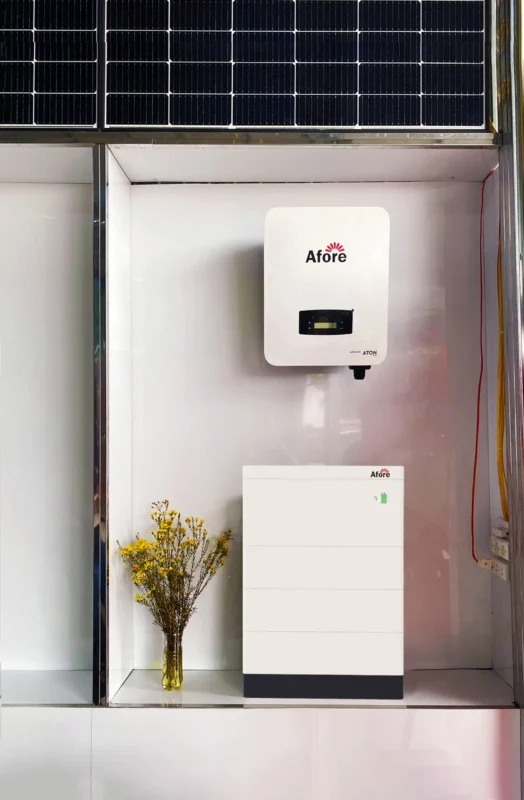
In an AC-coupled system, the PV inverter and battery inverter connect to the site’s AC electrical system. The PV inverter converts solar DC power into AC power. The battery inverter charges and discharges the battery through the same AC bus, depending on EMS commands, metering data, tariff logic, and grid conditions.
The battery inverter cannot inherently distinguish whether AC power originates from PV or the grid. Charging source control is typically enforced through EMS logic, metering configuration, and interconnection or incentive requirements.
This architecture is common in commercial retrofits because existing PV systems can often remain largely unchanged. If a facility already has a rooftop PV plant, an EPC can add a battery inverter, battery cabinets, metering, protection equipment, and EMS controls without redesigning the PV DC side.
AC coupling also supports modular expansion because storage capacity can be added as a separate subsystem.
However, energy may pass through additional conversion stages. For example, solar energy converted from DC to AC by the PV inverter and then from AC to DC by the battery inverter during charging experiences additional losses.
In practice, PV-only charging, grid charging, or mixed charging strategies are implemented through EMS control rules and utility or tariff requirements rather than inverter hardware alone.
In DC-coupled systems, PV and storage connect on the DC side, often through a hybrid inverter or shared DC bus. This can reduce conversion stages when charging the battery from solar generation. For new-build solar-plus-storage plants, DC coupling may improve solar-to-battery efficiency and reduce some balance-of-system costs, depending on the layout, DC/AC ratio, interconnection capacity, and protection design.
DC coupling can also help projects capture solar energy that would otherwise be clipped by the inverter during high-generation periods, if the system is designed to redirect that excess DC energy into the battery. This can be useful where grid export is limited or interconnection capacity is constrained.
However, DC-coupled designs require careful engineering. PV string design, battery voltage windows, DC protection, inverter operating limits, firmware compatibility, and safety coordination become more interdependent. Retrofits may be more difficult because modifying the existing PV DC architecture can increase labor, shutdown time, and permitting complexity.
| Criteria | AC-Coupled System | DC-Coupled System |
|---|---|---|
| Retrofit suitability | High | Low |
| New-build suitability | Medium | High |
| Conversion losses | Higher | Lower |
| Clipped energy capture | Limited | Strong advantage |
| PV inverter independence | Fully independent | Limited |
| Commissioning complexity | Lower | Higher |
| Export control complexity | Medium | High |
| Future expansion flexibility | High | Medium |
Commercial projects can use one larger centralized PCS or multiple smaller distributed battery inverters. Centralized designs may reduce equipment count and simplify some large installations, while distributed designs can improve redundancy and service flexibility. The right choice depends on project scale, available space, service strategy, and portfolio standardization.
| Design approach | Typical advantage | Key risk to evaluate |
|---|---|---|
| Centralized PCS | Lower equipment count and simpler high-power aggregation | Larger single point of failure |
| Distributed battery inverters | Better redundancy and modular service | More communication and commissioning points |
| Containerized inverter and battery block | Faster deployment and factory integration | Less flexibility in component selection |
| Site-level modular architecture | Easier phased expansion | Requires consistent firmware and controls |
For multi-site commercial portfolios, distributed or standardized modular designs can simplify training, spare parts, and O&M procedures. For a large factory or logistics hub, a centralized PCS may be more practical if service access, cooling, and redundancy are addressed properly.
Many battery inverters can operate without solar panels in standalone energy storage systems. In this configuration, the battery charges from the grid during low-cost periods or when instructed by an EMS, then discharges to reduce peak demand, support backup loads, or participate in grid programs where allowed.
This is relevant for facilities that want to start with storage before adding PV, or for sites where tariff optimization and resilience are the main drivers. However, grid-charged storage may face different interconnection rules, export permissions, incentive eligibility, and metering requirements than solar-plus-storage. EPCs should confirm whether the inverter is certified and approved for the intended operating modes, including grid import charging, export limitation, and backup operation.
The inverter’s kW rating determines how much instantaneous power the battery system can deliver or absorb.
Inverter power must also respect the battery’s allowable charge and discharge C-rate. The C-rate defines how fast the battery can safely be charged or discharged relative to its usable energy capacity. Even if the inverter is oversized, the system cannot exceed the battery’s manufacturer-defined continuous C-rate limits without reducing lifetime or triggering protection controls.
For example, a 500 kWh battery with a 0.5C continuous discharge limit can safely deliver about 250 kW of continuous power under normal operating conditions, before accounting for system losses and manufacturer safety margins.
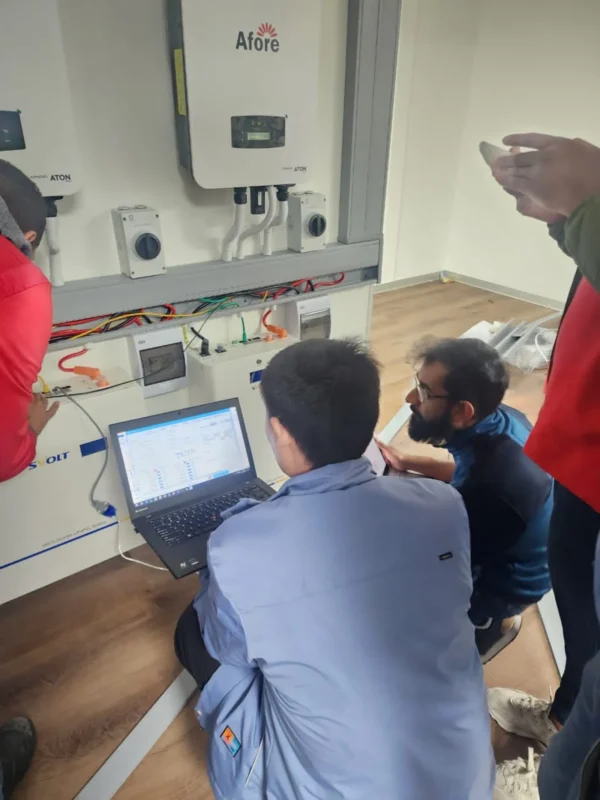
Beyond power rating, EPCs should also evaluate power quality performance of battery inverters. Key parameters include total harmonic distortion (THD), power factor range, reactive power capability, voltage regulation performance, phase imbalance support, fault ride-through behavior, and response time under dynamic grid conditions.
These parameters are important because commercial and industrial loads often include motors, compressors, HVAC systems, refrigeration units, and sensitive control equipment. Poor power quality can affect equipment stability, increase losses, or lead to utility non-compliance. In grid-connected projects, these requirements also influence interconnection approval and grid compliance studies.
The usable energy of the battery is determined by state of charge (SOC) operating limits, depth of discharge (DoD), and round-trip efficiency. These factors reduce the theoretical battery capacity into a practical usable energy window for real operation. Confusing these two values is one of the most common mistakes in commercial storage planning.
A 500 kWh battery paired with a 100 kW inverter can theoretically discharge at full inverter output for roughly five hours before losses and usable depth-of-discharge limits are considered. The same battery paired with a 250 kW inverter can deliver more power, but for a shorter duration. If the project goal is demand charge reduction, the inverter must be sized to reduce the facility’s demand peaks. If the project goal is backup, the inverter must support critical load power and surge requirements.
Overload and surge capacity are especially important for motor loads, pumps, compressors, elevators, refrigeration systems, and industrial equipment. The datasheet should distinguish between continuous output, short-duration overload, and peak surge behavior. EPCs should also check whether overload capability changes with ambient temperature, battery state of charge, or grid-connected versus islanded operation.
Battery inverter compatibility is more than nominal voltage matching. The inverter must operate within the battery system’s DC voltage window across its full state-of-charge range. It must also respect charge and discharge current limits, battery chemistry constraints, temperature boundaries, and BMS safety commands.
Communication is equally important. Commercial battery inverters commonly interface with batteries and EMS platforms through CAN, RS485, Modbus, Ethernet, IEC 61850, DNP3, or proprietary protocols. Both protocol selection and validated interoperability are critical because they determine system stability, data accuracy, and long-term maintainability.
The inverter–BMS interface must also be validated from a safety perspective, ensuring that charge and discharge limits, fault signals, and emergency shutdown commands are correctly executed under all operating conditions.
EMS and SCADA communication protocols must also support required telemetry, setpoints, alarm handling, and cybersecurity controls to ensure reliable remote operation and compliance with site IT requirements. Alignment with IEC 62443 or equivalent owner IT cybersecurity requirements is increasingly required in commercial and industrial projects.
A technically suitable inverter can still become a project risk if the battery and inverter have not been tested together. Firmware mismatch, incomplete BMS mapping, or unsupported alarm handling can delay commissioning and complicate warranty claims.
Modern commercial energy storage inverters typically offer high peak conversion efficiency, but overall project performance depends on system design and operating conditions. However, peak efficiency does not equal project-level performance.
It is important to distinguish between inverter conversion efficiency, battery DC round-trip efficiency, full system AC-to-AC round-trip efficiency, and auxiliary consumption from cooling, controls, and standby loads.
Real system performance includes inverter conversion losses, transformer losses, auxiliary consumption, battery losses, HVAC or ventilation loads, partial-load operation, and standby consumption.
A simplified loss path can be described as:
AC input during charging → inverter conversion losses → battery DC storage losses → inverter discharge losses → AC output, with auxiliary system consumption occurring throughout operation.
For commercial projects, the difference between brochure efficiency and field efficiency matters because storage revenue depends on usable discharged energy. A system that cycles daily for tariff optimization or grid services will be more sensitive to small efficiency differences than a backup-only system that rarely cycles.
| Metric | Why it matters in C&I projects |
|---|---|
| Peak inverter efficiency | Indicates best-case conversion performance |
| Partial-load efficiency | Important when system operates below rated power |
| Standby consumption | Affects annual losses during idle periods |
| AC round-trip efficiency | Better indicator of delivered value from stored energy |
| Thermal derating curve | Shows performance under real site temperatures |
Battery energy storage system performance and operating behavior are widely discussed in technical standards and industry research, which support system-level design and operational planning.
Sizing a battery inverter starts with the use case, not the battery nameplate capacity. EPCs should begin with measured load data at interval resolution, usually 15-minute or finer where available. The design team should identify peak demand events, critical loads, expected PV generation, tariff windows, export constraints, backup duration requirements, and interconnection limits.
The inverter kW rating should be matched to the power events the system must control. A practical sizing example for a commercial site can help validate this logic. For a facility with a measured peak demand of 900 kW and a target demand limit of 700 kW, the required peak shaving capacity is 200 kW. If the system is designed to sustain this reduction for 2 hours, the battery inverter must support at least 200 kW continuous output with additional safety margin. In this case, the usable battery energy should exceed 400 kWh after accounting for depth of discharge (DoD) and system efficiency losses to ensure stable operation during the full peak period.
Before finalizing inverter sizing, EPCs should verify that all key input data is available. This includes at least 12 months of 15-minute interval load data, utility tariff structure, historical electricity bills, and PV production profiles if applicable. Electrical system information such as single-line diagrams, transformer ratings, and available fault current levels should also be confirmed to ensure accurate system constraints.
Operational requirements must also be clearly defined, including peak demand targets, critical load identification, export limitation rules, backup duration expectations, and any known grid interconnection constraints. Site conditions such as ambient temperature range, altitude, ventilation limits, and available installation space should be included in the design assumptions.
Finally, integration requirements should be validated early in the design process. These include EMS or SCADA compatibility, communication protocol requirements, cybersecurity restrictions, and any utility-specific control or interconnection rules that may affect inverter operation.
For demand charge reduction, the inverter must discharge enough power during peaks to keep grid demand below the target threshold. For backup, it must supply the critical load panel and handle startup surges. For time-of-use shifting, it must charge and discharge within tariff windows without violating battery C-rate limits. For grid services, it must meet response time, ramp rate, accuracy, and availability requirements.
Battery kWh and inverter kW must be modeled together to ensure both power capability and energy duration are sufficient. A high-power inverter paired with insufficient battery capacity may reduce peaks briefly but fail to sustain the reduction. A large battery paired with an undersized inverter may store energy but be unable to discharge quickly enough to create the desired financial impact.
Battery inverters used in grid-connected commercial systems must comply with local interconnection requirements. In larger commercial and industrial systems, a transformer is often required when the inverter output voltage does not match the facility distribution voltage or utility interconnection voltage. Battery inverters may connect at low voltage (e.g., 400–480V) or medium voltage levels depending on system size and design architecture. Medium-voltage connection is typically used for larger capacity systems to reduce current levels and improve distribution efficiency.
In the United States, grid connection requirements commonly reference IEEE 1547-2018 and UL 1741 SB for inverter-based resource certification and interconnection behavior. In Europe, EN 50549 defines technical requirements for generator connection at low and medium voltage levels. In the United Kingdom, G99 and G100 govern distributed generation and export limitation. In Australia, AS/NZS 4777.2 specifies inverter performance and grid connection rules for distributed energy systems. Many utilities and regions also apply additional site-specific or utility-specific settings beyond these baseline standards.
These requirements typically cover key inverter functions such as anti-islanding protection, voltage and frequency ride-through, reactive power control, power factor regulation, export limitation, ramp-rate control, frequency-watt and voltage-watt response, and grid synchronization behavior.
While EU network codes provide a common regulatory framework, the actual compliance package for battery storage projects is determined by national regulations, utility procedures, and project-specific connection agreements.
In systems that require a transformer, several additional design factors must also be considered. Transformer losses directly affect overall system efficiency and should be included in lifecycle energy modeling and performance assessment. Grounding configuration must be coordinated between the inverter design and utility interconnection requirements to ensure stable operation and compliance.
Protection coordination between the transformer, switchgear, and inverter must be carefully designed to prevent nuisance tripping, miscoordination, or fault propagation across system components. In addition, the location of utility metering is typically on the grid side of the transformer, and this placement can affect energy accounting, billing accuracy, and compliance verification during commissioning and operation.
These functions ensure that battery inverters can operate safely and support grid stability under both normal and abnormal grid conditions.

However, certification to a standard does not automatically guarantee utility approval. Final interconnection approval often depends on utility-specific parameter settings, grid studies, protection coordination, and verification during commissioning at the site level.
For projects in North America, Europe, and other regulated markets, grid requirements may also reference regional regulations such as EU Regulation 2016/631, which defines technical requirements for generator and inverter-based resources within the European network code framework.
Storage classification and compliance requirements can vary depending on the country, connection voltage level, and operating mode, such as grid-tied, hybrid, or backup configurations.
Because of these differences, commercially available inverters may require different firmware versions, grid profiles, or certification packages depending on the target market. EPCs and system integrators should always verify not only hardware compliance, but also utility acceptance requirements before procurement to avoid delays in interconnection approval.
Many commercial PV and storage projects operate under export limits. Some utilities allow no export. Others allow limited export based on interconnection capacity. Battery inverters can help manage these constraints by charging when PV generation exceeds on-site demand and discharging when demand rises. However, zero-export control depends on accurate metering, fast control response, correct CT orientation, and coordination between PV inverter, battery inverter, and EMS.
Grid-support functions may include reactive power management, voltage regulation, frequency response, and controlled ramping. These features can be valuable or mandatory, depending on the site. In some markets, they create revenue opportunities through ancillary services. In others, they are necessary for interconnection approval.
The key project question is not simply whether the inverter has these functions, but whether they are certified, configurable, documented, and proven in the required operating mode.
Battery inverter safety must be coordinated with the complete electrical system. This includes not only electrical design but also compliance with multiple safety domains that apply to commercial energy storage systems.
Key safety areas include battery system safety, inverter safety, fire protection requirements, and site electrical installation rules. In many commercial projects, EPCs must consider compliance frameworks such as UL 9540 for energy storage systems, UL 9540A for thermal runaway fire propagation testing, UL 1741 for grid-tied inverter safety, UL 1741 SB for advanced inverter functions, IEC 62109 for power converter safety, IEC 62477 for power electronic systems, IEC 62933 for energy storage system safety requirements, and NFPA 855 for stationary energy storage installation fire codes, in addition to local electrical codes and utility requirements.
Commercial storage systems involve high DC voltages, high fault currents, and complex control interactions between batteries, inverters, switchgear, and protection devices. Proper coordination is required for DC isolation, AC breaker selection, grounding design, surge protection, insulation monitoring, and emergency shutdown logic.
Inverter protection settings must also coordinate with battery management systems, fire suppression systems, transformers, and EMS control commands. Safety verification should be completed during engineering and factory testing stages, not only during final commissioning, to reduce installation risk and delays.
Commercial projects usually require more documentation than product datasheets. Permitting authorities, utilities, insurers, owners, and EPC quality teams may request different documents at different stages. The most useful suppliers provide a complete documentation package early, because missing documents can delay approvals even when the hardware is technically suitable.
| Document | Why it is needed |
|---|---|
| Datasheet and installation manual | Engineering, layout, and installation planning |
| Grid-code certificates | Interconnection and utility review |
| Single-line diagram support | Permitting and protection review |
| Battery compatibility statement | Procurement and warranty validation |
| Protection settings | Commissioning and grid approval |
| Commissioning checklist | Handover and warranty record |
| Monitoring and communication guide | EMS and SCADA integration |
For EPCs, early document review is a risk-control step. If certificates, manuals, or approved battery lists are incomplete, the issue should be resolved before purchase orders are placed.
Battery inverters are sensitive to the installation environment. Indoor versus outdoor placement, enclosure rating, altitude, humidity, dust, ambient temperature, ventilation, and required clearances can all affect performance and warranty validity. An inverter that performs well in a controlled electrical room may derate or fail prematurely in a hot, dusty, poorly ventilated enclosure.
EPCs should verify inverter continuous output performance at different ambient temperatures, commonly at 40°C, 45°C, and 50°C. Many commercial inverters begin to derate output as temperature increases, which can directly reduce available peak shaving or backup capacity during high-load conditions.
Thermal management is especially important for high-utilization systems. Design review should also include ventilation airflow requirements, filter replacement intervals, and maintenance accessibility. Altitude derating thresholds must be checked for high-elevation sites, as reduced air density can impact cooling performance. EPCs should also confirm whether derating affects both charge and discharge modes, as some systems reduce only discharge capability while others limit full bidirectional power.
Fans, filters, heat exchangers, liquid cooling interfaces, or HVAC requirements must be maintained throughout the system life. If cooling is undersized, blocked, or poorly controlled, the inverter may reduce output during peak periods—the exact time when the storage system is expected to deliver value.
Physical wiring and digital integration are both critical. AC cabling must be sized for continuous current, fault levels, voltage drop, and thermal conditions. DC cabling must account for battery voltage, current, insulation, polarity, isolation, and routing. Communication wiring must be protected from noise, distance limitations, network instability, and cybersecurity weaknesses.
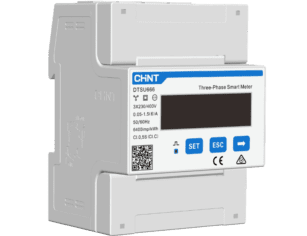
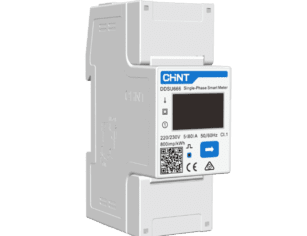
Smart meters and CTs are frequent sources of commissioning problems. Incorrect CT orientation, wrong meter location, or mismatched scaling can cause the EMS to misread site import/export conditions. This can lead to failed zero-export control, unexpected battery charging, or inability to meet demand shaving targets.
For larger sites, the battery inverter may need to communicate with an EMS, SCADA platform, PV inverter fleet, building management system, utility gateway, or aggregator. Controls integration should be tested before final utility inspection whenever possible.
Commissioning verifies that the installed system matches design intent and operates safely. Commissioning for commercial energy storage inverters should include formal acceptance evidence to confirm system performance and compliance. Meter accuracy verification must be completed to ensure correct energy accounting. CT orientation and wiring polarity tests are required to validate measurement correctness. Export limit response tests should confirm that the system can control grid import and export within defined thresholds.
Charge and discharge ramp tests should verify that the inverter responds correctly to dispatch signals under dynamic conditions. Alarm simulation tests are required to confirm fault detection, reporting accuracy, and system response behavior. Emergency stop verification must ensure that the system can safely shut down under fault or safety conditions.
Grid-code parameter files should be reviewed and confirmed against utility-approved settings before final acceptance. All results should be documented through signed FAT (Factory Acceptance Test) and SAT (Site Acceptance Test) records to provide traceable compliance evidence.
For commercial energy storage inverters, commissioning should confirm firmware versions, battery compatibility, polarity, insulation resistance, grounding, protection settings, grid synchronization, metering accuracy, charge/discharge operation, emergency stop response, alarms, remote monitoring, and EMS dispatch logic.
A practical commissioning process usually includes energization checks, low-power functional tests, full charge and discharge tests where feasible, backup or islanding tests if applicable, and verification of export limitation. EPCs should document test results carefully because commissioning records often become important for warranty claims, performance guarantees, and owner handover.
Many project delays are caused by details that appear minor during design. Battery firmware may not match inverter firmware. A meter may be installed on the wrong side of a transformer. Network access may be unavailable because the facility IT team was not involved early. Ventilation may be insufficient because actual room temperature is higher than assumed. Grid settings may not match utility-approved parameters.
These risks are manageable when EPCs treat the battery inverter as part of a complete control and protection system. Factory acceptance testing, pre-commissioning checklists, early utility coordination, and validated reference architectures can reduce the likelihood of last-minute redesign.
Cybersecurity is becoming a critical requirement for modern battery inverter systems, especially in commercial and multi-site deployments where remote monitoring and control are required.
Core security controls should include role-based access control, secure authentication and user permission management, encrypted communication channels (including for remote access), comprehensive audit/event logging, and strict password policies. Remote connectivity should ideally use VPN or secure gateway architecture, and firmware updates must be digitally signed and follow a clearly defined update procedure to prevent unauthorized modification.
Network segmentation between operational technology (OT) and IT networks is recommended to reduce cyber risk in critical infrastructure environments such as manufacturing, logistics, healthcare, and data centers. Where applicable, inverter systems should align with IEC 62443 cybersecurity standards or follow equivalent owner IT security requirements, since these facility types often carry their own internal cybersecurity requirements that must be considered during inverter selection.
Commercial battery inverter service life depends on operating temperature, duty cycle, component quality, environmental exposure, maintenance, firmware support, and availability of spare parts. Many project financial models assume inverter service life aligned with the storage system warranty period, but EPCs should plan realistically for mid-life maintenance.
Fans, filters, contactors, capacitors, auxiliary power supplies, and communication modules may require inspection or replacement during the system life. A battery inverter used for daily cycling, fast frequency response, or high-temperature operation may face more stress than one used mainly for occasional backup.
Warranty duration is important, but warranty quality matters more. Buyers should review exclusions for temperature, humidity, dust, cycling intensity, improper firmware updates, unapproved batteries, and unauthorized service. Extended warranty options may be valuable if they include response times, spare parts, and remote diagnostic support.

Preventive maintenance reduces downtime and protects project value. O&M providers should periodically inspect ventilation paths, filters, fans, cable terminations, torque marks, grounding, enclosure seals, surge protection, alarms, firmware versions, and communication links. Thermal imaging can help identify overheating conductors, loose connections, or blocked cooling paths before they cause failures.
Serviceability should influence procurement. A design with accessible power modules, clear alarm hierarchy, remote diagnostics, and local spare parts can reduce truck rolls and downtime. Conversely, a low-cost inverter with limited diagnostic tools may increase OPEX if faults require repeated site visits or long replacement lead times.
Battery inverters may derate, trip, or enter protective states due to high temperature, grid disturbances, battery alarms, communication loss, overcurrent, harmonics, or EMS command conflicts. A reliable commercial project needs a defined fault response plan. Operators should know which alarms are informational, which require immediate shutdown, and which can be resolved remotely.
Remote diagnostics are especially valuable for distributed portfolios. If an EPC manages systems across retail stores, warehouses, or commercial rooftops, standardized alarm codes and remote access can reduce service cost significantly. Spare-part planning also matters. If a failed inverter module takes months to replace, the lost savings may exceed the original equipment price difference.
The purchase price of the battery inverter is only one part of installed cost. Commercial projects also require switchgear, protection devices, meters, communication equipment, enclosures, transformers where needed, ventilation or HVAC, installation labor, engineering, permitting, grid studies, commissioning, and integration work.
A lower-cost inverter may not reduce project CAPEX if it requires additional external controls, custom engineering, longer commissioning, or more expensive protection equipment. EPCs should compare installed cost and project risk, not only unit price.
Operating costs include preventive maintenance, monitoring subscriptions, service contracts, spare parts, firmware support, remote access, inspections, and possible mid-life component replacement.
Warranty coverage should be evaluated against real operating risks in commercial projects. Key risk areas include use of unsupported battery models, operation outside approved temperature or humidity ranges, and unauthorized firmware modifications. Excessive cycling beyond design assumptions can also affect warranty validity.
Other common risks include missing maintenance records, use of non-certified grid settings, blocked cooling systems, and improper storage conditions before installation. These factors can lead to warranty denial even if the hardware itself is functioning correctly.
Warranty terms should be checked against the project’s intended operation. A system cycling once per day for self-consumption has a different risk profile than one performing fast grid services with frequent charge-discharge events.
Response time is also a financial variable. If the inverter is offline during demand peaks, the facility may lose monthly savings. If a grid-services project misses availability obligations, penalties may apply. Therefore, service capability, local support, and spare-part availability are part of financial due diligence.
Battery inverters influence financial performance through efficiency, availability, response speed, control accuracy, and operating flexibility. For projects relying on multiple revenue streams, battery inverters must support fast response to dispatch signals and high accuracy in load following. Precise control of charge and discharge is required to maintain scheduled performance under time-of-use or demand response programs.
High system availability is critical to avoid revenue loss during peak pricing periods. Accurate telemetry and real-time monitoring are required for settlement and verification. Remote setpoint control capability is also important for participation in grid services or aggregated energy programs.
In a demand charge project, a slow or undersized inverter may fail to shave peaks. In a time-of-use project, low partial-load efficiency and high standby consumption may reduce arbitrage value. In a grid-support project, poor setpoint tracking or frequent trips may reduce revenue and increase penalty risk.
For solar-plus-storage projects, the inverter also affects how much PV energy can be stored, how export limits are managed, and how the system behaves during curtailment or grid events. A project with slightly higher CAPEX may achieve better lifecycle value if the inverter improves availability, reduces commissioning time, supports future revenue streams, or lowers O&M cost.
A higher-cost battery inverter can be justified when it reduces total lifecycle risk. This is often the case where the project requires strict grid-code compliance, better thermal performance, stronger backup capability, validated battery compatibility, longer warranty coverage, modular expansion, or advanced monitoring.
For example, a manufacturing facility with high demand charges may benefit more from reliable peak shaving than from the lowest equipment price. A logistics site with refrigeration loads may need overload performance and fast service response. A multi-site retail portfolio may prefer standardized inverter platforms because training, commissioning templates, and spare-part stocking become easier across dozens of installations.
The commercial decision should be based on lifecycle cost, uptime, and project value—not only the initial inverter quotation.
Datasheets should be reviewed critically. Key procurement checks include rated AC power, charge and discharge power limits, DC voltage range, supported battery chemistries, approved battery models, peak and partial-load efficiency, operating temperature, enclosure rating, cooling method, certifications, grid-code profiles, communication protocols, overload capacity, warranty terms, and service requirements.
Resellers should avoid relying only on catalog claims. Official certificates, installation manuals, compatibility documents, and commissioning guides should be available before the product is offered for commercial projects. Incomplete technical documentation creates risk for the installer and the end customer.
Battery inverter suppliers should be evaluated on more than product specifications. EPCs and channel partners need technical training, design review support, commissioning assistance, remote diagnostic capability, clear RMA procedures, local spare parts, and warranty claim transparency.
After-sales capability directly affects customer satisfaction. If installers cannot obtain fast answers during commissioning, project handover may slip. If spare parts are unavailable during operation, the owner may lose savings. For B2B channels, supplier readiness is a core part of product suitability.
Commercial storage projects depend on interoperability. The battery inverter must coordinate with battery racks, PV inverters, EMS controllers, smart meters, protection devices, and sometimes utility or aggregator platforms. Each interface introduces potential failure points.
System integrators should request tested reference architectures. A validated combination of inverter, battery, EMS, and meter reduces commissioning uncertainty. If a project uses components that have not been tested together, the EPC should budget additional time for integration and troubleshooting.
Lead times can affect project schedules and interconnection deadlines. Procurement teams should confirm delivery timelines, packaging, market certifications, spare-unit availability, and replacement-part logistics. For portfolios, standardizing battery inverter models can simplify training, commissioning, monitoring, and O&M.
Standardization should not mean forcing one product into every application. Rather, EPCs can define a controlled set of approved inverter sizes and architectures for different project types. This balances flexibility with operational consistency.
Commercial energy needs change. Facilities add production lines, EV chargers, refrigeration, data infrastructure, or additional PV capacity. Modular battery inverter systems can support phased deployment if expansion is planned from the beginning.
EPCs should confirm parallel operation limits, communication architecture, firmware consistency, physical space, switchgear capacity, transformer capacity, and EMS scalability. Adding a second inverter later may be difficult if the original electrical room has no clearance, the switchboard lacks capacity, or the EMS cannot manage additional devices.
Grid-tied operation is different from backup operation. Backup and microgrid operation depends on several system-level components beyond the inverter itself. These include transfer switches, critical-load panel design, neutral-ground bonding configuration, and black-start capability. In systems with generators, coordination between inverter and generator is required for stable operation.
Load shedding logic must be defined to prioritize critical loads during limited battery capacity conditions. In addition, inverter overload capability and islanded short-circuit behavior must be verified to ensure stable operation under fault conditions.
A standard grid-following battery inverter may shut down when the grid fails unless the system includes approved islanding capability, transfer switching, and controls. If resilience is a project requirement, EPCs must evaluate black-start capability, grid-forming operation, critical-load panel design, neutral-ground bonding, generator coordination, and transition behavior.
Backup design also changes sizing. Adding backup functionality at a later stage can be difficult because it requires redesign of transfer switching, protection coordination, critical-load circuits, and islanding control logic. These dependencies often increase engineering complexity and commissioning time if not planned in the initial system design. The inverter must support critical loads continuously and handle startup surges. The battery must provide the required autonomy. The control system must prevent overload during island operation. These requirements should be specified early because adding backup functionality later can require substantial redesign.
For asset owners with multiple sites, battery inverter selection affects more than one project. Retail chains, warehouses, factories, and commercial property groups benefit from standardized monitoring platforms, commissioning templates, service procedures, and spare-part strategies.
A portfolio approach can reduce risk. EPCs can learn from the first installations, refine settings, improve documentation, and accelerate later deployments. However, each site still requires load analysis, tariff review, electrical assessment, and utility coordination. Standardization improves execution, but it does not replace site-specific engineering.
Grid requirements for inverter-based resources are evolving. More markets are requiring advanced ride-through behavior, reactive power control, cybersecurity measures, export control, and detailed performance reporting. Demand response and ancillary service programs may also create new value streams for commercial storage.
Selecting battery inverters with flexible firmware, open communication protocols, documented grid-support functions, and strong supplier support can protect long-term project value. Future-proofing does not mean buying every advanced feature. It means avoiding equipment that locks the project into one operating mode, one battery vendor, or one narrow compliance profile.
Battery inverters should be evaluated as project-critical infrastructure, not as standalone conversion devices. The right choice depends on architecture, load profile, battery compatibility, grid-code compliance, thermal environment, monitoring requirements, service support, and lifecycle economics. For EPCs, installers, resellers, and commercial facility owners, the strongest projects are those that validate inverter selection early, model kW and kWh together, confirm documentation and certifications, and plan for commissioning, O&M, and future expansion before procurement.
A battery inverter converts DC electricity from a battery into AC electricity for building loads or the grid. In bidirectional systems, it also converts AC power back into DC to charge the battery. In commercial storage systems, the inverter controls charge and discharge power, synchronizes with the grid, supports power quality, and follows BMS or EMS commands. It acts as the core interface between the battery system and the electrical network.
A battery inverter is dedicated to battery charging and discharging and is commonly used in AC-coupled retrofit systems. Hybrid inverters combine PV and battery functions in a single device for integrated control. Hybrid inverters are often used in new solar-plus-storage systems where PV and battery coordination is designed together. The choice depends on system architecture and project design flexibility.
Battery inverter sizing is based on the maximum power the system must charge or discharge at one time. For example, reducing a 900 kW peak demand to 700 kW requires at least 200 kW of usable discharge power plus design margin. Battery kWh determines how long this output can be sustained during operation. Proper sizing ensures both peak shaving performance and operational stability.
Yes, many battery inverters operate in grid-connected storage systems that charge directly from the grid. This is different from off-grid or island operation. Off-grid operation requires grid-forming or backup capability as well as proper transfer switching and protection systems. The operating mode must be confirmed during system design.
Commercial battery inverter service life depends on operating conditions, duty cycle, maintenance practices, and component quality. Components such as fans, filters, capacitors, contactors, and communication modules may require replacement during the project lifecycle. Proper maintenance and environmental control can significantly extend operational life.
https://standards.ieee.org/ieee/1547/5915








 Turkish
  Romanian