




The decision around inverter charger vs hybrid inverter is not a minor equipment choice in a photovoltaic project. For commercial and industrial PV systems, it affects the entire electrical architecture: how solar generation connects to batteries, how backup loads are supplied, how the system interacts with the grid, how export limits are enforced, how generators are integrated, and how service teams diagnose faults over the life of the asset.
For EPCs, installers, resellers, system integrators, and facility owners, the question is not simply “which device converts DC to AC?” Both technologies can do that. The real question is which inverter architecture best supports the project’s operating objective, grid connection requirements, battery strategy, commissioning workflow, and long-term service model.
A practical short answer is this: choose an inverter charger when AC-source charging, generator coordination, off-grid operation, and backup load support are central design requirements. Choose a hybrid inverter when solar PV, battery storage, grid import/export, backup output, monitoring, and energy management need to be coordinated in one integrated platform. For larger C&I systems, neither category may be the best fit; a separate PV inverter plus dedicated battery PCS and EMS may offer better scalability and redundancy.
The sections below compare both options from a commercial PV project perspective, moving from core definitions into system architecture, grid compliance, installation risk, O&M, lifecycle cost, and procurement decisions.
This comparison is focused on small to mid-sized commercial PV-plus-storage systems such as rooftop C&I projects, small industrial installations, and retrofit storage systems.
For large C&I and utility-scale energy storage projects, typically at megawatt scale, this comparison becomes less critical. System design at that level usually shifts toward a separated architecture consisting of PV inverters, battery PCS (Power Conversion System), and EMS coordination.
The phrase inverter charger vs hybrid inverter is often used loosely in the market, and this creates real project risk. Some suppliers use terms such as “solar inverter charger,” “battery inverter charger,” “hybrid solar inverter,” or “multi-mode inverter” in overlapping ways. For professional procurement, the label matters less than the actual functions shown in the datasheet, wiring diagram, certification file, and commissioning manual.
| Term | Definition | PV Input | Battery Role | Grid Role | Typical Application |
|---|---|---|---|---|---|
| Inverter Charger | Battery-based inverter with AC charger | Usually no | Charge/discharge from AC source | Limited or off-grid | Backup, generator systems |
| Solar Inverter Charger | Inverter charger with MPPT input | Sometimes yes | Battery charging via PV + AC | Limited grid interaction | Small off-grid solar systems |
| Hybrid Inverter | Integrated PV + battery + grid inverter | Yes (built-in MPPT) | Full battery control | Grid export/import | Residential / small C&I |
| Battery Inverter | General term for battery-based inverter | No | Battery only | Varies | Backup systems |
| Battery PCS | Utility-scale battery converter | No | High-power bidirectional | Grid-forming or following | C&I / utility ESS |
| Multi-mode Inverter | Flexible operating inverter | Depends | Multiple modes | Depends | Hybrid/off-grid systems |
| Grid-forming Inverter | Creates grid voltage/frequency | Sometimes | Battery support | Islanded microgrid | Microgrids |
| Grid-following Inverter | Follows grid signal | Yes | Battery/PV support | Grid-dependent | Grid-tied PV systems |
An inverter charger is primarily a battery-based inverter with an integrated AC battery charger. Some “solar inverter charger” models include built-in MPPT inputs and can function similarly to small hybrid inverters in compact off-grid or backup systems. It converts DC power from a battery bank into AC power for loads, and it can charge the battery from an AC source such as the grid, a generator, or an AC-coupled PV system. In many designs, the inverter charger does not directly accept PV strings. Solar input is handled separately through a solar charge controller or a grid-tied PV inverter connected to the AC bus.
A hybrid inverter, by contrast, usually combines several functions in one device. The term “hybrid inverter” is also used differently across residential, small commercial, and utility-scale markets, so the exact functions must always be confirmed from the datasheet rather than the product name. It can connect PV strings through built-in MPPT inputs, charge and discharge the battery, convert DC to AC for loads, interact with the grid, manage export limitation, and often provide a backup output for critical loads. Backup output is available on many models; however, power rating and islanding approval vary significantly depending on manufacturer and certification scope.
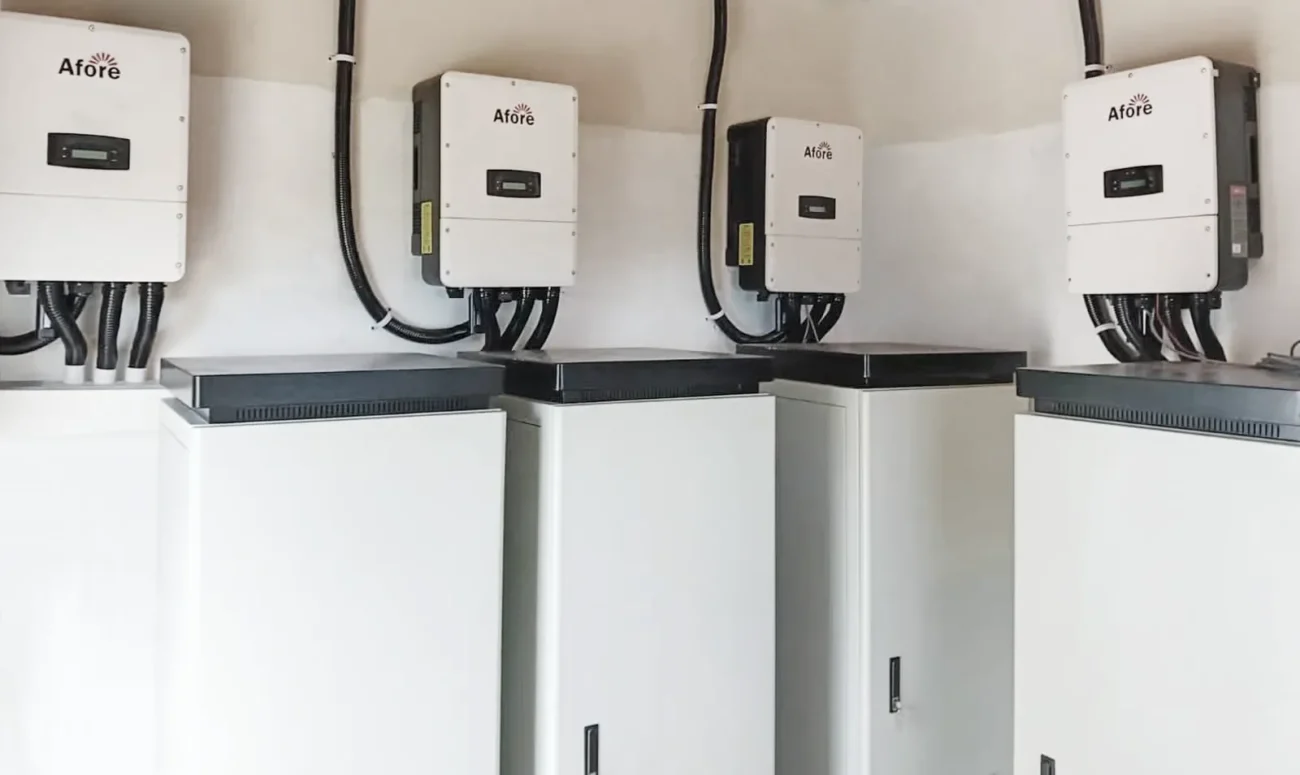
In larger commercial and utility-scale energy storage systems, a “battery PCS (Power Conversion System)” is more commonly used and may not include PV MPPT inputs, focusing instead on bidirectional battery charge and discharge control.
In many PV-plus-storage projects, the hybrid inverter is the central control point for solar generation, battery operation, grid exchange, and monitoring.
For commercial projects, this distinction affects more than hardware selection.
From a system perspective, three architectures should be clearly distinguished:
Each category differs in grid certification, islanding capability, and control behavior.
It influences cable routes, protection design, metering, grid approval, monitoring architecture, spare parts planning, and whether the system can be expanded later without redesign.
In addition to inverter charger and hybrid inverter architectures, large commercial systems often use a third configuration: PV inverters combined with a dedicated battery PCS and a centralized EMS. This architecture separates generation, storage, and dispatch control for better scalability and redundancy.
The table below summarizes the typical differences between inverter chargers and hybrid inverters. Exact capability depends on the specific model, certification scope, firmware version, and approved operating mode.
| Function | Inverter charger | Hybrid inverter |
|---|---|---|
| Main role | Battery DC to AC conversion and AC-source battery charging | Integrated PV, battery, grid, and load management |
| PV input | Usually requires separate MPPT controller or AC-coupled PV inverter | Usually includes built-in MPPT PV inputs |
| Battery charging | Strong AC charging from grid or generator | Charges from PV and often from grid, depending on settings and regulations |
| Grid export | Model-dependent; may require additional grid-certified equipment | Often designed for grid-tied PV export or export-limited operation |
| Anti-islanding | Not always available for grid export mode | Common in grid-tied hybrid solar inverter models |
| Backup output | Common, often robust for backup and off-grid use | Common, but capacity may be lower than total inverter rating |
| Generator integration | Often strong, especially in off-grid and weak-grid systems | Available on some models, but capability varies significantly |
| Best-fit projects | Off-grid, generator-hybrid, telecom, backup-heavy sites, retrofits | New PV-plus-storage, self-consumption, peak shaving, grid-interactive C&I systems |
The key takeaway is that inverter chargers are often stronger in battery-first systems where AC charging and generator coordination are central. Hybrid inverters are usually stronger in PV-first systems where solar generation, battery storage, grid compliance, export control, and monitoring must be integrated from the start.
If export or grid-parallel operation is required, the key question is not whether the device is labeled as an inverter charger or hybrid inverter, but whether the exact model is certified for grid-interactive operation in the target market.
In practice, inverter charger architectures are more flexible in retrofit and off-grid applications, while hybrid inverter architectures are more efficient in new PV-plus-storage installations where system integration is designed from the beginning.
Inverter chargers are common in remote sites, telecom shelters, rural facilities, temporary power systems, islanded microgrids, and facilities with generators as an important energy source. They are also useful in retrofit projects where an existing PV array already has grid-tied PV inverters and the owner wants to add batteries without replacing the PV conversion equipment.
Hybrid inverters are common in new commercial rooftop systems, carport PV projects, small industrial solar-plus-storage systems, and facilities targeting self-consumption, demand charge reduction, time-of-use optimization, and limited backup. They are especially attractive when the EPC wants fewer devices, simpler wiring, unified monitoring, and a repeatable design template across multiple sites.
However, system scale matters. A 30 kW commercial rooftop with 60 kWh of storage may be well suited to a three-phase hybrid solar inverter. A 2 MW industrial site with 4 MWh of batteries may require a dedicated battery power conversion system, separate PV inverters, switchgear, protection relays, and a supervisory EMS. In other words, the inverter charger vs hybrid inverter question is most relevant in small to mid-sized commercial systems, remote power systems, and retrofit storage projects. At larger scales, the decision often becomes “integrated hybrid inverter vs separate PV inverter and battery PCS architecture.”
For EPCs and installers, the most practical decision rule is application-first. If the project objective is reliable backup, generator support, off-grid operation, or flexible battery charging from AC sources, an inverter charger may be the more appropriate core device.
In these cases, system design must prioritize generator integration, AC input transfer behavior, surge capability, off-grid or grid-forming reliability, and configurable battery charging profiles.
Backup-first operating logic is more important than PV optimization in these scenarios. If the project objective is solar-plus-storage with grid interaction, PV self-consumption, export control, monitoring, and tariff-driven battery operation, a hybrid inverter is often the cleaner solution.
For resellers, correct positioning is essential. Selling an inverter charger into a grid-export PV-plus-storage project without verifying interconnection certification can lead to failed inspections and warranty disputes. Selling a hybrid inverter into a generator-heavy remote site without confirming generator charging behavior, transfer switching logic, and surge capability can result in commissioning failures.
The correct choice is not defined by product name, but by whether the inverter architecture matches the real operating requirements of the project.
A professional comparison must move beyond device labels and examine system topology. In PV-plus-storage systems, architecture determines energy flow, conversion losses, protection requirements, and future expansion options.
Inverter charger systems are often used in AC-coupled architectures. The PV array connects to one or more PV inverters that feed an AC bus. The inverter charger then charges the battery from that AC bus and discharges the battery back to the AC side when needed. This architecture is especially useful when PV already exists or when the project requires PV and battery capacity to be scaled independently.
Inverter charger systems are not inherently AC-coupled or DC-coupled. The coupling depends on whether PV charges the battery through a DC charge controller or through an AC PV inverter feeding an AC bus.
Inverter charger systems can be AC-coupled with PV inverters, DC-coupled through separate MPPT charge controllers, or configured in hybrid architectures that combine both methods depending on system design.
Standard grid-tied PV inverters normally shut down during utility failure because they require a stable grid reference to operate.
In backup or off-grid operation, an inverter charger or battery inverter may create an islanded AC bus to maintain voltage and frequency.
Some AC-coupled PV inverters can restart during outages if the islanded system provides a stable grid-forming reference.
Excess PV production must be controlled when batteries are full and loads are low to avoid overvoltage or system instability.
Curtailment methods include frequency shifting, communication-based control, relay switching, or EMS-based power limitation commands.
Not every inverter charger can safely form an AC microgrid for existing PV inverters. System compatibility must be verified at design stage.
The efficiency difference can matter in daily-cycling projects. In a DC-coupled hybrid system, PV energy stored in the battery may pass through fewer conversion stages. In an AC-coupled system, PV energy may be converted from DC to AC, then AC to DC for battery charging, and then DC to AC again when discharged. In real projects, the value of this difference depends on how often the battery cycles, whether PV is stored or directly consumed, and the operating efficiency of each device.
| Architecture | Typical equipment | Main advantage | Main trade-off |
|---|---|---|---|
| DC-coupled hybrid inverter | PV strings, hybrid inverter, battery, grid/load connection | Fewer devices and fewer conversion stages for PV-to-battery charging | Less flexible for retrofits and battery compatibility may be narrower |
| AC-coupled inverter charger | PV inverter, inverter charger, battery, AC bus, control equipment | Good for retrofits and independent PV/storage scaling | More conversion stages and potentially more complex controls |
| Separate PV inverter + battery PCS | PV inverters, PCS, EMS, switchgear | Scalable for larger C&I and microgrid systems | Higher engineering and commissioning complexity |
For EPCs, this topology decision affects DC string design, AC cable sizing, overcurrent protection, earthing strategy, equipment layout, thermal management, commissioning sequence, and the number of interfaces that must be tested.
Battery integration is one of the most common sources of project risk. Many modern hybrid inverters, especially those designed for high-voltage lithium battery systems, require batteries from an approved compatibility list. Communication between the inverter and battery BMS usually occurs through CAN, RS485, or another defined protocol. This communication allows the inverter to receive state of charge, allowable charge current, discharge limits, temperature alarms, and protection signals.
Inverter chargers often support a broader range of battery types, particularly in off-grid and backup applications. Many allow configurable charge profiles for lead-acid, AGM, gel, and lithium batteries. This flexibility is useful in retrofit or remote projects where battery types vary.
In commercial lithium systems, the safest approach is to treat the inverter and battery as a tested subsystem rather than separate commodities. A mismatch between inverter firmware and battery BMS communication can cause derating, nuisance shutdowns, inaccurate state-of-charge reporting, reduced usable capacity, or disputes over warranty responsibility. Before procurement, EPCs should confirm the exact battery model, firmware compatibility, communication cable specification, maximum current limits, and approved parallel battery configuration.
For hybrid inverters, PV input design is critical. The datasheet must be checked for maximum DC voltage, MPPT operating range, number of MPPT channels, maximum current per MPPT, short-circuit current limits, startup voltage, and allowed DC/AC oversizing ratio. These values determine how strings can be configured for commercial rooftops, carports, and ground-mounted arrays in different climates.
With larger modern PV modules, string current limits are particularly important. A hybrid inverter that worked well with older modules may not be suitable for high-current modules unless the MPPT inputs are designed accordingly. Similarly, rooftop systems with multiple orientations may require enough MPPT channels to avoid mismatch losses.
For inverter chargers without PV input, the PV array must be handled by another device. If the design uses a separate MPPT solar charge controller, the PV charging path is DC-coupled to the battery but independent from the inverter charger. If the design uses grid-tied PV inverters, the system becomes AC-coupled, and the inverter charger must coordinate with the AC bus during grid outages or islanded operation. This coordination is not automatic unless the devices and control strategy support it.
Commercial PV-plus-storage design must start with the load profile, not the inverter datasheet.
A structured load sizing process should include:
Critical loads, non-critical loads, motor starting currents, compressor loads, IT loads, lighting circuits, pumps, elevators, and HVAC systems behave differently. Some loads require high surge capability for a short period. Others require clean power quality, phase balance, or strict transfer times.
Hybrid inverters often have a dedicated backup output, but that output may not be rated to supply the whole facility. Not all commercial hybrid inverters or grid-interactive systems support islanded backup operation, and this capability must always be verified at model and certification level rather than assumed from product category. EPCs usually need to create a critical-load panel, separating essential circuits from general loads. Inverter chargers also require careful load segmentation, but they are often selected specifically for backup-heavy applications and may offer strong surge handling when properly configured.
Three-phase projects require additional attention. Some inverter platforms support true three-phase output, while others use multiple single-phase units configured together. Phase imbalance, neutral current, transfer switching, and motor startup behavior must be reviewed before installation. A system that looks adequate based on total kW may fail in practice if one phase is overloaded or if backup circuits are poorly distributed.
For example, a facility with a 20 kW critical load requiring 4 hours of backup operation would require at least 80 kWh of usable energy. After accounting for inverter efficiency (90–95%), battery depth-of-discharge limits (typically 80–90%), and system losses, the installed battery capacity may need to be sized closer to 100–110 kWh. Additional reserve margin should also be included for aging and peak surge events.
Product selection should be based on project requirements, not headline power rating alone. Inverter choice affects installation labor, inspection risk, customer satisfaction, and repeatability across a project pipeline.
Performance characteristics such as efficiency, backup capability, and grid-forming behavior are model-specific and should always be verified at the product and certification level rather than assumed from product category.
Continuous power rating describes what the inverter can supply under defined conditions, but commercial loads often require more detailed evaluation. This rating must be cross-checked against real load conditions, including continuous operating load, short-term surge demand from motors or compressors, phase imbalance in three-phase systems, and backup output limitations under islanded operation. Failure to account for these factors may result in nuisance tripping or insufficient backup performance even when nominal kW rating appears sufficient.
Surge rating, overload duration, ambient temperature derating, cooling method, and backup output rating may be just as important as nominal kW.
Key performance comparison points are typically influenced by system design and operating conditions rather than fixed device-level values. Actual performance can vary significantly depending on manufacturer, firmware, certification scope, wiring topology, and grid code requirements.
In commercial PV-plus-storage projects, the following aspects are commonly evaluated at a system level rather than as fixed specifications:
In some models, the PV inverter rating, battery charge/discharge rating, and backup rating are not identical. EPCs should verify whether the device can simultaneously support site loads, charge batteries, and comply with export limits.
| Selection factor | Why it matters in C&I PV projects |
|---|---|
| Continuous AC rating | Determines normal load support and export capacity |
| Surge capability | Supports motors, pumps, compressors, and startup loads |
| Three-phase configuration | Affects phase balance, commercial load compatibility, and grid approval |
| Parallel operation | Enables capacity growth and redundancy |
| Backup output rating | Determines whether whole-site or critical-load backup is realistic |
| Thermal derating | Impacts performance in hot plant rooms, rooftops, or outdoor enclosures |
For commercial PV-plus-storage systems, monitoring capability depends on communication protocols and platform integration rather than interface availability alone.
Key required communication protocols include Modbus TCP/RTU, RS485, Ethernet, API access, and SunSpec compatibility where applicable. These determine whether the inverter, battery system, meters, and EMS can operate within a unified control structure.
In commercial PV-plus-storage systems, EMS acts as the central decision layer that translates site objectives into coordinated inverter, battery, and grid actions.
Yes, an inverter charger can work in a solar system, but usually not by connecting PV panels directly to the inverter charger. In most cases, solar panels connect either to a separate MPPT solar charge controller that charges the battery or to a grid-tied PV inverter that feeds the AC bus. Some products marketed as a solar inverter charger include built-in MPPT functionality, which makes them closer to a hybrid device in practical use.
This terminology is important for resellers. A buyer asking for an “inverter charger for solar system” may need a simple battery inverter charger for generator-backed backup, a solar inverter charger with MPPT input, or a full hybrid solar inverter with grid-export certification. These are not interchangeable. The correct recommendation depends on whether the project is off-grid, grid-tied, export-limited, backup-only, or designed for daily battery cycling.
A technically suitable inverter can still create project risk if the supplier cannot support commercial deployment. EPCs should evaluate warranty terms, local service capability, spare parts availability, commissioning documentation, installer training, firmware support, and replacement lead times. For resellers, these factors determine whether a product can be deployed repeatedly without excessive support burden.
Certification documents should be checked before purchase, not after installation. Warranty conditions for commercial inverter and battery systems often include strict limits on years of coverage, cycle counts, or total energy throughput over lifetime.
Operating temperature ranges are also defined, and exceeding them may trigger derating or warranty exclusion.
Manufacturers may require compliance with approved BMS communication protocols, approved inverter-battery pairing lists, and specific firmware versions to maintain warranty validity.
Some warranties also require active remote monitoring to remain enabled throughout system operation.
Warranty terms may differ between backup-only systems and daily cycling applications, with significantly shorter effective lifetimes assumed under high-utilization use cases such as peak shaving or time-of-use operation.
The exact model number, firmware version, grid code setting, enclosure rating, battery compatibility list, and operating mode must match the intended project. In many markets, utility approval depends on these details.
Grid compliance is one of the clearest differences between a consumer-style device comparison and a professional PV project decision. In commercial systems, the inverter must satisfy electrical safety rules, grid interconnection rules, anti-islanding requirements, metering rules, and sometimes fire authority requirements for energy storage.

Hybrid inverters used for grid export or grid-parallel operation must comply with the relevant interconnection standards in the project market. Grid-following inverters operate by synchronizing their output to an existing grid voltage and frequency reference. They do not create grid stability but instead follow the grid conditions while injecting controlled power. In North America, IEEE 1547 is a key standard for distributed energy resource interconnection, while equipment certification commonly involves applicable inverter safety and grid-support requirements. In parts of Europe, EN 50549 and national grid codes are central to generating plant connection requirements. Local utilities may also require specific settings for voltage ride-through, frequency response, reactive power, and anti-islanding.
Applicable standards vary significantly by region, system size, and whether the project is focused on grid interconnection or energy storage safety. For clarity, they are often grouped into two main categories:
These standards define how inverters interact with the utility grid, including anti-islanding, voltage/frequency behavior, and grid support functions:
IEEE 1547 (North America distributed energy resource interconnection framework)
UL 1741 / UL 1741 SB (inverter grid support and certification in the US)
EN 50549 (European grid connection requirements for distributed generation)
UK G99 / G100 (UK grid connection and export limitation rules)
VDE-AR-N 4105 / 4110 (Germany low-voltage and medium-voltage grid codes)
AS/NZS 4777 (Australia/New Zealand inverter grid connection standard)
These standards focus on battery safety, system-level fire risk, and installation safety requirements:
UL 9540 (energy storage system safety standard)
UL 9540A (thermal runaway fire propagation test method)
NFPA 855 (installation safety requirements for energy storage systems in the US)
IEC 62109 (safety of power converters for use in PV systems)
IEC 62477 (safety requirements for power electronic converter systems)
IEC 62933 (electrical energy storage system standards framework)
This classification helps avoid confusion between grid behavior requirements and fire/safety certification requirements, which are often incorrectly grouped together in simplified comparisons.
The exact standard set depends on jurisdiction, system size, export mode, and battery chemistry.
Grid-forming inverters, by contrast, establish the voltage and frequency reference during islanded operation. They are essential in microgrid or backup systems where the grid is absent or unstable.
For EPCs, it is not enough to confirm that a product family is “grid certified.” The exact model and firmware must be approved for the intended grid code and operating mode. Some devices are certified for grid-following export but not for islanded backup. Others may be approved for non-export operation only when installed with a specific meter or controller.
Inverter chargers used behind transfer switches, generators, or off-grid systems may face different requirements from grid-export hybrid inverters. Off-grid systems and microgrids typically require grid-forming capability to maintain stable voltage and frequency without utility support. Without grid-forming functionality, system stability cannot be guaranteed during islanded operation.
The design must address isolation, transfer switching, neutral bonding, grounding, overcurrent protection, short-circuit current contribution, and local electrical code compliance.
In a backup system, the inverter charger may operate as part of a separately derived system during outages. This raises questions about neutral-ground bonding and transfer switching that must be reviewed by qualified electrical professionals. In generator-backed systems, the design must also prevent unsafe backfeed and ensure that the generator, inverter charger, and loads are coordinated correctly.
Grid-forming inverters are responsible for establishing voltage and frequency reference in islanded operation, while grid-following inverters synchronize to an existing grid and cannot operate independently.
Not every grid-tied hybrid inverter is capable of stable grid-forming operation. Some models are restricted to grid-following mode only and cannot independently maintain frequency or voltage in islanded conditions.
Many commercial PV systems operate under export limits. Some facilities are allowed to export only a fixed maximum power; others must maintain zero export. Hybrid inverters often include native export limitation using meters or current transformers. They may also provide power factor control, volt-var, frequency-watt, and other grid support functions depending on the market and certification.
Inverter charger-based systems can also support export-limited operation, but the control architecture may be more complex. If separate PV inverters, inverter chargers, meters, and EMS controllers are involved, the response time and fail-safe behavior must be validated. The utility will usually care about the behavior of the complete system, not only the individual device.
Commercial PV-plus-storage projects should evaluate inverter and battery compliance together. Safety requirements may include energy storage system certification, battery cell and module standards, fire propagation testing, ventilation, clearances, emergency shutdown, labeling, and fire authority review. In the United States, UL 9540 is commonly associated with energy storage system safety, while other regions apply IEC-based standards, national electrical codes, and local fire regulations.
The key point for EPCs is that a certified inverter plus a certified battery does not automatically equal an approved energy storage system. The combination, enclosure, installation location, operating mode, and documentation package all matter.
Permitting requirements often include additional safety considerations depending on installation environment.
Indoor installations typically require ventilation design, fire detection and suppression systems, emergency shutdown access, and clear separation from exits and combustible materials. Outdoor systems must consider enclosure rating, thermal management, and emergency access pathways.
Authorities having jurisdiction (AHJ) or fire marshals may also evaluate thermal runaway propagation risk, maximum allowable energy storage per fire area, labeling requirements, and emergency response documentation.
Documents commonly requested before permitting include:
The best inverter architecture on paper can underperform if installation and commissioning are poorly controlled. Integrated hybrid systems may reduce wiring and component count, while inverter charger architectures may offer modularity. Both approaches have risks.
A hybrid inverter can reduce the number of separate devices in a new PV-plus-storage installation. With PV MPPT, battery interface, grid connection, backup output, and monitoring in one unit, the EPC may reduce wall space, cable runs, protection devices, and commissioning interfaces.
An inverter charger system may require separate PV charge controllers or PV inverters, transfer switches, meters, generator interfaces, battery protection equipment, and external monitoring. This can increase installation labor but also gives the designer more flexibility. For example, an existing PV system can remain in place while storage is added on the AC side.
The right comparison is total installed cost, not inverter purchase price. A lower-cost inverter charger can become more expensive after adding PV controllers, external meters, communication gateways, enclosures, and labor. Conversely, a higher-cost hybrid inverter may reduce BOS and commissioning time.
Commissioning errors are common in PV-plus-storage systems because many settings interact. Battery parameters, grid code selection, export limits, backup reserve, time-of-use schedules, generator charging rules, current limits, firmware versions, and monitoring activation all influence operation.
A hybrid inverter may simplify commissioning because more functions are managed through one platform. However, this also means one incorrect setting can affect PV production, battery cycling, and grid behavior at the same time. Inverter charger systems may require coordination across multiple devices, which increases the importance of a documented commissioning checklist and site acceptance test.
For commercial projects, commissioning should include simulated grid outage behavior, battery charge/discharge verification, export limit testing, backup load testing, alarm reporting, remote monitoring validation, and customer handover documentation.
Inverter chargers are commonly used in generator-backed systems because AC-source charging is central to their design. They can often manage battery charging from a generator, support automatic generator start signals, and supply backup loads while coordinating with an AC input.
A generator-integrated system should be validated using a structured commissioning checklist:
Hybrid inverters may also support generator input, but capabilities vary widely. When AC-coupled PV systems continue operating during outages, frequency-shift or active curtailment logic is required to prevent overgeneration. Without this control, excess PV power may destabilize the inverter-generator balance or cause system shutdown.
Some can charge batteries from a generator but cannot export to it. Some require specific wiring arrangements or external transfer switches. Others have limited generator charging current or strict frequency and voltage acceptance windows.
Commercial projects should confirm generator start/stop logic, minimum generator loading, charging current limits, transfer time, surge behavior, anti-backfeed protection, and compatibility with existing ATS designs. This is especially important in facilities where the generator is part of a life-safety or critical power system.
Most system failures are caused by configuration or installation errors rather than equipment defects.
Critical validation steps include:
Proper commissioning and pre-operation testing are essential to avoid performance degradation and warranty disputes.
Once commissioned, inverter architecture influences energy yield, battery life, O&M cost, and downtime risk. For facility owners, these factors often matter more than small differences in equipment price.
Typical efficiency ranges in PV-plus-storage systems are highly dependent on topology, conversion stages, and operating conditions:
Overall system efficiency should be evaluated in the context of energy flow paths, conversion stages, and operating strategy rather than isolated component specifications.
Modern inverter efficiencies are high, but energy flow matters. In a DC-coupled hybrid system, PV energy used to charge the battery may avoid an extra AC conversion stage. In an AC-coupled inverter charger system, PV-to-battery-to-load energy may pass through multiple converters. Over thousands of cycles, this can affect usable energy and payback.
However, efficiency should not be evaluated in isolation. An AC-coupled system may be more economical if it avoids replacing existing PV inverters, enables storage retrofit with limited downtime, or improves redundancy. The relevant metric is lifecycle value: how much useful energy, demand reduction, backup resilience, or tariff savings the system delivers after losses, downtime, and service costs.
Battery ROI depends heavily on cycling strategy. Battery cycling strategies must also consider EMS-level enforcement rules. In commercial systems, EMS platforms often enforce battery operating limits defined by warranty conditions, including maximum daily cycles, state-of-charge operating windows, and degradation control strategies.
This ensures that peak shaving, arbitrage, and backup operation remain within manufacturer-defined lifecycle constraints.
A system designed for daily peak shaving or time-of-use arbitrage will cycle much more frequently than a backup-only system. Hybrid inverters often include operating modes for self-consumption, peak shaving, scheduled charging and discharging, backup reserve, and export limitation. Daily peak shaving and time-of-use cycling can reach battery throughput limits significantly earlier than backup-only operation, which directly affects battery lifetime and replacement timing. These functions can simplify commercial energy management when the project scale is moderate.
Inverter chargers may use simpler charge profiles unless paired with an advanced EMS. That can be sufficient for backup or off-grid systems, where the goal is reliable charging from a generator or grid source. For revenue-oriented commercial storage, however, the control layer must manage state of charge, demand peaks, tariffs, battery warranty limits, and site load behavior.
Fault diagnosis in commercial inverter systems is driven by structured alarm interpretation rather than general monitoring data.
Typical diagnostic cases include:
Effective troubleshooting requires identifying whether the issue originates from grid conditions, battery communication, metering configuration, thermal behavior, or firmware compatibility.
Maintenance requirements include thermal inspection, firmware updates, torque checks, enclosure inspections, filter or fan replacement, battery communication checks, protection device inspection, and environmental assessment.
Battery replacement planning in commercial systems should be based not only on calendar life but also on cycle count and total energy throughput.
In high-utilization applications, batteries may reach end-of-life significantly earlier than expected if cycling intensity is high.
Lifecycle planning should therefore include degradation modeling, replacement budgeting, and expected usable energy decline over time.
Outdoor installations require attention to ingress protection, corrosion, dust, humidity, and temperature extremes.
Integrated hybrid inverters may reduce the number of devices to inspect, but a single failure may affect both PV and battery functions. Modular inverter charger systems may be easier to service by subsystem, allowing PV generation or backup power to continue if one component is isolated. Commercial decision-makers should evaluate service access, spare unit availability, replacement time, and downtime cost before selecting the architecture.
Energy flow differences in real operation:
The financial comparison between inverter charger and hybrid inverter should not be reduced to unit price.
Lifecycle value should also consider system efficiency under real operating conditions, battery degradation over time, expected operating cycles depending on application type, downtime risk due to configuration complexity, and OPEX impact from monitoring and maintenance requirements.
These parameters directly affect LCOE (levelized cost of energy), usable energy output over system lifetime, and payback period accuracy in commercial PV-plus-storage projects.
EPCs and facility owners need to evaluate total installed cost, operating cost, performance risk, and revenue alignment.
A basic inverter charger may have a lower purchase price than a hybrid inverter with built-in MPPT, grid-interactive controls, and monitoring. But the project may still need separate PV controllers, PV inverters, transfer switches, meters, communication gateways, enclosures, and integration labor.
A hybrid inverter may cost more per unit but reduce BOS requirements and simplify installation. This can be particularly valuable in small and mid-sized commercial systems where labor, wall space, and commissioning time are significant cost drivers.
The commercial comparison should include equipment, protection devices, cabling, switchgear, metering, communications, engineering, permitting, commissioning, training, and expected service calls.
A hybrid inverter is often better when the project requires integrated PV generation, battery storage, grid export control, and energy management in one coordinated platform. For new commercial PV-plus-storage projects with moderate power ratings, it can reduce complexity and improve monitoring consistency.
However, a hybrid inverter is not automatically better for all commercial battery storage. For larger C&I installations, a dedicated battery PCS with separate PV inverters and a site-level EMS may provide better scalability, redundancy, serviceability, and flexibility. For remote generator-backed sites, an inverter charger may be more suitable because AC charging, grid-forming capability, and generator coordination are central to the design.
OPEX in PV-plus-storage systems is primarily driven by truck roll frequency, system downtime, SLA penalties, spare parts inventory, and warranty claim processing time.
System architecture directly affects service cost. Complex multi-device systems typically increase diagnostic time, while integrated systems reduce wiring complexity but may increase single-point failure impact.
Battery replacement planning should be aligned with expected cycle life or total energy throughput. In high-utilization systems, early replacement risk must be included in financial modeling and long-term asset planning.
Inverter choice supports or limits revenue streams. A self-consumption project needs efficient PV-to-load and PV-to-battery operation. A demand charge reduction project needs fast and reliable discharge control. A backup project needs dependable transfer behavior and adequate surge capacity. A time-of-use arbitrage project needs scheduling accuracy and battery warranty compliance. An export-compensation project needs certified grid interaction and metering accuracy.
Therefore, ROI should be framed around use case performance. A highly efficient inverter that cannot meet utility export rules may delay interconnection. A robust inverter charger that lacks tariff-based controls may not maximize battery revenue. A hybrid inverter with excellent monitoring but limited backup output may not satisfy a facility’s resilience requirement.
Commercial PV projects rarely remain static. Loads grow, EV chargers are added, tariffs change, batteries are expanded, and grid requirements evolve. Inverter architecture should support realistic expansion plans.
Both inverter chargers and hybrid inverters may support parallel operation, but limits vary. EPCs must confirm how many units can be paralleled, whether three-phase operation is supported, how phase balancing is handled, whether batteries are shared or dedicated, and what happens if one unit fails.
Modular inverter charger systems can work well for staged backup expansion and remote microgrids. Hybrid inverter scalability depends heavily on the platform. Some are excellent for standardized small C&I systems; others are better suited to single-site installations with limited expansion.
For resellers and EPCs, standardization can be more valuable than maximum flexibility. A repeatable hybrid inverter platform may simplify commercial rooftop deployment across retail stores, warehouses, schools, and small factories. Unified monitoring, consistent grid settings, and predictable battery compatibility reduce project risk.
Inverter chargers may scale better across remote or generator-backed portfolios where PV capacity, battery capacity, and AC charging sources differ from site to site. Telecom networks, rural facilities, and weak-grid industrial sites often benefit from modular architectures that can be adapted to local conditions.
Hybrid inverters are often easier to scale across small and mid-sized PV-plus-storage projects when the same grid rules, battery models, and monitoring platform apply. They support design templates and reduce installation variability.
Inverter chargers may be easier to scale across off-grid, backup-heavy, or generator-backed environments because they allow the PV subsystem and battery charging strategy to be engineered separately. The right answer depends on project type, load profile, regulatory environment, and service model.
Commercial electrification is changing site energy profiles. EV chargers, heat pumps, electric forklifts, process electrification, and backup resilience requirements can all increase peak demand. A system designed only for today’s load may become constrained within a few years.
Before choosing between an inverter charger and a hybrid inverter, decision-makers should ask whether the platform can support additional battery cabinets, controllable loads, EV charging coordination, microgrid controls, updated grid support functions, and future EMS integration. Future-proofing does not always mean buying the largest inverter today. It means selecting an architecture that can expand without replacing the entire system.

A structured procurement process reduces technical and commercial risk. The following matrix summarizes the most common project-fit scenarios.
| Project condition | Best-fit architecture | Best-fit architecture |
|---|---|---|
| New commercial PV-plus-storage for self-consumption | Hybrid inverter | Integrated PV, battery, grid, and monitoring functions |
| Existing PV system adding storage | Inverter charger or AC-coupled battery inverter | Allows storage retrofit without replacing PV inverters |
| Remote site with generator dependence | Inverter charger | Strong AC charging and generator coordination |
| Backup-heavy commercial facility | Inverter charger or modular battery inverter system | Better fit for critical-load and generator-backed operation |
| Small C&I peak shaving project | Hybrid inverter | Simpler energy management and installation |
| Large C&I or MW-scale ESS | Separate PV inverters, battery PCS, EMS | Better scalability, redundancy, and control flexibility |
The first procurement question should be: what is the system primarily expected to do? If the answer is backup during outages, generator fuel reduction, or off-grid power, an inverter charger deserves serious consideration. If the answer is solar self-consumption, demand charge management, export limitation, and coordinated PV-plus-storage operation, a hybrid inverter is often preferable.
If the project is large, complex, or mission-critical, EPCs should evaluate a dedicated battery PCS and EMS architecture rather than forcing the decision into a small-system product category.
Before procurement, EPCs should validate system compatibility at both electrical and communication levels.
Pre-purchase compatibility checklist:
This checklist should be validated against manufacturer documentation before system design finalization.
Commercial due diligence should include supplier lead time, certification documentation, training availability, local technical support, replacement policy, firmware maturity, warranty claim process, and spare parts availability. These factors determine whether a product is practical for repeat deployment.
A strong inverter platform is not only one that works in the lab. It is one that can be designed, permitted, installed, commissioned, monitored, serviced, and replaced efficiently across real project conditions.
An inverter charger converts battery DC power into AC power. It also charges batteries from an AC source such as the grid or a generator. It usually does not connect directly to PV panels. Solar input is handled by a separate charge controller or AC-coupled PV inverter. A hybrid inverter includes built-in MPPT for PV, battery charging and discharging, grid interaction, and backup output in one device.
Yes, but there are two main integration methods. Solar panels can connect through a separate MPPT solar charge controller that charges the battery, or through an AC-coupled grid-tied PV inverter that feeds power into the AC bus. Some inverter chargers include built-in MPPT inputs and are often marketed as solar inverter chargers or hybrid-style devices.
Hybrid inverters are usually better for small and mid-sized commercial PV-plus-storage systems where one platform manages PV, battery, grid, backup, and monitoring. They are not always better for large C&I or MW-scale projects, where separate PV inverters, battery PCS, and EMS often scale more effectively. Inverter chargers are often more suitable for off-grid or generator-backed systems.
Inverter chargers are often used in off-grid and generator-backed systems because many models are designed to support AC-source charging, generator coordination, and backup load supply in islanded configurations. Hybrid inverters can also operate in off-grid or backup scenarios, but only if the specific model is designed and certified for islanded operation, generator interaction, and required surge performance.
Hybrid inverters are usually easier to standardize across repeated small and mid-sized commercial PV-plus-storage projects when sites share similar batteries, grid requirements, meters, and monitoring platforms. Inverter chargers are often easier to standardize across remote, weak-grid, or generator-backed sites because PV capacity, battery size, and AC charging sources can be engineered more flexibly. EPCs should standardize based on site type, not product name.








 Turkish
  Romanian